Saudi-Pakistan defence pact as Riyadh strengthens ties with India
July 19, 2026
  • Read Ecopy
  • Circulation
  • Advertise
  • Careers
  • About Us
  • Contact Us
Android AppiPhone AppArattai
Organiser
  • ‌
  • Bharat
    • Assam
    • Bihar
    • Chhattisgarh
    • Jharkhand
    • Maharashtra
    • View All States
  • World
    • Asia
    • Europe
    • North America
    • South America
    • Africa
    • Australia
  • Editorial
  • International
  • Opinion
  • RSS @ 100
  • More
    • Op Sindoor
    • Analysis
    • Sports
    • Defence
    • Politics
    • Business
    • Economy
    • Culture
    • Special Report
    • Sci & Tech
    • Entertainment
    • G20
    • Azadi Ka Amrit Mahotsav
    • Vocal4Local
    • Web Stories
    • Education
    • Employment
    • Books
    • Interviews
    • Travel
    • Law
    • Health
    • Obituary
  • Subscribe
    • Subscribe Print Edition
    • Subscribe Ecopy
    • Read Ecopy
  • ‌
  • Bharat
    • Assam
    • Bihar
    • Chhattisgarh
    • Jharkhand
    • Maharashtra
    • View All States
  • World
    • Asia
    • Europe
    • North America
    • South America
    • Africa
    • Australia
  • Editorial
  • International
  • Opinion
  • RSS @ 100
  • More
    • Op Sindoor
    • Analysis
    • Sports
    • Defence
    • Politics
    • Business
    • Economy
    • Culture
    • Special Report
    • Sci & Tech
    • Entertainment
    • G20
    • Azadi Ka Amrit Mahotsav
    • Vocal4Local
    • Web Stories
    • Education
    • Employment
    • Books
    • Interviews
    • Travel
    • Law
    • Health
    • Obituary
  • Subscribe
    • Subscribe Print Edition
    • Subscribe Ecopy
    • Read Ecopy
Organiser
  • Home
  • Bharat
  • World
  • Operation Sindoor
  • Editorial
  • Analysis
  • Opinion
  • Culture
  • Defence
  • International Edition
  • RSS @ 100
  • Magazine
  • Read Ecopy
Home Bharat

Saudi-Pakistan defence pact remains symbolic as Riyadh deepens ties with New Delhi

India’s robust defence capabilities and strategic partnerships continue to ensure regional stability despite new security alignments. The Saudi-Pakistan defence pact, while boosting Islamabad’s profile, is unlikely to alter New Delhi’s calculated military posture

WEBDESKWEBDESK
Sep 27, 2025, 02:00 pm IST
in Bharat, World, South Asia, Asia, Defence
Follow on Google News
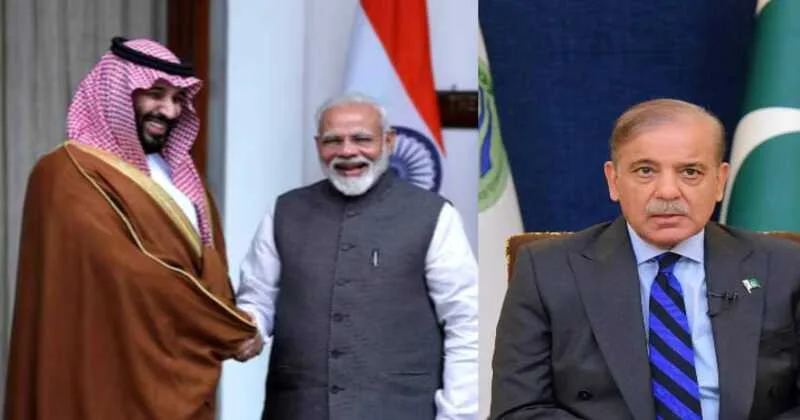
Saudi Prince Mohammed Bin Salman and Prime MInister Narendra Modi (Left) and Pakistan PM Shehbaz Sharif (Right)

Saudi Prince Mohammed Bin Salman and Prime MInister Narendra Modi (Left) and Pakistan PM Shehbaz Sharif (Right)

FacebookTwitterWhatsAppTelegramEmail

In a region still unsettled by the aftershocks of Operation Sindoor, the bold Indian military strikes on Pakistani terror camps in May that redefined South Asia’s deterrence, the spotlight has now shifted to Riyadh. On September 17, Saudi Arabia and Pakistan signed a sweeping Strategic Mutual Defence Agreement (SMDA) in the Saudi capital, pledging that any attack on one would be treated as aggression against both. The rhetoric, reminiscent of NATO’s Article 5, has added a new layer to the regional security matrix.The timing is crucial. The deal comes as tensions remain high along the Line of Control after Operation Sindoor, in which India’s missile and drone defences thwarted Pakistani retaliation and precision strikes dismantled militant hubs across the border.

From informal cooperation to formal pact

The Saudi-Pakistani security relationship is not new. For decades, Pakistani troops have guarded the holy sites of Mecca and Medina, while Saudi financial assistance, through loans, grants, and investments, has repeatedly helped Islamabad in times of crisis. What has changed is the formalization of this arrangement into a comprehensive defence pact.

The agreement was finalised during Pakistani Prime Minister Shehbaz Sharif’s recent visit to Riyadh, where he met Crown Prince Mohammed bin Salman. Official statements from both sides emphasised that the pact seeks to expand defence cooperation and strengthen joint deterrence. Reports suggest that while the deal avoids specifics, it may pave the way for greater military integration, potentially allowing Saudi Arabia to benefit from Pakistan’s nuclear capabilities.The announcement came shortly after a summit in Doha, where leaders from 40 Islamic countries condemned Israel’s recent strike on Hamas figures in Qatar. For Riyadh, the timing underscores its growing desire to diversify security partnerships, hedge against American unpredictability, and counter regional threats, particularly from Iran.

Also Read: Rajasthan: Hanif Khan arrested for allegedly leaking military secrets to Pakistani ISI during Operation Sindoor

Within Pakistan, the pact is being hailed as a major strategic achievement. For a country still reeling from the humiliation of Operation Sindoor, the agreement signals renewed external backing. It effectively acknowledges Saudi Arabia’s willingness to stand behind Pakistan in moments of crisis, at least symbolically.

Limited impact on India’s security calculus

In India, however, the announcement has been met with scepticism rather than alarm. While New Delhi’s Ministry of External Affairs has stated that the implications of the pact will be carefully studied, officials stressed that India’s comprehensive national security would remain safeguarded. Strategic experts argue that Riyadh’s growing economic and political engagement with New Delhi, Saudi Arabia was India’s third-largest trading partner last year with bilateral trade worth $52 billion, limits the possibility of Saudi Arabia taking sides in a conflict over Kashmir. India’s importance to Riyadh’s Vision 2030 agenda and energy security makes a sharp alignment with Pakistan improbable.

Analysts also note that India’s military doctrine since Operation Sindoor has prioritised rapid, precise retaliation against cross-border terrorism, reducing the risk of full-scale escalation. Indian planners are confident that regional defence pacts will not constrain New Delhi’s ability to respond decisively to future provocations. Observers point out that while the agreement boosts Pakistan’s morale, its practical impact on India’s security calculus is limited. Saudi Arabia may gain access to Pakistan’s strategic assets in exchange for financial and political support, but Riyadh is unlikely to jeopardise its growing partnership with India by intervening in a border conflict.

Strategic commentators describe the pact as asymmetric. Pakistan might be willing to extend nuclear deterrence to protect Saudi interests, but the reverse is far less likely. Saudi Arabia’s broader priorities, economic diversification, balancing ties with major Asian economies, and ensuring stable energy markets, remain paramount. Indian experts see the deal more as a reminder to continue diversifying deterrence strategies. Strengthening partnerships within the Quad, accelerating indigenous missile and hypersonic weapons programmes, and building deeper ties with Gulf states such as the UAE are viewed as logical steps.

The Saudi-Pakistani pact underlines the shifting nature of alliances in the Islamic world. For Saudi Arabia, it represents a hedge in a volatile region. For Pakistan, it restores a sense of strategic reassurance after setbacks in recent months. But for India, it is less a cause for concern than a signal to remain vigilant and adaptable.

Ultimately, the SMDA underscores a paradox at the heart of South Asian geopolitics. Riyadh may formalise its defence ties with Islamabad, yet its deepening economic and strategic relationship with New Delhi will restrain its willingness to act against India. The pact may boost Pakistan’s standing among its domestic audience, but its deterrent value against India appears limited.




Topics: India Saudi RelationsIndia-Pakistan tensionsOperation SindoorSouth Asia geopoliticsSaudi Pakistan Defence PactPakistan Strategic Partnerships
ShareTweetSendShareSend
✮ Subscribe Organiser YouTube Channel. ✮
✮ Join Organiser's WhatsApp channel for Nationalist views beyond the news. ✮
Previous News

Oil India reports occurrence of natural gas in Andaman Shallow offshore block

Next News

UP: Mohammad Zubair, main accused in Gorakhpur NEET student Deepak Gupta murder, killed in STF encounter in Rampur

Related News

From Battlefield Validation to Global Ambition: Bharat’s defence push marks the rise of indigenous military power

Joint Drill being held by security forces in Arunachal Pradesh

Arunachal Pradesh: Army-ITBP joint drill boosts border security readiness

India's firm national security response after Operation Sindoor reshaped ties with Turkey, forcing Celebi's exit from the country's aviation sector

Operation Sindoor Impact: Turkish firm Celebi Aviation says India exit erased Rs 4,700 crore overnight

Chinese President Xi Jinping, Russian President Vladimir Putin and Prime Minister Narendra Modi

China’s New Tone Towards India: Tactical shift or strategic necessity? What Beijing’s push for RIC ties really signals

Saurav Das, Chief Spokesperson of CJP

Exposing CJP’s Saurav Das: Inside his controversial commentary on Article 370, Umar Khalid & nationalism

As Khalistani networks seek new platforms beyond the West, Azerbaijan has emerged as a key venue for conferences, campaigns and narratives aligned with the Pakistan-Turkey axis against India.

Khalistan’s New Grazing Ground: Azerbaijan emerges as new hub for Turkey-Pakistan backed anti-India networks

Load More

Latest News

Japan Open 2026: PV Sindhu ends long wait & becomes first Indian to conquer the title; Beats Akane Yamaguchi

Uttar Pradesh Chief Minister Yogi Adityanath with children of the state (Image used for representative purposes)

UP launches statewide drive to create digital records of every student on U-DISE plus

Floods, wage protests and expanding digital surveillance underscore Beijing's efforts to contain social unrest and suppress public dissent

China tightens online surveillance and censorship as floods, economic distress and labour unrest fuel dissent

Amit Shah Reviews Criminal Justice System In West Bengal

West Bengal: Union HM Amit Shah reviews implementation of new criminal laws, calls for higher conviction rate

A representative image

Maharashtra sets up panel to review ST benefits after religious conversion; Policy on converted tribals under review

PM Modi’s diplomatic arc across the Indo-Pacific and strategic calculations to seal national security

Shiv Sena (UBT) leader Uddhav Thackeray (Left) and Maharashtra Deputy Chief Minister Eknath Shinde (Right)

Maharashtra: Big setback for Uddhav Thackeray as LS speaker recognises merger of 6 (UBT) MPs with Eknath Shinde faction

Representative Image

Why are the poor always the primary target of the conversion racket?

How E20 vision is powering India’s journey towards energy independence

Uttar Pradesh's economy gets inpetus after Yogi Govt gives boost to One District One Product

Uttar Pradesh: How ODOP is revising traditional industries, creating jobs and driving economic growth

Load More
  • Privacy
  • Terms
  • Cookie Policy
  • Refund and Cancellation
  • Delivery and Shipping

© Bharat Prakashan (Delhi) Limited.
Tech-enabled by Ananthapuri Technologies

  • Home
  • Search Organiser
  • Bharat
    • Assam
    • Bihar
    • Chhattisgarh
    • Jharkhand
    • Maharashtra
    • View All States
  • World
    • Asia
    • Africa
    • North America
    • South America
    • Europe
    • Australia
  • Editorial
  • Operation Sindoor
  • Opinion
  • Analysis
  • Defence
  • Culture
  • Sports
  • Business
  • RSS @ 100
  • Entertainment
  • More ..
    • Sci & Tech
    • Vocal4Local
    • Special Report
    • Education
    • Employment
    • Books
    • Interviews
    • Travel
    • Health
    • Politics
    • Law
    • Economy
    • Obituary
  • Subscribe Magazine
  • Read Ecopy
  • Advertise
  • Circulation
  • Careers
  • About Us
  • Contact Us
  • Policies & Terms
    • Privacy Policy
    • Cookie Policy
    • Refund and Cancellation
    • Terms of Use

© Bharat Prakashan (Delhi) Limited.
Tech-enabled by Ananthapuri Technologies