
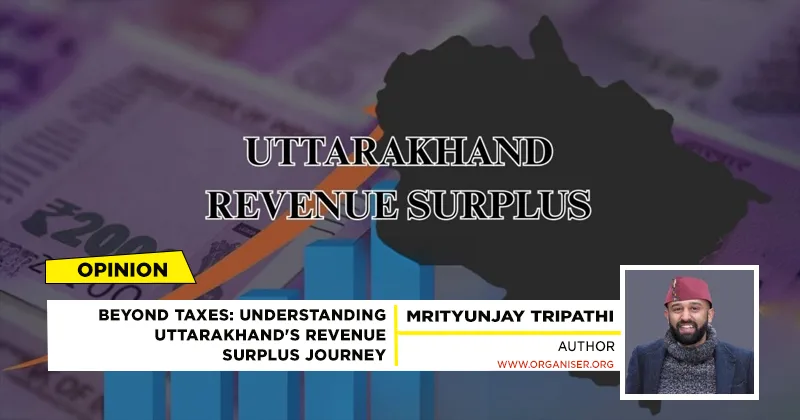
A state that came under the category of a Sick State: Economically weaker states had a complete turnaround from being categorised as such. Uttarakhand has noted a historic revenue surplus of Rs 5,300 crore for the financial year 2022-2023, according to the latest report of Comptroller and Auditor General (CAG)
This highlights the aspects of accountability, transparency, and detailed leadership and puts into action the concept of good governance and stronger fiscal management, as Prime Minister Narendra Modi talked about. The state being revenue surplus puts the state of Uttarakhand among the 16 Indian states that recorded revenue surplus in the financial year 2022-2023.
Here are some factors that would have led to Uttarakhand achieve this milestone:
Strengthening of Own Tax Revenues
One of the clearest drivers has been the improvement in tax revenue mobilization. Own-tax revenue has increased as a percentage of Gross State Domestic Product (GSDP) in recent years, as evidenced by data from the state budget: Goods and Services Tax (GST): With economic recovery after the pandemic, collections from GST, particularly in the services and hospitality sector, improved significantly. Tourism revival boosted restaurant, hotel, and transport taxes, while the formalization of trade brought more transactions under the tax net.
State Excise: Uttarakhand has traditionally derived a substantial share of its revenue from liquor excise duties. Excise reforms and stricter monitoring reduced leakages, ensuring higher compliance.
Stamp Duty and Registration Fees: Property transactions, especially in urban centers like Dehradun, Haridwar, and Haldwani, have increased stamp duty collections. This is partly linked to the migration of people buying second homes or settling in Uttarakhand for its climate and lifestyle.
These tax buoyancies gave the state a stable, recurring revenue base. Importantly, they reflect policy-driven gains, better enforcement, and modernisation of tax collection rather than just one-off windfalls.
Central Transfers and Grants
Like most hill states, Uttarakhand’s finances rely heavily on the Union government. In FY 2022–23, tax devolution and central grants formed a significant component of revenue receipts. Several factors played a role here:
Higher share from divisible pool: Central transfers increased due to buoyant national-level GST and income tax collections.
Scheme-linked grants: Enhanced flows under centrally sponsored schemes (health, rural development, education) strengthened revenue accounts.
Post-disaster and recovery assistance: The state is highly vulnerable to natural calamities and has received disaster-relief funds, which, while earmarked, still show up in revenue receipts.
These transfers ensured that Uttarakhand’s revenue base grew beyond its taxes, which cushioned volatility from the externalities and stabilized its finances.
Containment of Revenue Expenditure: Growth Achieving a revenue surplus is as much about controlling expenditure as it is about raising income. Any state that wants to achieve any surplus will always have to reduce its spending than its earnings, which is what Uttarakhand adopted! Several expenditure-side measures that may have contributed are as follows:
Rationalization of subsidies and administrative expenses: The government restricted excessive salary expenditure growth and tightened regulations regarding non-essential subsidies. Any subsidies that we poorly targeted, inefficient, fiscally unsustainable, or that would create any fiscal burdens were dropped. Duplication reforming of subsidies and schemes was kept at the forefront by the Government of Uttarakhand. Streamlining government processes by adopting technology, reducing redundant positions, and limiting the expansion of administrative expenditure wherever possible were not overlooked and were an essential aspect of governance.
Efficiency in welfare spending: Many social-sector schemes were restructured to reduce duplication and improve targeting, ensuring that benefits reached the intended population without ballooning costs. The concept of Antyodaya was put into practice, which clearly means the last man in the queue must have his due.
Digitalisation and e-governance: The concept of Digital India, a dream that has now become a reality, was put into the governance framework, which not only reduced any leakages but also increased automation and reduced unwanted administrative costs.
The state created fiscal space by ensuring revenue expenditure did not outpace receipts. In the financial year 2022-2023, Uttarakhand had revenue receipts (INR 55,440 crore approx.) that were higher than the Revenue expenditure (INR 52,979 crore pprox), which left the state with a Revenue Surplus of about INR 2,461 crore. This clearly means the state did not borrow to pay salaries, pensions, and subsidies. The state had money left even after covering all the routine costs.
Non-Tax Revenues and One-Time Gains: Non-tax revenues include the state’s income beyond regular taxation, such as royalties, mining fees, and other factors. While smaller than tax revenue, non-tax revenues also contributed to the surplus.
Dividends from State Public Sector Enterprises (SPSEs): Profit-making utilities like hydropower corporations provided dividends.
Fees and royalties: Uttarakhand earns royalties from hydroelectric projects and user charges from tourism services, mining fees from forest produce, dividends from state public sector undertakings, and others.
Land sales and property monetization: Though not sustainable, periodic monetization of government land parcels boosted receipts in select years.
Such inflows often play the role of “balancers” in state accounts, pushing the balance into surplus even when recurring flows are only marginally higher than expenditure.
Post-Pandemic Economic Recovery
The broader economic revival after COVID-19 also cannot be understated. Uttarakhand’s economy is heavily service- and tourism-oriented. With domestic tourism rebounding strongly in 2022–23, hotel occupancy, religious tourism (notably the Char Dham Yatra), and transport services surged. This produced a dual effect:
Revenues from the GST and service tax are up, spilling over to ancillary sectors like real estate, retail, and hospitality.
Simultaneously, manufacturing hubs in Haridwar and Pantnagar benefited from improved demand, contributing to excise and VAT revenues. This cyclical uplift gave the revenue side an extraordinary push.
Prudential Fiscal Management
The state government also consciously pursued fiscal discipline, aiming to project itself as investment-friendly. Invest Uttarakhand and others were integral to policy decisions that led to what we see today. Uttarakhad is adhering to the Fiscal Responsibility and Budget Management (FRBM) standards, emphasizing lowering deficits.
Better debt restructuring: Refinancing high-cost debt at lower interest rates reduced interest burdens, freeing resources for other expenditures.
Outcome-oriented budgeting: A shift from input-based to output-based budgeting improved spending efficiency.
These measures demonstrate a deliberate strategy to combine administrative tightening with resource mobilisation.
Political Will and Governance Focus
Fiscal performance is often tied to political choices. The ruling government prioritized fiscal credibility as part of its governance agenda. It signals “good governance” and plays a key role in attracting investors. To that end, bureaucratic machinery was aligned to ensure tight control over expenditure and higher compliance in tax collection.
Moreover, fiscal prudence was framed as part of Uttarakhand’s developmental vision, lending political backing to difficult decisions like curbing subsidies or enforcing tax compliance.
External and Structural Factors
Beyond deliberate policy, some external conditions helped Uttarakhand’s books:
High remittances: Migration from hill districts has created strong remittance inflows, indirectly boosting consumption and tax revenues.
Hydropower advantage: Royalties from hydropower projects contribute steady inflows.
Urbanization and property demand: Cities like Dehradun and Haridwar have seen rapid property growth, enhancing stamp duty collections.
Uttarakhand’s achievement of a Rs 5,310 crore revenue surplus in FY 2022–23 is the product of multiple converging factors: more substantial tax revenues, buoyant central transfers, expenditure discipline, non-tax receipts, tourism-led recovery, and definitely political will. The state was pushed into surplus territory by all of these small contributions. The policy challenge for the state of Uttarakhand and any other state to have achieved a revenue surplus would be to continue at this pace without giving up on the principles of sustainable growth.