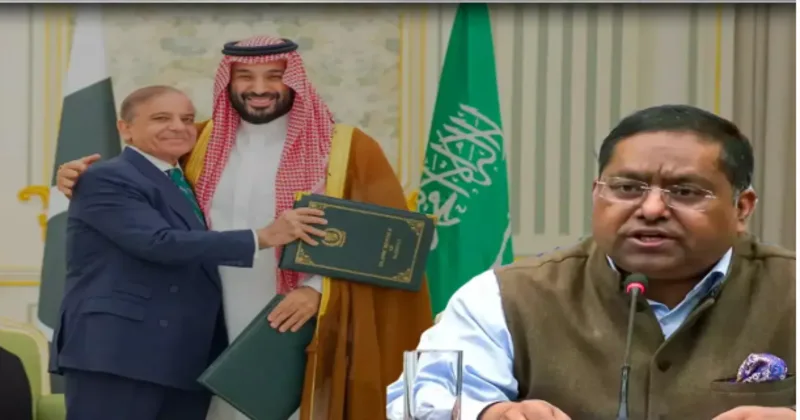
The Strategic Mutual Defence Agreement (SMDA) signed between Saudi Arabia and Pakistan on September 17, 2025 has already attracted breathless commentary across newsrooms and social media — some alarmist, some jubilant. The treaty’s headline clause — “any aggression against either country shall be considered an aggression against both” — invites easy comparisons with NATO’s Article 5. But strip away the hype and geopolitical theater, and the pact looks less like a bold new geopolitical bloc and more like a short-term psychological salve for Riyadh and a dangerous, ultimately self-undermining lifeline for Islamabad. Crucially for Bharat, while the pact demands sober attention, it does not constitute a new military threat that should unnerve New Delhi.
What the pact actually does — and what it doesn’t
The SMDA formalises a long-standing security relationship: Saudi funding and political muscle in return for Pakistani manpower, basing logistics and — potentially — a security guarantee that outsiders interpret as a “nuclear umbrella.” Pakistan’s defence minister and other officials have publicly underscored the collective-defence language and even signalled that Pakistan’s capabilities would be available to Riyadh in extremis. That rhetoric has naturally provoked questions in New Delhi and elsewhere.
But important limitations must be emphasised. The agreement does not, by default, transfer Pakistani strategic assets into Saudi control, nor does it establish an institutionalized or integrated command structure comparable to NATO. As the Belfer Center for Science and International Affairs and other analysts have pointed out, such treaties are essentially political instruments whose effectiveness rests on realpolitik incentives, logistics, interoperability, and—most critically—mutual trust and capacity. None of these preconditions are in abundant supply between Riyadh and Islamabad. Thus, while the pact may appear on paper as a robust deterrent line, translating its provisions into sustained, coordinated action—particularly in the event of a conflict with a major power such as Bharat—would be both fraught and highly uncertain.
Why Bharat should treat the pact with strategic calm — not panic
First, Bharat’s immediate military calculus need not change. Bharat’s armed forces are focused, capable and increasingly integrated with strategic partners. The SMDA does not — and realistically cannot overnight — supply Riyadh with an effective anti-Bharat war-fighting apparatus. Saudi financial guarantees do not substitute for shared logistics, secure basing, and decades of joint training and combined command structures.
In short: rhetoric ≠ capability.
Second, the pact creates incentives that are likely to accelerate Pakistan’s strategic decline rather than arrest it. Pakistan has long been economically dependent on external funding; formalizing payments as “security fees” to prop up a moribund military-state complex merely embeds that dependency. The political elites who cheer such deals now — and who hope to cash in on arms purchases and contracts — may gain short-term perks, but they also tie Pakistan’s fate ever closer to Riyadh’s whims, and to the strategic overhangs of the Middle East. This transactional relationship will not address Pakistan’s core weaknesses: economic mismanagement, political fragility, governance deficits, and strategic overstretch.
How Riyadh has misread the strategic arithmetic
Why did Saudi Arabia — a state which has been quietly exploring a more open relationship with Israel and strengthening ties with major powers — sign up for a formal defence pact with a cash-strapped, nuclear-armed but fragile Pakistan? The proximate trigger appears to be regional insecurity: a series of strikes and the unpredictable use of force in the Gulf and Levant has unnerved Gulf capitals, prompting hedging beyond the American security umbrella. The logic is simple: if the U.S. is intermittently unreliable, look for alternatives. But the choice of Pakistan as guarantor is a political — not a strategic — solution. It buys political theatre (the appearance of deterrence) at the cost of strategic coherence. The pact risks undermining Riyadh’s longer-term aim of normalization and de-escalation in the region, including careful outreach to Israel and a gradual diversification away from overdependence on external patrons.
The domestic angle: who really benefits in Pakistan?
This is the section that many commentary pieces miss. The immediate beneficiaries are not the people of Pakistan but segments of the military-political elite who can monetize the arrangement: inflated contracts, fresh procurement lines, and a political narrative of regained relevance. The SMDA gives leaders like the army chief a domestic platform — “we are international players again” — even as real structural problems fester at home. This is classic rentier politics cloaked as geopolitics. The result? Greater corruption, higher expectations of external bailouts and a strategic posture that invites entanglement without capacity.
Why the pact is a long-term liability for Pakistan, and, indirectly, for Saudi Arabia and Washington
A security relationship built on transactional payments and symbolic language will sooner rather than later generate perverse incentives. Pakistan’s leadership may be tempted to convert the pact into a forward policy of adventurism to preserve the funding stream; Riyadh, by formalizing payments, relinquishes leverage it previously had as a creditor and patron. For Washington, which faces an increasingly assertive Bharat and a complex China equation, encouraging a re-securitization of the Gulf via Pakistan is short-sighted. The U.S. should have been investing in deeper ties with Bharat and Gulf states rather than shipping strategic dilemmas onto Islamabad. Analysts have already flagged that the pact may be more about political signalling against Iran and local instability than about any practical collective defence architecture.
What Bharat should do
What Bharat needs at this juncture is a posture of pragmatism combined with strategic clarity. New Delhi must maintain calm deterrence by continuing to strengthen both its conventional and strategic capabilities, while simultaneously ensuring that unnecessary escalation is avoided. At the same time, Bharat should deepen its outreach to Riyadh by highlighting the importance of their partnership in energy, investment, and security, making it clear that Saudi Arabia’s long-term stability is best secured through cooperation with a responsible regional power like Bharat. Beyond Riyadh, Bharat must also expand its diplomacy across the Gulf, offering meaningful alternatives to transactional security arrangements—such as intelligence sharing, defence cooperation, and joint counter-terrorism efforts—that can provide greater stability without the theatrics of headline-grabbing pacts. Finally, New Delhi should seize the moment to publicly, and through discreet back-channel communication, expose the structural weaknesses inherent in the Saudi–Pakistan agreement, underlining that the SMDA is no substitute for genuine institution-building and responsible statecraft.
The Saudi-Pakistan SMDA will produce headlines, political theatre and domestic gains for Pakistani grandees. But the treaty is not a strategic juggernaut aimed at Bharat; it is a symptom — a transactional, short-term attempt by two vulnerable elites to paper over deep insecurities. For Bharat, the right response is steady strategy, decisive diplomacy with Riyadh, and a continued focus on strengthening Bharat’s own security partnerships and deterrence. Let others chase headlines; New Delhi should keep doing what makes the nation secure.