India, home to more than 1.4 billion people, is preparing for Census 2027, the world’s largest administrative and population-mapping exercise. What makes this edition historic is its method: for the first time in over 140 years of census history, the count will be fully digital, moving away from bulky paper forms to mobile applications, smart maps, GPS tracking, and real-time data transfer.
This leap in methodology reflects not only India’s technological progress but also the rising demand for accurate, timely, and multi-layered data in governance and planning.
Mock Drill: Testing the system before the count
The groundwork will officially begin on October 1, 2025, with a 60-day nationwide mock drill. This test run is not symbolic; it is designed to rigorously stress-test every stage of the census machinery, from digital platforms to on-field data collection.
Any flaws identified during this drill will be corrected in the following six months, ensuring that when the actual census begins, the system runs smoothly. Officials describe this as a “dress rehearsal” for India’s largest digital experiment.
A two-phase rollout
Registrar General and Census Commissioner Mrityunjay Kumar Narayan has confirmed that the operation will unfold in two carefully planned phases:
Phase 1 (House Listing): Begins April 1, 2026, with a focus on inventorying houses and households.
Phase 2 (Population Enumeration): Begins on February 1, 2027, when enumerators will collect details on individuals, caste, property, employment, and socio-economic markers.
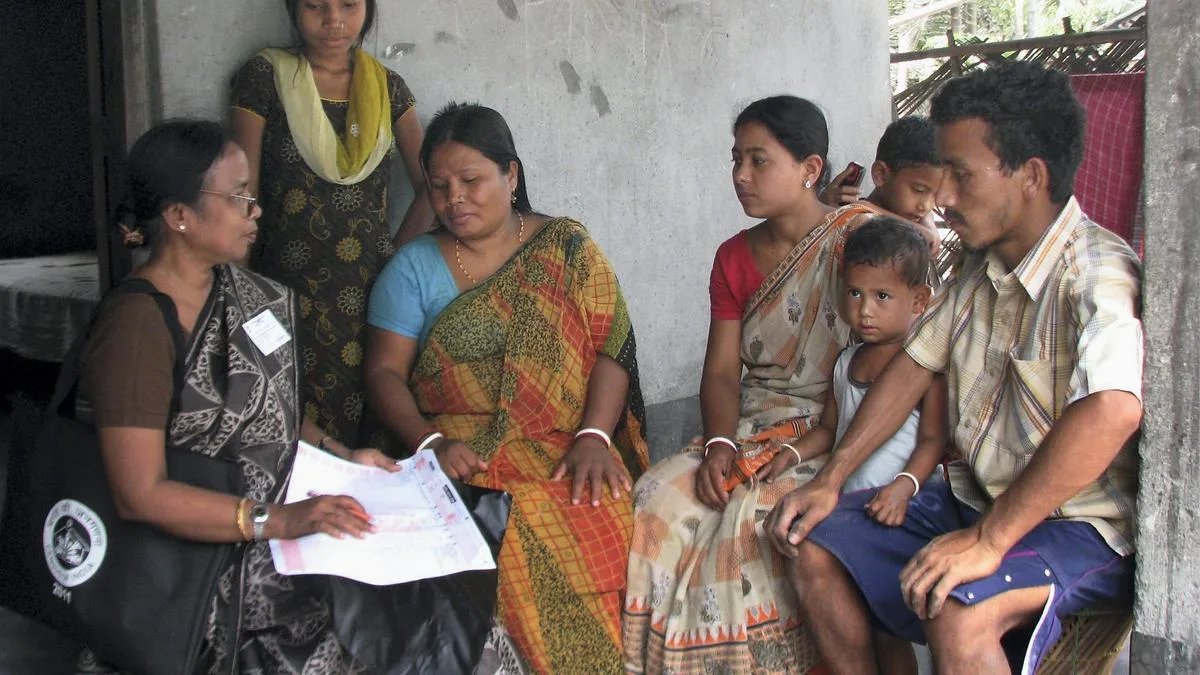
By then, an army of 34 lakh enumerators and supervisors, backed by 1.3 lakh census staff, will fan out across every village, town, and city. Each will carry a digital tablet or smartphone, surveying between 150-175 households.
‘Digi Dots’: Redrawing India’s data map
Perhaps the most transformative feature of Census 2027 will be the creation of digital geo-tagged markers, nicknamed “Digi Dots.” Every house, shop, religious place, hotel, or establishment will be assigned one.
Notably, this is not just a census exercise, it is an overhaul of India’s demographic mapping with benefits that extend far beyond headcounts:
Disaster Relief: Quick estimates of affected populations in flood, earthquake, or cloudburst zones.
Delimitation: A balanced approach to drawing constituency boundaries, especially as urban-rural divides widen.
Urban Planning: More precise allocation for schools, hospitals, transport networks, and green spaces.
Migration Trends: Easier monitoring of population shifts, crucial for understanding urbanisation and labour mobility.
Voter List Clean-Up: Aadhaar-linked geo-verification to eliminate duplication and improve electoral rolls.
To reduce human error, the census will employ AI-based tools to read handwritten data, dropdown menus for uniform entry, and GPS tagging for real-time verification.
Frozen boundaries for stability
The Ministry of Home Affairs has already issued a Gazette notification (June 16, 2024) declaring that administrative boundaries will remain frozen between January 1, 2026, and March 31, 2027.
This means that no new districts, blocks, or tehsils can be created during the census period, a practice aimed at preventing data inconsistencies.
The first rollout will begin in four high-altitude and logistically challenging states, Himachal Pradesh, Uttarakhand, Jammu & Kashmir, and Ladakh, from October 1, 2026. The rest of India will be covered in March 2027.
Madhya Pradesh: The testing ground
If the census is going digital, Madhya Pradesh (MP) is set to be its ground zero. Preparations are already underway for the state-wide rollout in 2026, where 1.5 lakh employees will be deployed to complete the first digital phase within 20 days.
Before this, a pilot project will run between October and November 2025 in three districts, Gwalior (urban-heavy), Ratlam (mixed terrain), and Seoni (tribal and forested areas).
Census Director Bhavana Walimbe explained that these pilot districts were deliberately chosen to represent India’s diversity. Findings will be compiled and forwarded to the Ministry of Home Affairs, which will then refine the national framework.
Meanwhile, the MP government has instructed four key departments, Urban Development, Forest, Panchayat & Rural Development, and Revenue, to finalise all boundary changes by December 31, 2025. After that, no new administrative boundaries will be entertained until the census concludes.
Training: Building the largest civil workforce in history
The census demands not just technology but people. To prepare, the Centre has designed a three-tier training system:
National Trainers – to set overall guidelines.
Master Trainers – to train officials at the state level.
Field Trainers – to directly train enumerators and supervisors.
Armed with digital questionnaires, enumerators will collect detailed information ranging from family size and caste to property ownership, housing conditions, and employment.
Each submission will undergo a verification round through home visits to cross-check accuracy. This ensures that, despite being digital-first, the census does not compromise on authenticity.
The caste census factor
The 2027 census carries added weight because it will also double as India’s ninth caste census.
Historically, India conducted seven caste-based counts under British rule (1872–1931) and once in 2011. However, the findings of 2011 were never officially published due to inconsistencies and political sensitivities.
The new caste census will thus be the first credible, comprehensive caste-based survey since independence, opening up a politically sensitive but socially significant database.
Why this census matters more than ever
India has not conducted a census since 2011. The 2021 edition was postponed due to the COVID-19 pandemic, creating a 16-year data gap.
This gap has serious implications: policymakers are relying on outdated population figures while drafting healthcare schemes, educational reforms, electoral delimitation, and welfare programmes.
Since the first modern census in 1881, India’s decennial count has been a backbone for governance. Now, with a digital-first approach, the government hopes to bring greater speed, transparency, and accuracy.
The world’s most ambitious digital experiment
Between now and 2027, India faces the enormous task of training 34 lakh enumerators, conducting multiple pilot projects, and stress-testing its digital infrastructure.
If successful, Census 2027 will not just be another headcount, it will stand as the largest digital governance experiment ever attempted anywhere in the world.
From geo-tagging every household to conducting a caste enumeration alongside population mapping, the census will be more than a statistical exercise, it will be a mirror of India’s future demographic and social landscape.
Looking back: The 2011 census and its findings
The last full census India conducted was in 2011, the 15th national census and the 7th since independence. It recorded India’s population at 1.21 billion, marking a 17.7 percent increase over 2001. Notably, India added more people between 2001 and 2011 than the entire population of Brazil.
The findings shed light on several key demographic trends:
Population Distribution: Uttar Pradesh alone had over 199 million people, more than the population of Brazil.
Gender Ratio: India’s sex ratio improved slightly to 940 females per 1,000 males, but female foeticide and gender imbalance remained pressing issues.
Literacy: Literacy rose sharply from 64.8 percent in 2001 to 74 percent in 2011, with female literacy showing the most growth.
Urbanisation: The census found that over 31 percent of India’s population lived in urban areas, reflecting the rapid migration to cities.
Youth Dividend: With nearly 41 percent of the population below 20 years, India was confirmed as one of the world’s youngest nations.
Despite these findings, the 2011 caste enumeration data, conducted separately as the Socio-Economic and Caste Census (SECC), was never officially released, citing errors in collection and classification. Many argued that this was a political decision, as caste data remains deeply contentious in policy and electoral politics.
New avenues await
By law and practice, a census is due every ten years, yet India has not conducted one since 2011. The 2021 Census, critical for updating India’s demographic database, was first delayed by the COVID-19 pandemic and later postponed indefinitely by the government.
The government’s decision to conduct the upcoming census in a fully digital format marks a historic leap towards transparency, accuracy, and efficiency. By replacing outdated manual practices with digital data collection, the process will not only save time and resources but also minimise errors and manipulation.
Moreover, the inclusion of the caste factor in this census reflects the government’s commitment to addressing long-standing socio-economic realities that shape policy-making. For decades, discussions on caste have remained politically charged, but with its systematic inclusion, policymakers will now have authentic data to design welfare schemes, target social justice initiatives, and bridge inequalities more effectively. This bold step demonstrates the government’s vision to combine technology with inclusivity, ensuring that every section of society is truly represented in the nation’s development roadmap.