Teacher count crosses one crore, dropouts decline: Report
June 6, 2026
  • Read Ecopy
  • Circulation
  • Advertise
  • Careers
  • About Us
  • Contact Us
Android AppiPhone AppArattai
Organiser
  • ‌
  • Bharat
    • Assam
    • Bihar
    • Chhattisgarh
    • Jharkhand
    • Maharashtra
    • View All States
  • World
    • Asia
    • Europe
    • North America
    • South America
    • Africa
    • Australia
  • Editorial
  • International
  • Opinion
  • RSS @ 100
  • More
    • Op Sindoor
    • Analysis
    • Sports
    • Defence
    • Politics
    • Business
    • Economy
    • Culture
    • Special Report
    • Sci & Tech
    • Entertainment
    • G20
    • Azadi Ka Amrit Mahotsav
    • Vocal4Local
    • Web Stories
    • Education
    • Employment
    • Books
    • Interviews
    • Travel
    • Law
    • Health
    • Obituary
  • Subscribe
    • Subscribe Print Edition
    • Subscribe Ecopy
    • Read Ecopy
  • ‌
  • Bharat
    • Assam
    • Bihar
    • Chhattisgarh
    • Jharkhand
    • Maharashtra
    • View All States
  • World
    • Asia
    • Europe
    • North America
    • South America
    • Africa
    • Australia
  • Editorial
  • International
  • Opinion
  • RSS @ 100
  • More
    • Op Sindoor
    • Analysis
    • Sports
    • Defence
    • Politics
    • Business
    • Economy
    • Culture
    • Special Report
    • Sci & Tech
    • Entertainment
    • G20
    • Azadi Ka Amrit Mahotsav
    • Vocal4Local
    • Web Stories
    • Education
    • Employment
    • Books
    • Interviews
    • Travel
    • Law
    • Health
    • Obituary
  • Subscribe
    • Subscribe Print Edition
    • Subscribe Ecopy
    • Read Ecopy
Organiser
  • Home
  • Bharat
  • World
  • Operation Sindoor
  • Editorial
  • Analysis
  • Opinion
  • Culture
  • Defence
  • International Edition
  • RSS @ 100
  • Magazine
  • Read Ecopy
Home Bharat

Indian teaching workforce crosses one crore, dropouts fall sharply: UDISE+ 2024-25 Report 

India’s school education system has recorded its strongest improvements in recent years, according to the Unified District Information System for Education Plus (UDISE+) 2024-25 report. With teacher strength crossing the one-crore mark and dropout rates falling sharply, the data reflects a major stride towards achieving NEP 2020 goals

Shashank Kumar DwivediShashank Kumar Dwivedi
Sep 2, 2025, 12:00 pm IST
in Bharat, Education
Follow on Google News
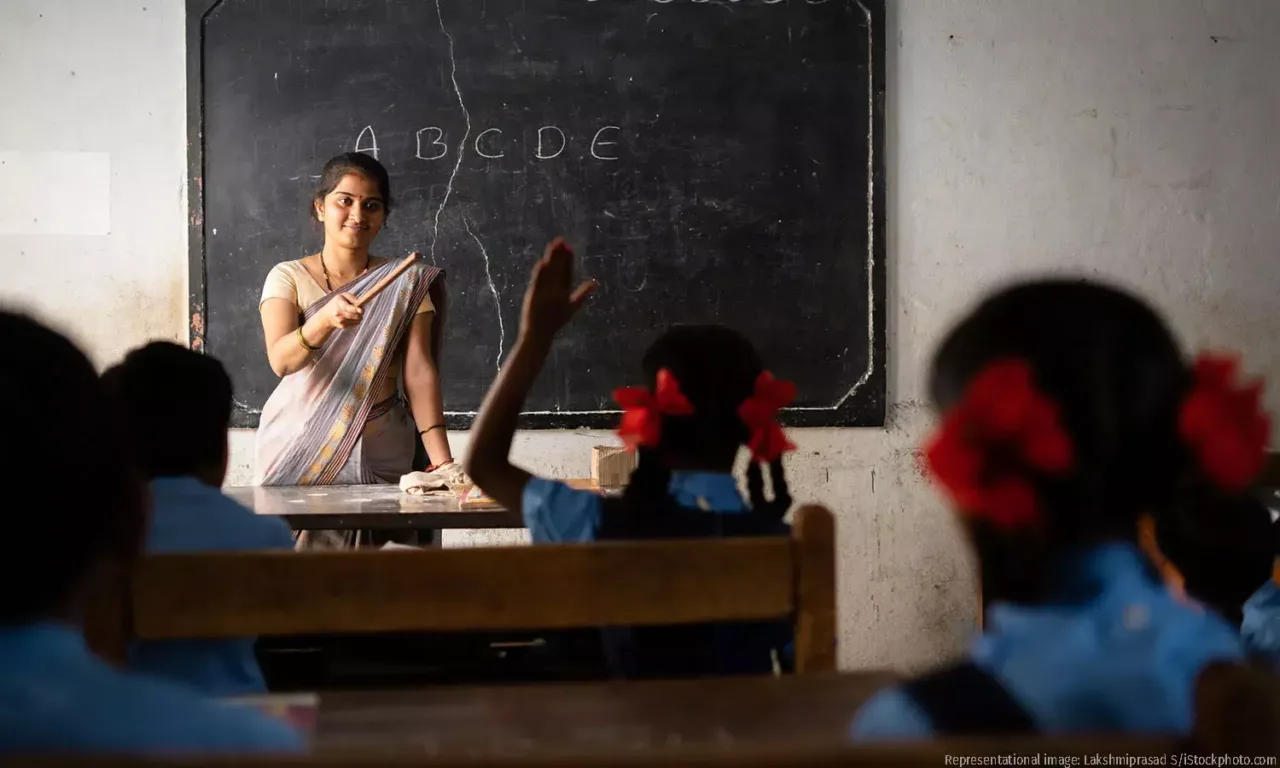
A representative image

A representative image

FacebookTwitterWhatsAppTelegramEmail

The Ministry of Education on August 28, released the Unified District Information System for Education Plus (UDISE+) 2024-25 report, offering one of the most comprehensive assessments of India’s school education landscape to date. The data presents a promising picture of progress in access, quality, and equity, while also underlining the country’s steady movement towards the goals set out under the National Education Policy (NEP) 2020.

Among its most significant milestones, the report highlighted that for the first time since the launch of UDISE+ in 2018-19, the total number of teachers in India has crossed the one-crore mark, recording a 6.7 percent increase compared to the figures reported in 2022–23. This expansion in teacher strength has had a direct impact on the overall quality of education, ensuring that students receive better guidance, individualised attention, and more opportunities for learning.

One of the most encouraging outcomes of the increase in teacher strength is the improvement in pupil-teacher ratios (PTR) across all levels of schooling. According to the 2024-25 data, the PTR now stands at 10 students per teacher at the foundational level, 13 at the preparatory level, 17 at the middle level, and 21 at the secondary level. These figures are well below the NEP 2020 benchmark of a maximum of 30 students per teacher.

Such ratios are critical for maintaining quality learning, as smaller classroom sizes allow teachers to identify individual student needs better, foster interactive learning, and provide remedial support where required. This improvement also aligns with the government’s broader focus on making classrooms more student-centric and holistic.

The report also brought encouraging news regarding student retention, an area where India has historically faced challenges. Dropout rates have witnessed a sharp decline across all levels of schooling. At the preparatory level, dropout rates fell from 3.7 percent in 2022-23 to 2.3 percent in 2024-25. The middle level recorded a drop from 5.2 percent to 3.5 percent, while the secondary level, traditionally the most vulnerable to dropouts, saw a significant decline from 10.9 percent to 8.2 percent. These figures not only reflect stronger retention but also suggest that interventions aimed at reducing economic, social, and infrastructural barriers to education are beginning to yield results.

The improved access to scholarships, midday meals, better infrastructure, and targeted government schemes could be contributing to this encouraging trend.

Another notable achievement documented in the UDISE+ report was the rise in enrolment and transition rates. India’s Gross Enrolment Ratio (GER) at the middle level climbed to 90.3 percent, while at the secondary level, it reached 68.5 percent in 2024-25. Transition rates, the proportion of students successfully moving from one stage of schooling to the next, also improved, signalling smoother progression across the education system. This reflects not only better retention but also growing parental trust in the formal education system, which is increasingly seen as a pathway to social mobility and economic opportunity.

The report highlighted further structural improvements in the school system by recording a sharp reduction in the number of single-teacher schools and zero-enrolment schools. Single-teacher schools decreased from 110,971 in 2022-23 to 104,125 in 2024-25, while zero-enrolment schools dropped from 12,954 to 7,993. Both reductions indicate a stronger push towards consolidation, resource optimisation, and ensuring that schools function effectively with adequate teaching staff and active student enrolment.

Beyond human resources and enrolment, infrastructure development and digital access emerged as strong pillars of progress. According to the data, 64.7 percent of schools now have computers, and 63.5 percent have access to the internet, marking significant strides towards bridging the digital divide.

Additionally, basic facilities have expanded rapidly: electricity access has reached 93.6 percent of schools, safe drinking water is available in 99.3 percent, and handwashing facilities cover 95.9 percent. Efforts to make schools inclusive have also gained momentum, with 54.9 percent of schools now equipped with accessibility features such as ramps and handrails for children with disabilities. Together, these figures show how infrastructural improvements are creating a more enabling environment for both learning and teaching.

Another highlight of the report was progress on gender equity. The proportion of female teachers increased to 54.2 percent, reflecting greater participation of women in shaping the education system. On the student side, girls’ enrolment also grew slightly to 48.3 percent in 2024-25. This progress suggests that India is gradually bridging gender disparities in education, an essential step for achieving the NEP 2020 goal of universal and equitable access. Having more women teachers not only boosts representation but also creates safer and more encouraging environments for girl students, thereby improving attendance and retention rates.

Summing up the findings, the Ministry of Education emphasised that the UDISE+ 2024-25 report reflects India’s determined journey towards achieving the vision of NEP 2020, to build a universal, equitable, and high-quality school education system.

The simultaneous improvements in teacher strength, pupil-teacher ratios, dropout rates, enrolment, infrastructure, and gender balance demonstrate a comprehensive strengthening of the education ecosystem. If sustained, these gains could lay a strong foundation for India’s long-term demographic dividend, ensuring that every child not only attends school but also learns in a supportive, inclusive, and future-ready environment.


Topics: Gross Enrolment RatioUDISE+ 2024–25education report Indiateacher strengthpupil-teacher ratiodropout rate decline
ShareTweetSendShareSend
✮ Subscribe Organiser YouTube Channel. ✮
✮ Join Organiser's WhatsApp channel for Nationalist views beyond the news. ✮
Previous News

Obama’s white house dinner jibe set Trump on path to power and an obsession with the Nobel peace prize

Next News

India defies US pressure, stands by Russian oil imports as Trump threatens heavy tariffs on medicines

Related News

A group pof school girls in uniform

Education in Crisis: 65 lakh students fail in Class 10 and 12 as state boards struggle to compete with Central boards

Decoding the advent of foreign universities in India

Load More

Latest News

The Porumamilla inscription and the ancient science behind a reservoir that survived 650 years

India’s 655-Year-Old Water Policy: The Porumamilla inscription that turned stone into a manual of hydrology

India’s Permanent Representative to the United Nations Ambassador Harish Parvathaneni

India slams Pakistan at UNSC for peddling false narratives on Jammu & Kashmir

Keralam: Pathanamthitta temple property occupied beyond lease period reclaimed by devotees

A series of high-level engagements signals New Delhi's growing focus on building interoperable security networks across the Indo-Pacific

India strengthens Indo-Pacific security architecture with new defence and maritime partnerships

Prime Minister Narendra Modi

“Makes every Indian proud”: PM Modi hails India’s 7.7 per cent GDP growth in FY 2025-26

Once known for maoist violence, Minpa now leads healthcare revolution with telemedicine services in Sukma

From Maoist Stronghold to Healthcare Hub: How Chhattisgarh’s Minpa is transforming through telemedicine & development

Dr Surendra Jain, Joint General secretary, VHP

VHP Demands Audit of Waqf Properties Amid Encroachment Claims: “Land should go to rightful owner,” says Surendra Jain

A Special NIA Court has framed charges against banned PFI and 20 office bearers, including E. Abubakar and O.M.A. Salam, under UAPA and IPC

PFI Terror Case: Special NIA court charges Abubakar, Salam & others for alleged conspiracy to wage war against India

Prime Minister Narendra Modi with women during an event (Old image used for representative purposes)

The Nari Shakti Decade: How 12 years of policy reforms under Modi govt transformed lives of women in Bharat

Ritabrata Banerjee, expelled by Mamata Banerjee from TMC, has been appointed as the Leader of the Opposition in Bengal assembly.

TMC House Divided: Mamata’s party battles Itself as LoP row exposes deepening cracks after BJP’s big blow

Load More
  • Privacy
  • Terms
  • Cookie Policy
  • Refund and Cancellation
  • Delivery and Shipping

© Bharat Prakashan (Delhi) Limited.
Tech-enabled by Ananthapuri Technologies

  • Home
  • Search Organiser
  • Bharat
    • Assam
    • Bihar
    • Chhattisgarh
    • Jharkhand
    • Maharashtra
    • View All States
  • World
    • Asia
    • Africa
    • North America
    • South America
    • Europe
    • Australia
  • Editorial
  • Operation Sindoor
  • Opinion
  • Analysis
  • Defence
  • Culture
  • Sports
  • Business
  • RSS @ 100
  • Entertainment
  • More ..
    • Sci & Tech
    • Vocal4Local
    • Special Report
    • Education
    • Employment
    • Books
    • Interviews
    • Travel
    • Health
    • Politics
    • Law
    • Economy
    • Obituary
  • Subscribe Magazine
  • Read Ecopy
  • Advertise
  • Circulation
  • Careers
  • About Us
  • Contact Us
  • Policies & Terms
    • Privacy Policy
    • Cookie Policy
    • Refund and Cancellation
    • Terms of Use

© Bharat Prakashan (Delhi) Limited.
Tech-enabled by Ananthapuri Technologies