The Modi Government has once again reaffirmed its deep commitment to strengthening rural livelihoods and empowering Bharat’s villages by making a historic Rs 86,000 crore allocation for the Mahatma Gandhi National Rural Employment Guarantee Act (MGNREGA) in the financial year 2025-26. This is the highest budgetary support the scheme has ever received since its inception and shows the government’s vision of building economic resilience, social equity, and sustainable livelihoods for millions of rural households.
The unprecedented allocation is more than a financial announcement; it is a powerful statement that the government sees rural India not as a dependent periphery but as the backbone of the nation’s progress.
As of July 23, 2025, the Centre has already released Rs 45,783 crore, with a substantial Rs 37,912 crore earmarked exclusively for wage payments. This ensures that rural workers are not left waiting endlessly for their dues, a problem that plagued the scheme during earlier years, but instead receive their earnings in a timely and transparent manner.
Officials have underlined that the focus is not only on providing employment but also on preserving the dignity of workers by making sure they are financially included through prompt disbursals. This approach highlights the larger vision of Atmanirbhar Bharat, where the poorest citizens are given both opportunity and dignity, and where empowerment begins at the grassroots.
The employment guarantee scheme has emerged as a pillar of livelihood assurance, especially in times of economic uncertainty or natural distress. Data from the financial year 2024-25 demonstrates its strength and relevance. During this period, MGNREGA generated 290.60 crore person-days of employment, benefiting close to 16 crore households.
Crucially, 99.79 percent of all households who demanded work under the Act received it, a figure that shows the responsiveness of the programme to people’s needs. In many districts, the scheme acted as a safety net, cushioning families against the shocks of rising living costs, unpredictable weather, and seasonal unemployment.
The certainty of work and wages under MGNREGA has also reduced the compulsion of distress migration, allowing families to stay within their communities and contribute to local development rather than being forced to leave for cities in search of uncertain and often exploitative jobs.
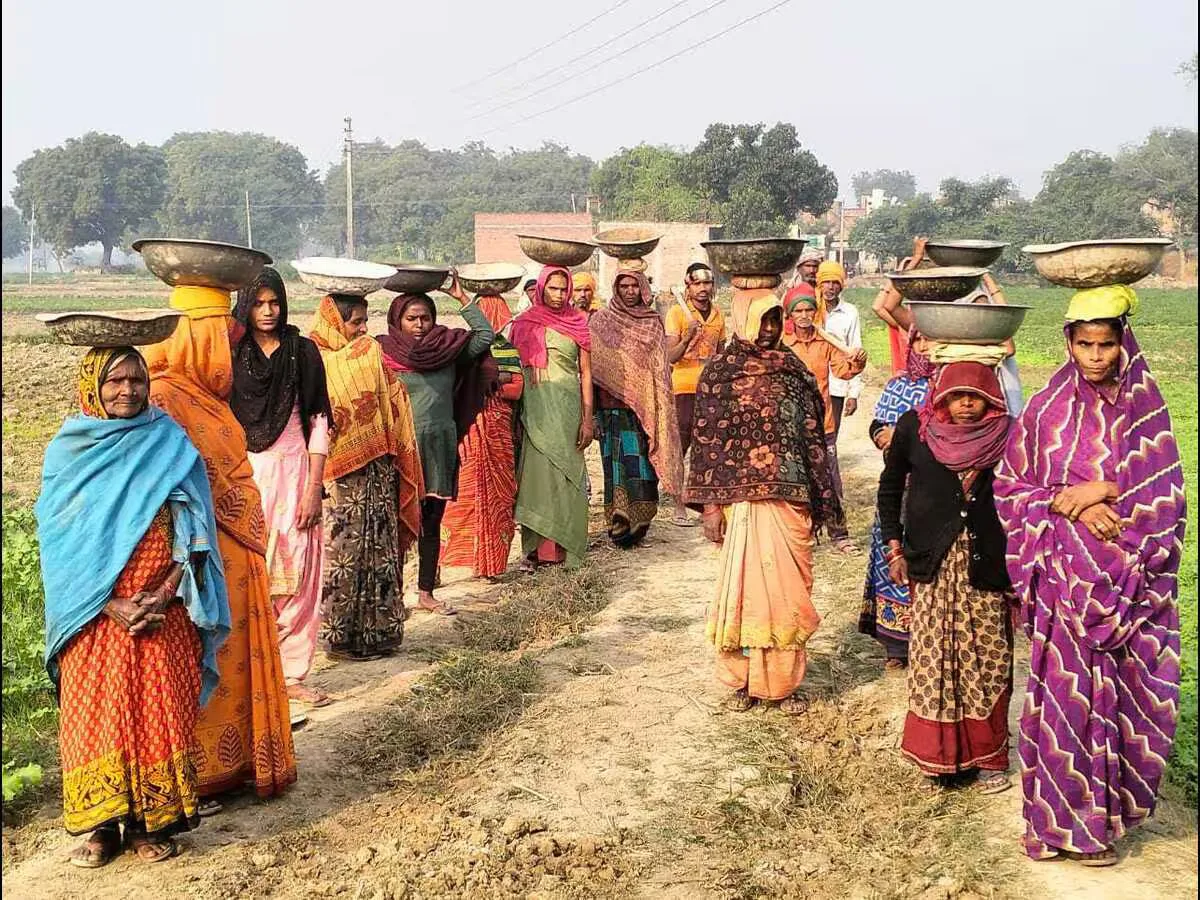
One of the most transformative aspects of the scheme in recent years has been the rising participation of women.
In 2013-14, women accounted for 48 percent of the total workforce under MGNREGA. By 2024-25, that figure had surged to an impressive 58.15 percent, involving more than 440 lakh women across rural Bharat. This rise has been hailed as a marker of social inclusion and empowerment. Women are no longer passive participants in rural development; they are now at the heart of transformative projects such as water harvesting structures, rural roads, farm ponds, and plantation drives.
The increased participation of women has had ripple effects, enhancing their decision-making power within households, improving the nutritional outcomes of children, and channelling earnings into education and healthcare. The empowerment of women through MGNREGA is, therefore, not just economic but also deeply social, contributing to the building of stronger families and communities.
While employment remains the core mandate, MGNREGA has also been instrumental in asset creation that has long-term benefits for villages. Across the country, durable assets such as rural roads, check dams, irrigation canals, and sanitation facilities have been built through this programme.
In Assam, for instance, the construction of a brick-lined irrigation canal not only created more than a thousand man-days of employment for local villagers but also significantly improved access to water for farming, thereby boosting agricultural productivity and reducing drudgery for farmers. These projects highlight the scheme’s capacity to combine wage employment with community development, ensuring that short-term work results in long-term progress.
The emphasis on asset creation also dovetails with the government’s broader sustainability goals, as many projects under MGNREGA are designed to conserve soil, promote water harvesting, and make agriculture more resilient to the impacts of climate change.
In recognition of the fact that sustainable livelihoods cannot be built on casual wage labour alone, the Modi government has linked MGNREGA with skill-building initiatives through Project UNNATI. This programme is designed to equip workers with skills that enable them to move beyond unskilled manual labour and take up more sustainable employment opportunities.
By the end of March 2025, nearly 91,000 workers had already received training under UNNATI, with the government aiming to train two lakh workers in total. Training modules in trades such as masonry, carpentry, tailoring, and food processing are creating pathways for workers to become entrepreneurs, skilled artisans, or employees in better-paying industries. This forward-looking initiative reflects the government’s ambition to not just provide temporary work but to integrate rural citizens into India’s growth story in a meaningful and lasting way.
Another area where the government’s reformist approach has made a dramatic difference is in governance and transparency. Through a digital revolution in the scheme’s administration, MGNREGA has moved into the age of accountability. Nearly 99.94 percent of wage disbursals are now Aadhaar-based, with over 13.45 crore active workers linked to Aadhaar and more than 13 crore under the Aadhaar Payment Bridge System. This has drastically reduced leakages, ghost entries, and the problem of middlemen siphoning off wages.
More than 6.26 crore assets created under the programme have been geo-tagged, ensuring real-time monitoring and public transparency. Tools such as the Yuktdhara portal, the JALDOOT app, the JANMANREGA platform, and the NMMS attendance system have all enhanced accuracy, streamlined operations, and empowered communities to track the progress of work in their villages.
The government has also implemented rigorous verification processes to maintain the scheme’s integrity. In the financial year 2024-25 alone, more than 58,000 fake or duplicate job cards were identified and cancelled following Aadhaar verification. Social audits, which are now mandated twice every year, provide communities themselves with the opportunity to monitor the functioning of the scheme and report irregularities.
Campaigns such as Rozgar Diwas and other awareness initiatives have further strengthened community engagement and built public trust in the programme. The emphasis has consistently been on ensuring that every rupee allocated under MGNREGA reaches the intended beneficiary, living up to the principle that government resources must enrich the lives of the poor and not the pockets of intermediaries.
Among the many achievements under the asset-creation framework of the scheme, the success of Mission Amrit Sarovar stands out. Originally launched with a target of constructing 50,000 water bodies across the country, the mission has already exceeded expectations with more than 68,000 such assets built. These water bodies are helping villages harvest rainwater, recharge aquifers, and secure their water future in an age of climate unpredictability. By doing so, the programme has not only generated employment but also contributed to long-term environmental sustainability. In water-scarce regions, these reservoirs have been nothing short of lifelines, ensuring year-round water availability for both farming and daily needs.
Taken together, these achievements show how MGNREGA has been transformed under the Modi government from a simple wage-support scheme into a multi-dimensional programme of rural empowerment. It now provides income security during times of distress, enhances agricultural productivity through asset creation, empowers women as central players in development, strengthens local governance and accountability through digital innovations, and promotes ecological sustainability through water and soil conservation.
The vision of Atmanirbhar Bharat finds one of its strongest expressions in MGNREGA today, where the focus is not only on temporary relief but on building lasting resilience and prosperity at the grassroots.
The record-breaking allocation of Rs 86,000 crore for MGNREGA in the current financial year is, therefore, much more than a budgetary decision. It represents the Modi government’s deep and abiding commitment to rural Bharat. By combining livelihood assurance, women’s empowerment, skill training, asset creation, digital governance, and sustainability, the government has ensured that MGNREGA is no longer just an employment guarantee but a pathway to dignity, resilience, and empowerment. Rural households are reaping the benefits in the form of timely wages, new skills, and better infrastructure, while villages are being steadily transformed into hubs of productivity and hope.
Under the leadership of Prime Minister Narendra Modi, the scheme is fulfilling its promise of building not only durable assets but also aspirations, strengthening the very backbone of Bharat, one village at a time.