The Malegaon verdict has torn apart the carefully woven myth of Bhagwa Aatank (saffron terror), revealing it to be exactly what author Manoj Jwala had forewarned in his eye-opening book “Safed Aatank: Hume Se Maino Tak” — a white-collared conspiracy (Safed Aatank) crafted through political deceit, bureaucratic complicity, and relentless media propaganda who spun the falsehood of saffron terror so often that it began to wear the mask of truth. The collapse of this false narrative marks not just a legal vindication but a civilizational wake-up call. For over a decade, innocent Hindus were vilified, persecuted, and paraded as “terrorists” while the real culprits roamed free. The truth is now out — but justice demands more than the acquittal.
This article delves into how state institutions were co-opted to craft this false narrative, the role of media and political actors, the denial of fundamental rights, and most importantly, what Hindus must do to ensure that such targeted persecution never happen again.
Safed Jhooth: A Manufactured Lie Defeated in Court
In the book, the author Manoj Jwala has aptly described the concocted notion of “saffron terror” as “Safed Aatank” —a whitewashed form of terrorism rooted in “Safed Jhooth” (pure lies) propagated by the “safedposh”—the “white-collared” elite, which included influential politicians, bureaucrats, and their collaborators in the media and academia. He rightly explained how this falsehood was crafted with precision, targeting Hindu symbols, traditions, and nationalistic sentiments, and then systematically injected into public discourse. He traced how this fabrication was conceived, nurtured, and amplified until it permeated every nook and corner of the nation and even reached the international stage. Drawing on the principle that “a lie told often enough becomes the truth” in public perception, the author rightly shows how the architects of this narrative (the then ruling regime) applied the technique relentlessly, repeating the same falsehood in political discourse, public speeches and in media until it solidified in the minds of the masses as an unquestioned fact.
The NIA Court’s eventual exposure of this false narrative has, therefore, not merely acquitted the innocent accused; it has rescued the Hindu civilization from the burden of carrying an undeserved mark of shame.
Freedom of Expression vs. False Narrative: The Legal Angle
The Constitution of India under Article 19(1)(a) guarantees freedom of speech and expression to the citizens of India – enforceable against the State. However, this right is not absolute. It comes with reasonable restrictions—such as those relating to security of the nation, public order, incitement to an offence, and defamation [mentioned in Article 19(2)]. And when all other organs of the State — including the fourth pillar, the media — themselves become violators of this right by crafting and promoting the false narrative of “Hindu terror” or “saffron terror” the constitutional fabric is endangered.
In such circumstances, the judiciary should have stepped in as the ultimate guardian of fundamental rights. The Supreme Court, by invoking judicial activism or taking suo moto cognizance, could and should have restrained the government and its officials from making adverse remarks against Hindu Dharma, or from asserting the existence of a so-called “Hindu terror” behind the blasts — particularly when the allegations were still under judicial scrutiny and ensured that no state authority link religion to terror, and that the religious sentiments of the Hindu community are respected. Similarly, investigative agencies should have been barred from making public statements about the ongoing cases in ways that could prejudice trial proceedings and fair trial, and the media should have been restrained from running parallel media trials that endangered the presumption of innocence of the accused persons – one of the cardinal principles of the criminal justice system.
Had such judicial intervention occurred, the damage caused by this concocted narrative might have been contained. Instead, the absence of timely restraint allowed the falsehood to spread nationally and internationally.
Selective Secularism: A Tool against Hindus
India’s constitutional promise of secularism is meant to ensure equal treatment for all religions (“Sarv Dharma Sambhava”), yet in practice, it often degenerates into a political tool applied selectively—usually against Hindus. The so-called “saffron terror” narrative is one of the most glaring and recent examples of this bias. The collapse of this narrative after the Malegaon verdict has laid bare the double standards of those who crafted and promoted this myth. For years, certain politicians, self-proclaimed secular activists, individuals and sections of the media had no hesitation in branding an entire community with labels like “Hindu terror” and “saffron terror,” despite the absence of conclusive evidence and while cases were still sub judice. Yet, after the court’s acquittals, the very same voices have switched their tone—now insisting that “terrorism has no religion”. If terrorism truly has no religion, then they must answer – why were Malegaon and other incidents so readily branded as “Hindu terror”? Why was the entire Dharma vilified? This is not secularism in true sense—it is used as a political tool, used for minority appeasement, vote-bank politics, and to undermine Hindu Dharma and the civilizational interests of the Hindus.
Dharma’s Dual Mandate: Protect Peace, Destroy Adharma
It is pertinent to emphasize that Hindu Dharma is the antithesis of terrorism. Yet, while Hinduism’s spiritual goal is ‘Ahinsa’ (non-violence/peace), our Dharma Shastras — and the Bhagavad Gita in particular — recognize that ‘Hinsa’(violence) is not only permissible but obligatory when it is exercised for the protection of Dharma and the innocent.
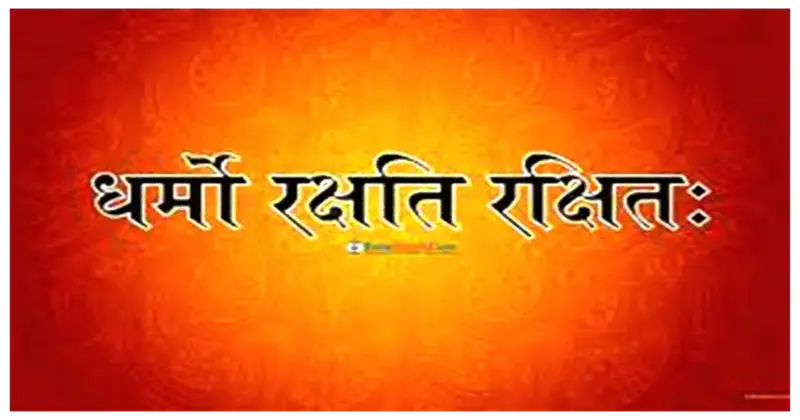
Every Hindu has the foremost duty to stand for and protect Dharma, for as our scriptures say — “धर्मो रक्षति रक्षितः”. If we safeguard Dharma, it will safeguard us. Our rich civilizational history is filled with examples — from the righteous war between Bhagwan Ram and Ravan in the Ramayan to the epic battle between the Kauravas and Pandavas in the Mahabharat — where the real conflict was always between Dharma and Adharma. And as the shloka (in Mahabharat) says, “यतो धर्मस्ततो जयः” (Where there is Dharma, there is victory).
Our Dharmic texts clearly convey that we must actively protect Dharma whenever it is violated or attacked. The false construct of “saffron terror” is one such modern attempt to malign the very soul of Sanatan Dharma. In such times, it is not enough to quietly reject these lies in our personal capacity and think that we have discharged our duty by not believing such lies. If every Hindu merely “doesn’t believe” the lies/attack but “does nothing”, then who will actually defend our Dharma? Silence is not protection. We must collectively resist and counter such assaults lawfully.
We must become Kshatriyas in spirit — for the prime duty of a Kshatriya is to stand for Dharma. And if Dharma cannot be protected or respected through dialogue, mediation, or negotiation, then our scriptures do not hesitate to endorse the last resort — righteous force. We see this very principle in our epics like Ramayan and Mahabharat. In Gita, Bhagwan Shri Krishna said to Arjun-
अथ चैत्त्वमिमं धर्म्यं संग्रामं न करिष्यसि। ततः स्वधर्मं कीर्तिं च हित्वा पापमवाप्स्यसि॥ (If you do not fight this righteous battle, you will abandon your own Dharma and honour, and will incur sin.)
From these eternal learnings, it is clear – while Hindu Dharma is the very antithesis of terror, Ahinsa does not mean inaction in the case of Adharma. Our Dharmashastras affirm that, force – when used for the protection of Dharma, is not only justified but sacred. Indeed, the entire theme of the Bhagavad Gita rests on this truth.
Institutional Reform and the Need for Hindu Unity
When the state apparatus is used not to uncover the truth but to manufacture narratives, the result is catastrophic. Institutions like ATS, CBI, and NIA are meant to be apolitical. But very often, they became tools of political vendetta. The Supreme Court, in the Vineet Narain vs Union of India(1997), famously described the CBI as a “caged parrot,” lamenting its susceptibility to act under political pressure. Yet, decades later, no meaningful institutional reforms have been implemented. This lack of reform leaves the door wide open for the manufacture of false narratives in the future — much like the “saffron terror” myth — enabling the targeting of innocent Hindus.
To prevent the repeat of such injustices, Hindus must unite and act proactively within lawful boundaries against the attacks on their Dharma. Advocate J. Sai Deepak rightly said, “Do not use the Gita to teach pacifism…, teach the Gita to teach Kshatriya Dharma…” Only when the Hindu community demonstrates the collective determination for protecting their Dharma, any government that come to power regardless of its ideology, or any biased investigation agency or media outlet, think twice before attempting to malign Hinduism or fabricate such narratives.
Some degree of lawful deterrence is necessary. Those who seek to malign Hindu Dharma — whether individuals, governments, or national and international media — must understand that the community will respond in unity, lawfully and firmly. This is especially vital because Hinduism, at its core, embodies benevolent principles like- Vasudhaiva Kutumbakam; Sarve Bhavantu Sukhinah, Sarve Santu Niramayah, Sarve Bhadrani Pashyantu, Ma Kashchit Duhkha-Bhaag-Bhavet. These inherent values of Hinduism are fundamentally incompatible with the very idea of terrorism — but they do not demand passivity in case of malicious attacks on the Hindu Dharma itself.