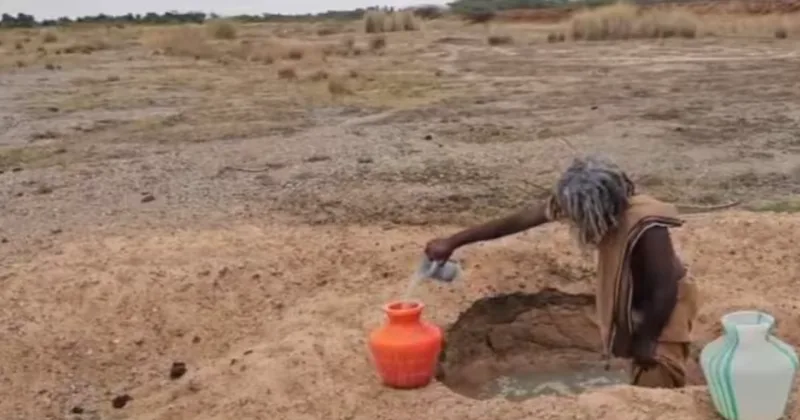
The quiet lanes of Naatakudi tell a story of steady decline. Once home to over 5,000 people, the village is now almost entirely deserted, with residents having abandoned their homes in search of safety, water, and basic amenities. According to BJP leader K. Annamalai, the last straw for the community came after a spate of murders that shook the village’s sense of security.
In a strongly worded statement on X Annamalai said: “Once home to over 5,000 people, the village of Naatakudi in Sivagangai district has now become a ghost village, with just one soul left behind. Thiru @mkstalin, while your attention remains fixated on matters far removed from the lives of ordinary Tamilians, this village is a glaring symbol of administrative apathy under your watch.”
திமுக ஆட்சியில் நீரின்றி அழியும் கிராமங்கள்..! pic.twitter.com/jYTXe3gGGx
— BJP Tamilnadu (@BJP4TamilNadu) August 6, 2025
He further criticised the state government for its failure to provide clean drinking water and pointed to the Central Government’s Jal Jeevan Mission, which has released Rs 4,835 crore to Tamil Nadu in the last four years. According to Annamalai, the Tamil Nadu government declared that Mathur Village Panchayat, which includes Naatakudi, had achieved 100 per cent tap water connections — a claim he described as “betrayal” in light of the village’s plight.
Once home to over 5,000 people, the village of Naatakudi in Sivagangai district has now become a ghost village, with just one soul left behind. Thiru @mkstalin, while your attention remains fixated on matters far removed from the lives of ordinary Tamilians, this village is a… pic.twitter.com/BapgGJyb6e
— K.Annamalai (@annamalai_k) August 5, 2025
Critics accuse the Stalin-led DMK government of prioritising self-promotion over genuine governance. They claim that instead of initiating new welfare projects, the administration has merely rebranded central schemes with the late M. Karunanidhi’s name, while accusing the Union government of withholding funds. Allegations of scams in various state-run schemes and selective appeasement policies that neglect the Hindu majority have also surfaced.
Political observers say Naatakudi’s fate is emblematic of a larger problem — the government’s failure to address rural distress, even as it announces populist schemes aimed at electoral gains.
Ghost Villages of Tamil Nadu
Naatakudi now joins the ranks of Tamil Nadu’s abandoned settlements — a list that includes Meenakshipuram and Dhanushkodi, both deserted under different circumstances.
Meenakshipuram: The ‘Voiceless Village’
In Thoothukudi district, Meenakshipuram became a ghost village earlier this year when 73-year-old Kandasamy Naicker, its last resident, passed away on May 24, 2024. Known as “pechilla gramangal” (voiceless village), Meenakshipuram was abandoned gradually due to erratic monsoons, droughts, and lack of drinking water. At its peak, the village had 1,296 residents according to the 2021 Census. Residents eventually lost hope after years of walking several kilometres for water and essential needs, leading to a slow but steady migration.
Dhanushkodi: A Town Lost to the Sea
Dhanushkodi, near Pamban Island in Ramanathapuram district, remains the most famous ghost town in Tamil Nadu. Once a thriving port and railway hub connecting India and Sri Lanka via the Indo-Ceylon Express (Boat Mail), Dhanushkodi was destroyed by a devastating cyclone on December 22, 1964. With wind speeds of 240 km/h and tidal waves 7 metres high, the cyclone wiped out the town’s infrastructure, including a railway station, church, hospital, and police station.
The disaster also claimed the lives of all 200 passengers aboard a train nearing Dhanushkodi station when it was washed away into the sea. The town has never been rebuilt, with only ruins remaining as a silent testimony to the tragedy.
Beyond its tragic history, Dhanushkodi holds cultural significance in the Ramayana as the site where Lord Rama is believed to have instructed Hanuman to build the bridge to Lanka. The name itself means “end of the bow.”
The reasons for the abandonment of villages in Tamil Nadu are varied — natural disasters, drought, lack of infrastructure, and in rare cases like Naatakudi, a combination of poor governance and breakdown of law and order.
In older times, mass migrations often occurred due to wars, invasions, or the lure of better livelihoods in more prosperous areas. Today, despite modern governance structures, the root causes often remain the same: inadequate access to water, electricity, healthcare, and roads.
Naatakudi’s story stands apart because it is not the result of a sudden natural disaster, but of years of administrative neglect. Critics argue that despite significant central funding under schemes like the Jal Jeevan Mission, rural development remains patchy due to poor implementation, corruption, and lack of political will.
The state government’s claims of 100 per cent tap water coverage ring hollow when entire communities abandon their homes over unfulfilled promises.