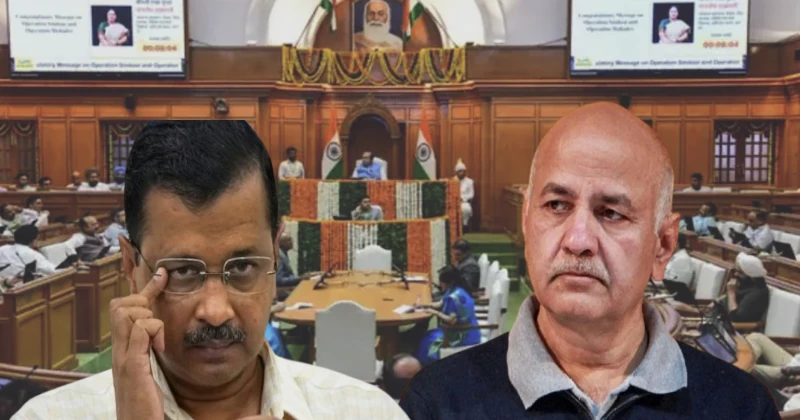
The Aam Aadmi Party’s (AAP) carefully scripted “patriotic” spectacle inside the Delhi Assembly has collapsed in spectacular fashion and now threatens to drag its top leadership into a parliamentary probe.
What was once celebrated as a rediscovered relic of India’s colonial past the so-called hanging house has been exposed as an elaborate work of fiction. Speaker Vijender Gupta has announced that former chief minister Arvind Kejriwal, ex-deputy CM Manish Sisodia, and other senior AAP leaders will be summoned before the Privileges Committee for allegedly misleading the public, misusing government funds, and manipulating history for political theatre.
Inaugurated on August 9, 2022, the anniversary of the Quit India Movement, the structure was unveiled with pomp and ceremony. Flanked by tricolours and drenched in patriotic symbolism, AAP leaders claimed the site was a British-era gallows where freedom fighters were executed. They even spun a dramatic story of an underground tunnel linking the Assembly to the Red Fort, supposedly used by colonial authorities to transport prisoners.
A plaque affixed to the structure carried the names of Kejriwal and Sisodia, immortalising them as the political patrons of this “historic rediscovery.” Crores of rupees in public money were poured into its renovation, beautification, and the publicity blitz that followed.
But behind the tricolour-draped ceremony, there was one glaring problem: none of it was true.
Speaker Gupta revealed during the Monsoon Session that the claims had been thoroughly investigated by some of the country’s most credible historical bodies — including the National Archives, the Indian Council of Historical Research (ICHR), the Indira Gandhi National Centre for the Arts (IGNCA), the MCD Heritage Cell, and prominent historians from Delhi University and JNU.
The verdict was unanimous:
- No evidence of any colonial-era gallows at the site.
- No trace of any tunnel between the Assembly and the Red Fort.
- No historical records or maps supporting AAP’s dramatic claims.
“This was a story scripted for drama, not fact,” Gupta said. “Like thousands of others, I too felt patriotic pride when it was unveiled. But today, I feel betrayed. It was all a lie.”
Gupta accused AAP of executing not just a construction project but a political con job weaponising India’s freedom struggle for electoral image-building. “Crores were spent on a structure falsely projected as a colonial-era gallows. Misleading advertisements were run. Not one document was produced to support the claim. This confirms it was a deliberate act of forgery,” Gupta told the House.
The Speaker has ordered the immediate removal of the commemorative plaque carrying AAP leaders’ names and directed that the Assembly’s heritage building be restored to its original 1912 design, with authentic historical maps displayed.
This scandal is more than a one-off embarrassment. Critics argue it fits into AAP’s long-running pattern of propaganda over governance — where taxpayer money is spent on image-building projects, emotional narratives, and publicity stunts rather than factual or policy-driven initiatives.
The Delhi Assembly building, a legitimate heritage site, was transformed into a stage prop in what now appears to be a taxpayer-funded exercise in political storytelling.
Who will face the heat
The Privileges Committee is expected to summon:
- Arvind Kejriwal, former CM
- Manish Sisodia, former Deputy CM
- Ram Niwas Goel, former Speaker
- Rakhi Birla, ex-Deputy Speaker
All four played visible roles in the 2022 inauguration and the public promotion of the “hanging house” story. AAP has dismissed the probe as “political vendetta” by the BJP-led Assembly leadership.
“Such unconstitutional and unprecedented moves will not survive judicial scrutiny,” the party said, accusing the Speaker of “setting a dangerous precedent” by summoning a former Speaker before the panel.
However, the factual findings from multiple national institutions leave AAP on thin ice. The party’s counterattack may resonate with its core supporters, but outside that circle, the revelation risks further eroding its credibility — especially after a string of corruption and mismanagement allegations in recent years.
This controversy strikes at the heart of public trust. By wrapping a fabricated story in the tricolour, AAP leaders stand accused of emotional exploitation turning history into a campaign prop, then spending crores of taxpayer money to sustain the illusion.
As Speaker Gupta put it, “This is not just about bricks and walls. This is about rewriting history for political spectacle. The country will not forgive such acts.” The Privileges Committee’s proceedings could now become a public trial of AAP’s ethics and a reminder that when leaders manufacture history, they risk becoming history themselves.