





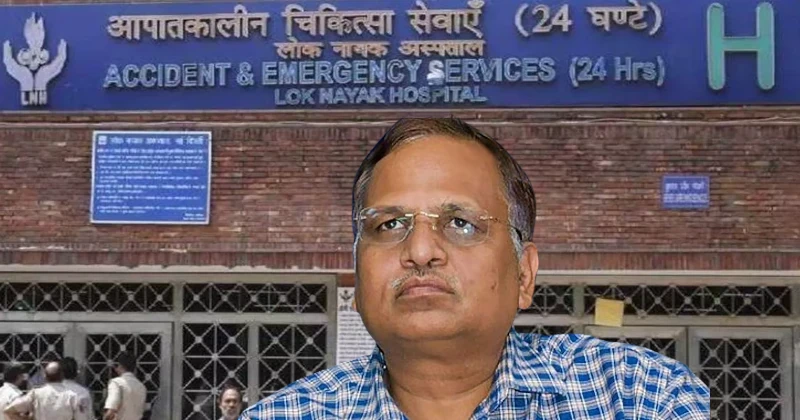
In one of the biggest public infrastructure scams under the Aam Aadmi Party (AAP) regime, the former Delhi Government’s own internal probe has unearthed shocking irregularities in the construction of a new block at LNJP Hospital, exposing a scam worth Rs 650 crore allegedly orchestrated under the direct supervision of then Health and PWD Minister Satyendar Jain.
The project cost shot up by 243 per cent from Rs 465 crore to an astronomical Rs 1,139 crore, raising serious questions about fiscal mismanagement, contractor collusion, and brazen violation of procurement norms. With findings pointing to deliberate procedural manipulation, favouritism in consultancy allotment, and mid-project design changes to benefit private players, the Delhi government has referred the matter to Lt. Governor VK Saxena, recommending a CBI or Anti-Corruption Branch (ACB) investigation.
This fresh revelation comes barely 24 hours after a CBI court discharged Satyendar Jain in another corruption case, a development the AAP had publicly celebrated. But now, the very government he served has admitted to grave anomalies and suspicious conduct under his watch.
At the centre of the scandal is the Lok Nayak Jai Prakash Narayan (LNJP) Hospital, one of Delhi’s largest public health institutions. The expansion project was initially cleared for Rs 465 crore, but under Jain’s tenure, the budget ballooned to Rs 1,139 crore an increase of Rs 674 crore, which the PWD Minister Parvesh Verma has termed “a scam in plain sight.”
“This was not a routine escalation. This was manipulation deliberate mid-course changes in design and scope, all engineered to help chosen contractors. The public has been looted in the name of healthcare,” said Verma.
Perhaps the most glaring violation flagged by the committee involves the award of architectural consultancy for 84,420 square metres without floating a tender. The contract, valued at Rs 5.27 crore, was handed out on a nomination basis, allegedly at the behest of Jain.
This was done despite the fact that six consultants were already empanelled and GFR (General Financial Rules) clearly stipulate competitive bidding even among empanelled entities.
“This is a textbook case of cartelisation and manipulation of process. Tendering was bypassed. Favouritism is evident. And all this happened under the nose of Satyendar Jain,” an official involved in the internal inquiry told this reporter. The report states that instead of floating financial bids for each project, the department arbitrarily divided Delhi into zones and assigned projects district-wise to “preferred consultants”, eliminating price competition altogether.
The committee constituted to investigate procedural lapses submitted a damning report, which clearly points fingers at systemic manipulation:
- Project cost inflated by 243 per cent without clear justification or proportional benefit.
- Consultants appointed without bidding, despite existing rules and empanelled pool.
- Design changes introduced during construction, causing scope creep and price escalation.
- Financial bids were not invited as required, in violation of the GFR and PWD norms.
- Decision-making centralised around the then minister, raising red flags about intent and transparency.
“This was not poor oversight. This was intentional. Every rule that protects taxpayer money was bent or broken,” the committee noted.
Following these revelations, PWD Minister Parvesh Verma said that the file has been sent to Lt. Governor Saxena, who will decide whether to involve the ACB or the CBI. Given the magnitude of financial irregularities and procedural sabotage, central investigation now appears imminent. “This cannot be brushed under the carpet. We are duty-bound to expose this betrayal of public trust,” Verma said.
In its response, the AAP did what it always does when faced with evidence: play the victim card. In a statement, the party said, “The BJP and its ministers are obsessed with the ACB, CBI, and ED. Every day, they hatch conspiracies against AAP leaders, waste time drafting baseless and frivolous cases.”
It went on to claim that the CBI court’s clean chit to Jain proves his innocence. But legal experts argue that closure of one case does not negate newer, well-documented evidence of financial misconduct. If anything, AAP’s defensive posturing further undermines public trust, as the Delhi government now finds itself attacking its own internal committee’s findings.
This is not the first time Jain has come under the scanner. From disproportionate assets to hawala-linked shell companies, Jain’s ministerial career has repeatedly been marked by controversy. But this time, it’s not just investigative agencies raising the alarm it’s the Delhi government itself.















Comments