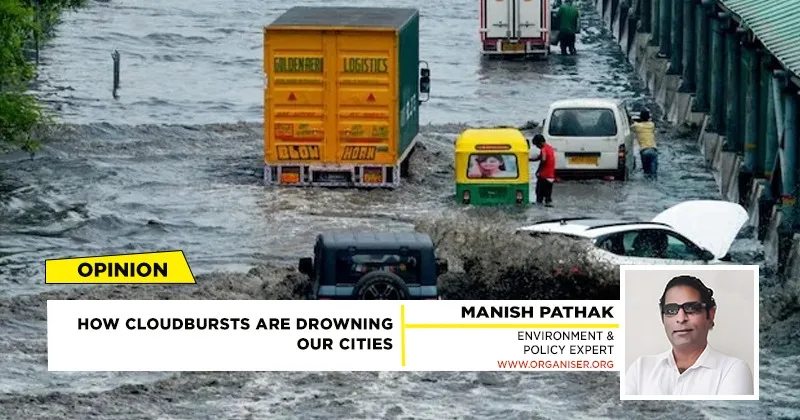
When the sky falls in buckets: At dawn on May 20, Bengaluru’s Outer Ring Road looked like an inland sea. Forty millimetres of rain—roughly a month’s quota—tumbled from the sky in under an hour. Tech-park staff were ferried to glass towers in inflatable boats; a young commuter, swept off his scooter, never made it home. A week later, a brand-new metro station in Mumbai turned into a waterfall. Delhi’s arterial roads became canals, Gurugram revived its dreaded #Gurujam, and even desert-hot Jaipur saw traffic lights flicker under waist-deep water.
These are not freak events. An IIT-Gandhinagar analysis of 10,000 incidents finds that short, intense cloudbursts now trigger three-quarters of India’s urban flash floods. Warmer air holds more moisture, so the monsoon no longer taps politely; it kicks the door down.
Drains built for another century
Most city drains still follow a British-era rule of thumb: design for a “25-year storm” of about 15 mm an hour. Bengaluru’s May squall dumped nearly triple that. Three chronic ailments finish the job:
• Plastic choke-points: In a single pre-monsoon sweep this year, Bengaluru crews hauled a hundred kilos of sanitary pads, wet wipes and e-commerce cartons from two short stretches of drain.
• Paved wetlands: Mumbai’s commercial district sits on reclaimed mangroves; Delhi’s metro piers straddle the Yamuna’s floodplain. Natural storage has been concreted out of existence.
• Shared pipes: In many towns, storm drains double as sewers, their gradients flattened by silt and faecal sludge that never had an exit.
Engineers have diagnosed these flaws for decades. The National Disaster Management Authority’s superb Urban Flood Management Guidelines appeared back in 2010—and remain largely unread outside training workshops.
A governance vacuum, not a cash crunch
It is fashionable to blame money, but budget lines exist. A decade of the AMRUT scheme has sanctioned more than Rs 2.7-lakh-crore worth of urban projects. Storm-water, however, competes with flashier water-supply and LED-streetlight packages, and only a fraction of approved drainage work is complete. Data, too, are abundant: Doppler radar blankets every metro; the Central Water Commission posts real-time river levels online. Yet few municipalities translate forecasts into ward-level action. Pimpri-Chinchwad, which this summer deployed a street-scale flood model on a public dashboard, proves that even a mid-tier city can build such muscle.
The real deficit is institutional. Drainage is nobody’s child—too engineering-heavy for environment departments, too invisible for transport planners, and straddling too many revenue boundaries to attract a political champion. Until a single agency owns the whole pipe, desilting will remain an annual photo-op.
Six fixes for a cloudburst age
1. Treat storm-water as a utility
Give drainage its own account book. Several American cities levy a tiny surcharge—often less than a rupee per square foot—on property tax to fund operation and maintenance. Indian ULBs could adopt the same model, ringing-fencing cash that now disappears into general works.
2. Map every inch of pipe
Many municipalities cannot tell you a drain’s diameter, depth or gradient. LiDAR scans and inexpensive CCTV crawlers can build a live asset register, flag hidden choke-points and guide targeted upgrades. Singapore updates its drainage master plan annually from such surveys; so can we.
3. Green the grey
A city cannot out-pipe climate change; it must absorb water where it falls. Retrofitting medians, schoolyards and bus depots as “sponge parks” and rain gardens slows runoff and filters pollutants. Chennai has already built 57 sponge parks and budgeted ₹88 crore for 30 more after pilot sites saw local water-logging drop sharply.
4. Restore the vanished water bodies
Reclaiming floodplains and scrubbing legacy dumps unlocks vast storage. Ahmedabad’s clean-up of the Pirana landfill freed 60 hectares and raised ₹200 crore through a municipal green bond backed by the land value—a template for other land-starved metros.
5. Hard-wire early warning into standard operating procedure
Forecasts belong on dashboards that talk to traffic lights, metro control rooms and ward WhatsApp groups. Pimpri-Chinchwad’s 72-hour, street-level alerts now trigger automatic road diversions and pump-house starts. If an industrial township can do this, megacities have no excuse.
6. Train a new cadre
India produces plenty of civil engineers but almost no urban hydrologists. A thousand fellowships—one for every million-plus city—would cost less than a single kilometre of flyover and build the talent pool needed for climate-savvy drainage.
Counting the cost—and the payoff
A city-wide sponge retrofit typically runs Rs 60–80 crore per 100 km², plus a few crore a year for upkeep. By contrast, one day of metro shutdown in Mumbai costs the economy roughly Rs 300 crore, while Bengaluru’s 2022 tech-campus floods wiped Rs 225 crore off two IT majors’ quarterly revenues. The payback period for robust drainage is measured in months, not years. Every litre of rain captured locally is a litre not pumped, treated or trucked later, saving both carbon and cash.
What Delhi can do in the next Budget
• Launch a ten-year, Rs 1-lakh-crore Blue-Green Cities Fund that rewards runoff reduction, not cement volume.
• Make climate-stress tests for building permits mandatory in flood-prone zones, akin to earthquake certificates.
• Cut the GST rate on permeable pavers and rain-garden membranes to mainstream sponge technology.
• Feed IMD forecasts directly into smart-city data centres so hydrologic warnings flip sluice gates and pump houses without waiting for human intervention.
The water will only come faster
Urban India loves big metaphors—digital stacks, startup unicorns, Viksit Bharat. Yet the humblest civic asset, the drain, will decide whether these dreams float or sink. The monsoon has changed character; it no longer trickles in, it barges through. A climate-ready city accepts that water will arrive faster than it can be pumped. Its resilience lies not in higher embankments but in creating room for water: parks that double as ponds, streets that briefly store runoff instead of sending it to someone else’s basement, and citizens who treat a chocolate wrapper tossed into a gutter as civic vandalism.
The science is clear, the economics compelling, and the pilots proven. All that remains is political plumbing—someone who wakes up every morning with the sole brief of keeping the pipes clear. Until that accountability flows, expect the next cloudburst to write its own headline—and perhaps rewrite the ground-floor blueprint of your home.