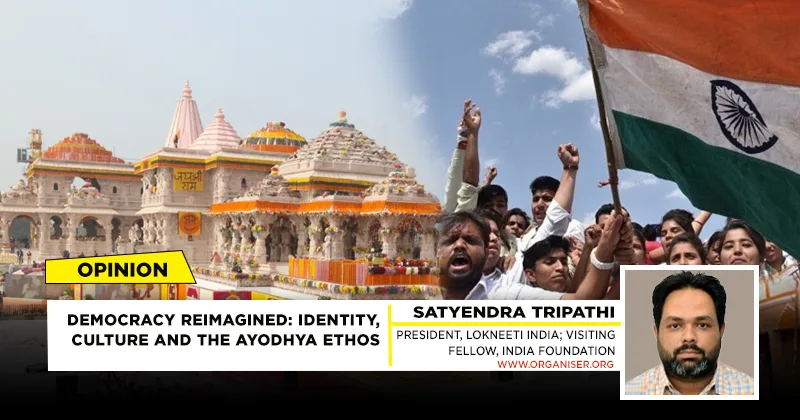
Democracy Reimagined: Identity, culture and the Ayodhya ethos
June 5, 2026
  • Read Ecopy
  • Circulation
  • Advertise
  • Careers
  • About Us
  • Contact Us
Android AppiPhone AppArattai
Organiser
  • ‌
  • Bharat
    • Assam
    • Bihar
    • Chhattisgarh
    • Jharkhand
    • Maharashtra
    • View All States
  • World
    • Asia
    • Europe
    • North America
    • South America
    • Africa
    • Australia
  • Editorial
  • International
  • Opinion
  • RSS @ 100
  • More
    • Op Sindoor
    • Analysis
    • Sports
    • Defence
    • Politics
    • Business
    • Economy
    • Culture
    • Special Report
    • Sci & Tech
    • Entertainment
    • G20
    • Azadi Ka Amrit Mahotsav
    • Vocal4Local
    • Web Stories
    • Education
    • Employment
    • Books
    • Interviews
    • Travel
    • Law
    • Health
    • Obituary
  • Subscribe
    • Subscribe Print Edition
    • Subscribe Ecopy
    • Read Ecopy
  • ‌
  • Bharat
    • Assam
    • Bihar
    • Chhattisgarh
    • Jharkhand
    • Maharashtra
    • View All States
  • World
    • Asia
    • Europe
    • North America
    • South America
    • Africa
    • Australia
  • Editorial
  • International
  • Opinion
  • RSS @ 100
  • More
    • Op Sindoor
    • Analysis
    • Sports
    • Defence
    • Politics
    • Business
    • Economy
    • Culture
    • Special Report
    • Sci & Tech
    • Entertainment
    • G20
    • Azadi Ka Amrit Mahotsav
    • Vocal4Local
    • Web Stories
    • Education
    • Employment
    • Books
    • Interviews
    • Travel
    • Law
    • Health
    • Obituary
  • Subscribe
    • Subscribe Print Edition
    • Subscribe Ecopy
    • Read Ecopy
Organiser
  • Home
  • Bharat
  • World
  • Operation Sindoor
  • Editorial
  • Analysis
  • Opinion
  • Culture
  • Defence
  • International Edition
  • RSS @ 100
  • Magazine
  • Read Ecopy
Home Bharat

Democracy Reimagined: Identity, culture and the Ayodhya ethos

As the century progresses, a new form of identity politics is emerging, driven by groups seeking adequate recognition for their diverse identities based on nation, religion, society, ethnicity, or gender

Satyendra TripathiSatyendra Tripathi
Jul 18, 2025, 08:00 pm IST
in Bharat, World, Opinion
Follow on Google News
FacebookTwitterWhatsAppTelegramEmail

It’s time of churning ideas across the spectrum of democracy, rights and social structuring. Sometimes in the last leg of the second decade of the 21st century, politics changed dramatically.

Democracies across the world had witnessed significant change classified as electoral democracies increased from 35 to more than 110 during the period of 1970’s to mid 2000s termed as ‘third wave’ by political thinker Samuel Huntington. Most newly adopted democracies followed liberal democracy, at least in aspiration if not in practice.

In parallel to this shift in the political system has brought globalisation. Eventually, this liberal world order did not benefit everyone. In many countries around the world, inequalities increased dramatically resulting in a huge new middle class that arose in democratic countries. This social momentum towards an increasingly open and liberal world order began to falter, then went into reverse. Ultimately it damaged the reputation of liberal democracy as a whole.

It was the ‘democratic recession’ which aggregated the number of democracies that fell from their peak in virtually all regions of the world as per Larry Diamond, democracy scholar. Meanwhile a number of self-confident and assertive countries are on rise as a new model of democracies and China & Russia showed the path to the rest. A number of countries who have been liberal democracies in the past are now moving towards nationalist politics. Eroding long-established cultural identities due to immigrants after Arab conflicts in 2011-2016 had led to a new political migration across the EU and even forced the US to rethink their society on model of development. Gains in anti- immigration and identity politics, rise of nationalist forces can be noticed in Germany, Austria, Hungary and many more.

Twentieth century politics has been organised along the left-right spectrum defined on economic issues, rights, equality and freedom. On another hand the other idea of politics was focused on the government, governance model. In the second decade, it has been taken by identity politics — economic equality, promoting the interest of marginalized groups — blacks, immigrants, women, LGBT and the like. While the central politics is redefining itself as nationalists based on values of traditional national, cultural identities.

The politics of resentment in this part of the century is taken by the nationalist. Political narrative of ‘Focusing on regaining identity, culture, self-reliance and building their own future’ has taken centre stage in many countries. India wasn’t untouchable to this global change phenomenon in politics. The rise of nationalist party Bharatiya Janata Party led by Narendra Modi was the same. Focusing on cultural identity, nation first and economic reforms, good governance promises bring this party into centre stage of Indian politics.

India had witnessed many socialist governments in its states. Based on rights politics, socialists had ruled the state for a long time, meanwhile the rise of economic disparity, social class division has raised political unrest into a large section. Social movements like Rashtriya Swayamsevak Sangh focused on cultural integration and the idea of oneness helped in social mobilization. The Patriotic national class has emerged as the central political class.

In the last leg of this century, another phenomenon will take the centre stage. It believes that it has the identity that is not being given adequate recognition — either by the state or by the members of the same society or by the political class. Those identities can be and are incredibly varied, based on nation, religion, society, ethnicity, or gender. The very manifestations of a common phenomenon will define new identity politics. Identity politics encompasses a large part of the political struggles of the contemporary world, from democratic revolution to new social movements, from nationalism to identity politics. Indeed, this struggle for recognition is the ultimate driver of human history, a force that will be the key to understanding the emergence of the modern world, as per the philosopher Hegel.

The imperative of democracy goes back to Bharat’s greater ethos in Vedas to Ayodhya. The very idea of Indian state as per Chankya is based on the Yogakshema – security and welfare of the people. In Ram Rajya, the state is a democratic-righteous rule, should strive to secure for its people ample wellbeing and security from internal and external threats. Ayodhya wasn’t only the place where Lord Rama take birth, Hindus god but it has significance in Bharat’s ethos in democracy. The very Ayodhya tatva leads this very idea of a welfare state. From Vansh to Ram, it has been exemplary for the idea of state with security, inclusivity, inquisitiveness, wellbeing.

With the volatile political spectrum across world, the very Ayodhya tatva can be drawn as greater idea for future of democracy. Full of exemplary group empowerment to societal equality to the renouncement of power when one in the most powerful system. Whole system is dharma to kartavya leads to governance model.

The new contemporary identity politics will be the cocktail of national-nationalist and an agenda for nation building within this very society who has been marginalized for their selfless social framework.

Topics: DemocracyPM Narendra Modibhagwan ramAyodhya Ram MandirRSS
ShareTweetSendShareSend
✮ Subscribe Organiser YouTube Channel. ✮
✮ Join Organiser's WhatsApp channel for Nationalist views beyond the news. ✮
Previous News

Tamil Nadu: IIT Madras develops & launches Bharat’s lightest active wheelchair

Next News

Recalibrating the Past: Applauding NCERT’s historiographical course correction on Mughal Realpolitik

Related News

Padma Bhushan awardee and noted industrialist Kumar Mangalam Birla Kumar Mangalam Birla addressing the Samapana Samaroh (Valedictory Function) of the Rashtriya Swayamsevak Sangh Karyakarta Vikas Varg – Dwitiya at Nagpur, on June 4, 2026

“RSS always stood by the society and nation”, Kumar Mangalam Birla at RSS Karyakarta Vikas Varg 2 in Nagpur

Fire-fighting officials at the site of the restaurant in Delhi Malviya Nagar

Fire at Delhi restaurant in Malviya Nagar claims 21 lives, 40 rescued; PM Modi expresses grief, announces relief

Madras High Court quashes case against RSS swayamsevaks linked to centenary celebrations in Ambur on Vijayadashami 2025

Veteran actress, dancer and Padma Shri awardee Mamata Shankar has openly expressed her admiration for the Rashtriya Swayamsevak Sangh (RSS), stating that she strongly supports its ideals, discipline and efforts to preserve India's cultural heritage

Exclusive: BJP and RSS will preserve our culture; I support their ideals and work — Mamata Shankar

VHP International President Alok Kumar

No place for Jihadi extremism in the modern world; ideological supporters must also be held accountable: Alok Kumar Ji

J. Nandakumar addresses the Citizens programme

Hindutva is Bharat’s identity and intellectual foundation, Says J Nandakumar

Load More

Latest News

India seals robust 7.7% GDP Growth in FY26: Reflects economic resilience amid West Asia crisis & other global headwinds

A representative image

After TCS, Corporate Jihad allegations reach SBI: Married Hindu employee conversion claims trigger FIR in Mumbai

MEA spokesperson Randhir Jaiswal highlights India's resolve to deport illegal Bangladeshi migrants via bilateral mechanisms

India reiterates strong resolve to deport illegal Bangladeshis; Flags delay of bilateral procedures from Dhaka

Kerala HC rejects CMRL appeal, clears way for ED probe against Pinarayi Vijayan’s daughter in money laundering case

Uttar Pradesh leads in Bharat's green transformation

World Environment Day 2026: On his birthday, Yogi Adityanath’s green vision powers Uttar Pradesh’s transformation

As Khalistani networks seek new platforms beyond the West, Azerbaijan has emerged as a key venue for conferences, campaigns and narratives aligned with the Pakistan-Turkey axis against India.

Khalistan’s New Grazing Ground: Azerbaijan emerges as new hub for Turkey-Pakistan backed anti-India networks

Kochi IPL Mystery: Why Did Sunanda Pushkar Surrender Stake Amid Benami Claims Tied to Shashi Tharoor, Sonia Gandhi?

Kochi IPL Mystery: Why Did Sunanda Pushkar Surrender Stake Amid Benami Claims Tied to Shashi Tharoor, Sonia Gandhi?

BAPS Hindu Mandir Abu Dhabi wins “Tolerance Award 2026” for promoting peace, universal harmony and mutual respect

Former CPM leader PP Divya - Late Naveen Babu, ADM. (Left to Right)

Kannur ADM Naveen Babu’s death case: Keralam Cabinet approves CBI enquiry

(Left) Ramalinga Reddy (Right) KH Muniyappa

Karnataka: Ramalinga Reddy resigns, Muniyappa voices displeasure; Congress rebellion grows over portfolio allocation

Load More
  • Privacy
  • Terms
  • Cookie Policy
  • Refund and Cancellation
  • Delivery and Shipping

© Bharat Prakashan (Delhi) Limited.
Tech-enabled by Ananthapuri Technologies

  • Home
  • Search Organiser
  • Bharat
    • Assam
    • Bihar
    • Chhattisgarh
    • Jharkhand
    • Maharashtra
    • View All States
  • World
    • Asia
    • Africa
    • North America
    • South America
    • Europe
    • Australia
  • Editorial
  • Operation Sindoor
  • Opinion
  • Analysis
  • Defence
  • Culture
  • Sports
  • Business
  • RSS @ 100
  • Entertainment
  • More ..
    • Sci & Tech
    • Vocal4Local
    • Special Report
    • Education
    • Employment
    • Books
    • Interviews
    • Travel
    • Health
    • Politics
    • Law
    • Economy
    • Obituary
  • Subscribe Magazine
  • Read Ecopy
  • Advertise
  • Circulation
  • Careers
  • About Us
  • Contact Us
  • Policies & Terms
    • Privacy Policy
    • Cookie Policy
    • Refund and Cancellation
    • Terms of Use

© Bharat Prakashan (Delhi) Limited.
Tech-enabled by Ananthapuri Technologies