Democracy Reimagined: Identity, culture and the Ayodhya ethos
June 25, 2026
  • Read Ecopy
  • Circulation
  • Advertise
  • Careers
  • About Us
  • Contact Us
Android AppiPhone AppArattai
Organiser
  • ‌
  • Bharat
    • Assam
    • Bihar
    • Chhattisgarh
    • Jharkhand
    • Maharashtra
    • View All States
  • World
    • Asia
    • Europe
    • North America
    • South America
    • Africa
    • Australia
  • Editorial
  • International
  • Opinion
  • RSS @ 100
  • More
    • Op Sindoor
    • Analysis
    • Sports
    • Defence
    • Politics
    • Business
    • Economy
    • Culture
    • Special Report
    • Sci & Tech
    • Entertainment
    • G20
    • Azadi Ka Amrit Mahotsav
    • Vocal4Local
    • Web Stories
    • Education
    • Employment
    • Books
    • Interviews
    • Travel
    • Law
    • Health
    • Obituary
  • Subscribe
    • Subscribe Print Edition
    • Subscribe Ecopy
    • Read Ecopy
  • ‌
  • Bharat
    • Assam
    • Bihar
    • Chhattisgarh
    • Jharkhand
    • Maharashtra
    • View All States
  • World
    • Asia
    • Europe
    • North America
    • South America
    • Africa
    • Australia
  • Editorial
  • International
  • Opinion
  • RSS @ 100
  • More
    • Op Sindoor
    • Analysis
    • Sports
    • Defence
    • Politics
    • Business
    • Economy
    • Culture
    • Special Report
    • Sci & Tech
    • Entertainment
    • G20
    • Azadi Ka Amrit Mahotsav
    • Vocal4Local
    • Web Stories
    • Education
    • Employment
    • Books
    • Interviews
    • Travel
    • Law
    • Health
    • Obituary
  • Subscribe
    • Subscribe Print Edition
    • Subscribe Ecopy
    • Read Ecopy
Organiser
  • Home
  • Bharat
  • World
  • Operation Sindoor
  • Editorial
  • Analysis
  • Opinion
  • Culture
  • Defence
  • International Edition
  • RSS @ 100
  • Magazine
  • Read Ecopy
Home Bharat

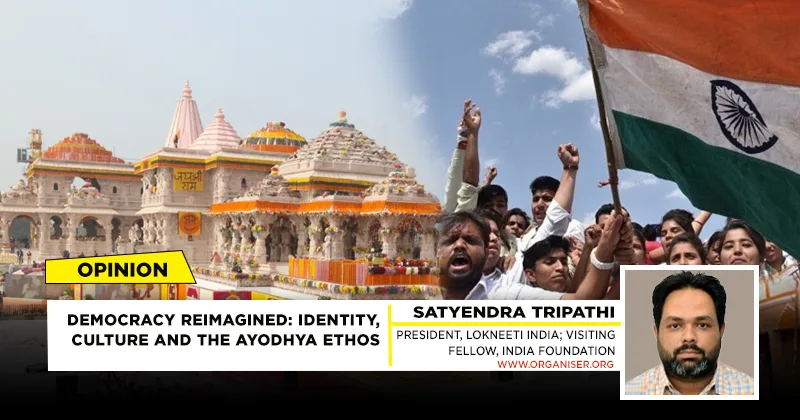
Democracy Reimagined: Identity, culture and the Ayodhya ethos

As the century progresses, a new form of identity politics is emerging, driven by groups seeking adequate recognition for their diverse identities based on nation, religion, society, ethnicity, or gender

Satyendra TripathiSatyendra Tripathi
Jul 18, 2025, 08:00 pm IST
in Bharat, World, Opinion
Follow on Google News
FacebookTwitterWhatsAppTelegramEmail

It’s time of churning ideas across the spectrum of democracy, rights and social structuring. Sometimes in the last leg of the second decade of the 21st century, politics changed dramatically.

Democracies across the world had witnessed significant change classified as electoral democracies increased from 35 to more than 110 during the period of 1970’s to mid 2000s termed as ‘third wave’ by political thinker Samuel Huntington. Most newly adopted democracies followed liberal democracy, at least in aspiration if not in practice.

In parallel to this shift in the political system has brought globalisation. Eventually, this liberal world order did not benefit everyone. In many countries around the world, inequalities increased dramatically resulting in a huge new middle class that arose in democratic countries. This social momentum towards an increasingly open and liberal world order began to falter, then went into reverse. Ultimately it damaged the reputation of liberal democracy as a whole.

It was the ‘democratic recession’ which aggregated the number of democracies that fell from their peak in virtually all regions of the world as per Larry Diamond, democracy scholar. Meanwhile a number of self-confident and assertive countries are on rise as a new model of democracies and China & Russia showed the path to the rest. A number of countries who have been liberal democracies in the past are now moving towards nationalist politics. Eroding long-established cultural identities due to immigrants after Arab conflicts in 2011-2016 had led to a new political migration across the EU and even forced the US to rethink their society on model of development. Gains in anti- immigration and identity politics, rise of nationalist forces can be noticed in Germany, Austria, Hungary and many more.

Twentieth century politics has been organised along the left-right spectrum defined on economic issues, rights, equality and freedom. On another hand the other idea of politics was focused on the government, governance model. In the second decade, it has been taken by identity politics — economic equality, promoting the interest of marginalized groups — blacks, immigrants, women, LGBT and the like. While the central politics is redefining itself as nationalists based on values of traditional national, cultural identities.

The politics of resentment in this part of the century is taken by the nationalist. Political narrative of ‘Focusing on regaining identity, culture, self-reliance and building their own future’ has taken centre stage in many countries. India wasn’t untouchable to this global change phenomenon in politics. The rise of nationalist party Bharatiya Janata Party led by Narendra Modi was the same. Focusing on cultural identity, nation first and economic reforms, good governance promises bring this party into centre stage of Indian politics.

India had witnessed many socialist governments in its states. Based on rights politics, socialists had ruled the state for a long time, meanwhile the rise of economic disparity, social class division has raised political unrest into a large section. Social movements like Rashtriya Swayamsevak Sangh focused on cultural integration and the idea of oneness helped in social mobilization. The Patriotic national class has emerged as the central political class.

In the last leg of this century, another phenomenon will take the centre stage. It believes that it has the identity that is not being given adequate recognition — either by the state or by the members of the same society or by the political class. Those identities can be and are incredibly varied, based on nation, religion, society, ethnicity, or gender. The very manifestations of a common phenomenon will define new identity politics. Identity politics encompasses a large part of the political struggles of the contemporary world, from democratic revolution to new social movements, from nationalism to identity politics. Indeed, this struggle for recognition is the ultimate driver of human history, a force that will be the key to understanding the emergence of the modern world, as per the philosopher Hegel.

The imperative of democracy goes back to Bharat’s greater ethos in Vedas to Ayodhya. The very idea of Indian state as per Chankya is based on the Yogakshema – security and welfare of the people. In Ram Rajya, the state is a democratic-righteous rule, should strive to secure for its people ample wellbeing and security from internal and external threats. Ayodhya wasn’t only the place where Lord Rama take birth, Hindus god but it has significance in Bharat’s ethos in democracy. The very Ayodhya tatva leads this very idea of a welfare state. From Vansh to Ram, it has been exemplary for the idea of state with security, inclusivity, inquisitiveness, wellbeing.

With the volatile political spectrum across world, the very Ayodhya tatva can be drawn as greater idea for future of democracy. Full of exemplary group empowerment to societal equality to the renouncement of power when one in the most powerful system. Whole system is dharma to kartavya leads to governance model.

The new contemporary identity politics will be the cocktail of national-nationalist and an agenda for nation building within this very society who has been marginalized for their selfless social framework.

Topics: Ayodhya Ram MandirRSSDemocracyPM Narendra Modibhagwan ram
ShareTweetSendShareSend
✮ Subscribe Organiser YouTube Channel. ✮
✮ Join Organiser's WhatsApp channel for Nationalist views beyond the news. ✮
Previous News

Tamil Nadu: IIT Madras develops & launches Bharat’s lightest active wheelchair

Next News

Recalibrating the Past: Applauding NCERT’s historiographical course correction on Mughal Realpolitik

Related News

RSS struggle to defend the Constitution during the Emergency

Samvidhan Hatya Diwas: Revisiting RSS’s role in defending India’s Constitution & democratic freedoms during 1975-77

Sunil Ambekar (Akhil Bharatiya Prachar Pramukh Rashtriya Swayamsevak Sangh addressing the gathering in Patna

The Emergency taught us that a vigilant society is essential to protect democracy: Sunil Ambekar ji

Nagpur | Acceptance of Bharatiya civilisational values is steadily increasing worldwide: Shanta Kumari

Suhail arrested for plotting terror attack on Ayodhya Ram Mandir

Karnataka: Terror plot targeting Ayodhya Ram Mandir unearthed after arrest of suspected terrorist Suhail

(Left) Petrol bomb hurled at BJP leader’s clinic opposite newly inaugurated RSS office in Bhatinda (Right) BJP leader Dr Tarsem Garg

Punjab: Petrol bomb hurled at BJP leader’s clinic opposite newly inaugurated RSS office in Bhatinda

Functionaries of Akhil Bharatiya Rashtriya Seva Bharati on the stage release Rashtriya Seva Sadhana–2026

Tamil Nadu: Seva Bharati reviews service initiatives, charts roadmap for future expansion

Load More

Latest News

Moshiur Khan alias Aman Khan ( Image Courtesy- Janam TV Keralam

Keralam: Another Bangladeshi national arrested from Islamic madrasa in Kollam with forged Indian documents

For 40 years, Bastar’s “Badi Didi” Dr. Budhri Tati walked across 570 villages to educate tribal girls and transform lives

Bastar’s ‘Badi Didi’: Inspiring story of Padma Shri Dr Budhri, who walked across 570 villages to educate tribal girls

The landmark India-UK FTA balances greater market access with domestic industry interests while opening new export opportunities for India's rapidly growing electric vehicle sector

India-UK FTA: How the trade deal opens new global markets for Made-in-India EVs

US Congressman Sanford Bishop(File Photo)

US: “We must stand against Hinduphobia”; Congressman Sanford Bishop hails Georgia’s anti-Hindu hate resolution

Tamil Nadu Higher Education Minister P. Viswanathan (Black T Shirt)

Tamil Nadu: TVK minister faces POCSO complaint over alleged inappropriate conduct with girl athletes in viral videos

Emergency Anniversary: Jaishankar says 1975 tested India's Democracy

Samvidhan Hatya Diwas: EAM Jaishankar recalls 1975 Emergency, lauds those who stood up for constitutional values

Ghar Wapsi in Khandwa: Azad Pathan after embracing Sanatan Dharma at Mahadevgarh temple becomes Ajay Kashyap

RSS struggle to defend the Constitution during the Emergency

Samvidhan Hatya Diwas: Revisiting RSS’s role in defending India’s Constitution & democratic freedoms during 1975-77

Fresh plea in Odisha High Court seeks CBI probe into Swami Laxmanananda murder case amid missing Naidu Commission report

Swami Laxmanananda Murder Case: Fresh plea in Odisha HC cites missing Naidu Commission report, seeks CBI inquiry

For the first time, NCERT adds Emergency to class 9 curriculum, highlights suspension of rights and democratic struggles

NCERT includes Emergency chapter in class 9 textbook, describes 1975-77 period as a major challenge to Indian democracy

Load More
  • Privacy
  • Terms
  • Cookie Policy
  • Refund and Cancellation
  • Delivery and Shipping

© Bharat Prakashan (Delhi) Limited.
Tech-enabled by Ananthapuri Technologies

  • Home
  • Search Organiser
  • Bharat
    • Assam
    • Bihar
    • Chhattisgarh
    • Jharkhand
    • Maharashtra
    • View All States
  • World
    • Asia
    • Africa
    • North America
    • South America
    • Europe
    • Australia
  • Editorial
  • Operation Sindoor
  • Opinion
  • Analysis
  • Defence
  • Culture
  • Sports
  • Business
  • RSS @ 100
  • Entertainment
  • More ..
    • Sci & Tech
    • Vocal4Local
    • Special Report
    • Education
    • Employment
    • Books
    • Interviews
    • Travel
    • Health
    • Politics
    • Law
    • Economy
    • Obituary
  • Subscribe Magazine
  • Read Ecopy
  • Advertise
  • Circulation
  • Careers
  • About Us
  • Contact Us
  • Policies & Terms
    • Privacy Policy
    • Cookie Policy
    • Refund and Cancellation
    • Terms of Use

© Bharat Prakashan (Delhi) Limited.
Tech-enabled by Ananthapuri Technologies