Uttarakhand urges NCERT to add Gita, Ramayana to curriculum
October 11, 2026
  • Read Ecopy
  • Circulation
  • Advertise
  • Careers
  • About Us
  • Contact Us
Android AppiPhone AppArattai
Organiser
  • ‌
  • Bharat
    • Assam
    • Bihar
    • Chhattisgarh
    • Jharkhand
    • Maharashtra
    • View All States
  • World
    • Asia
    • Europe
    • North America
    • South America
    • Africa
    • Australia
  • Editorial
  • International
  • Opinion
  • RSS @ 100
  • More
    • World Hindu Congress 2026
    • Op Sindoor
    • Analysis
    • Sports
    • Defence
    • Politics
    • Business
    • Economy
    • Culture
    • Special Report
    • Sci & Tech
    • Entertainment
    • G20
    • Azadi Ka Amrit Mahotsav
    • Vocal4Local
    • Web Stories
    • Education
    • Employment
    • Books
    • Interviews
    • Travel
    • Law
    • Health
    • Obituary
  • Subscribe
    • Subscribe Print Edition
    • Subscribe Ecopy
    • Read Ecopy
  • ‌
  • Bharat
    • Assam
    • Bihar
    • Chhattisgarh
    • Jharkhand
    • Maharashtra
    • View All States
  • World
    • Asia
    • Europe
    • North America
    • South America
    • Africa
    • Australia
  • Editorial
  • International
  • Opinion
  • RSS @ 100
  • More
    • World Hindu Congress 2026
    • Op Sindoor
    • Analysis
    • Sports
    • Defence
    • Politics
    • Business
    • Economy
    • Culture
    • Special Report
    • Sci & Tech
    • Entertainment
    • G20
    • Azadi Ka Amrit Mahotsav
    • Vocal4Local
    • Web Stories
    • Education
    • Employment
    • Books
    • Interviews
    • Travel
    • Law
    • Health
    • Obituary
  • Subscribe
    • Subscribe Print Edition
    • Subscribe Ecopy
    • Read Ecopy
Organiser
  • Home
  • Bharat
  • World
  • Operation Sindoor
  • Editorial
  • Analysis
  • Opinion
  • Culture
  • Defence
  • International Edition
  • RSS @ 100
  • Magazine
  • Read Ecopy
Home Bharat

Uttarakhand urges NCERT to introduce Bhagavad Gita & Ramayana; Initiative aims to strengthen civilizational roots

In a significant move to correct decades of ideological imbalance in Indian education, Uttarakhand’s Education Minister Dhan Singh Rawat announced that the state has urged NCERT to include the Bhagavad Gita and Ramayana in the curriculum of 17,000 government schools

WEBDESKWEBDESK
Jul 17, 2025, 12:30 pm IST
inBharat, Education, Uttarakhand
Follow on Google News
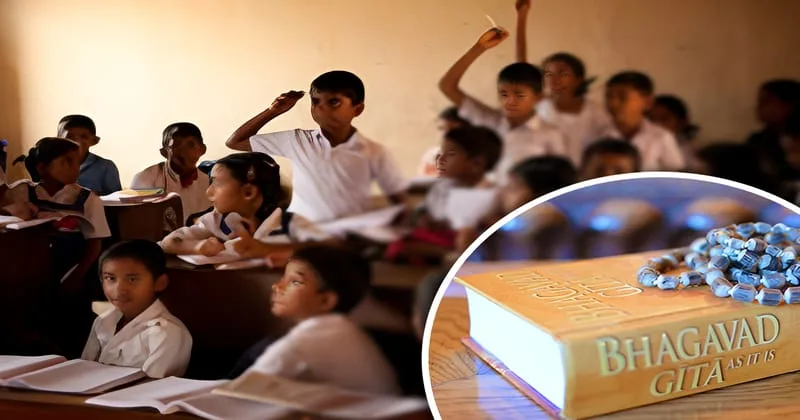
Representative image

Representative image

Facebook
Twitter
WhatsAppTelegramEmail

In a significant move seen as part of a broader effort to correct decades of ideological imbalance in Indian education, Uttarakhand’s Education Minister Dhan Singh Rawat announced on July 16 that the state has urged NCERT to include the Bhagavad Gita and Ramayana in the academic syllabus of 17,000 government schools.

“In a recent meeting with the Chief Minister, the Education Department directed NCERT to incorporate the Bhagavad Gita and Ramayana into the school syllabus,” Rawat told ANI. He added that until the updated curriculum is introduced, students would recite selected verses from these sacred texts during daily prayers.

Also Read: CATS warrior UCAV nears takeoff: India set to test indigenous combat drone in 2026

This push reflects a growing national trend to reclaim India’s civilisational narrative in the classroom — a story often sidelined or reduced in past decades due to ideological slants that favoured Eurocentric and Marxist historiographies. The left-leaning academic establishment has long been accused of portraying India’s cultural and spiritual traditions as regressive or irrelevant, while downplaying indigenous achievements in science, philosophy, and governance.

Now, under the NEP 2020, a conscious effort is underway to reshape educational content — bringing history closer to heritage, and promoting a balanced understanding of India’s cultural roots alongside its scientific progress.

On July 15, NCERT released a new textbook titled Veena, which is emblematic of this new direction. The book blends tradition with modernity and is designed to foster cultural pride while nurturing scientific inquiry. One chapter, Ganga ki Kahani, follows the river’s journey from Gomukh to Gangasagar, weaving together geography, spirituality, and economy. It celebrates the spiritual heritage of cities like Varanasi and Prayagraj, while also highlighting ecological and economic aspects — an approach previously uncommon in mainstream textbooks. Another chapter introduces middle schoolers to Artificial Intelligence (AI), demystifying how machines think and solve problems, promoting scientific thinking from a young age.

The book also delves into India’s space ambitions through a chapter on Gaganyaan, spotlighting ISRO’s human spaceflight mission and the humanoid robot Vyommitra, effectively linking modern innovation with national pride.

Importantly, Veena doesn’t shy away from teaching moral and civic values. Nyay Ki Kursi uses the legacy of just rulers like Raja Bhoj and Vikramaditya to teach fairness, while Haathi aur Cheenti uses animal allegory to promote road safety awareness, blending storytelling with life lessons.

Other chapters spotlight icons and places often ignored in previous syllabi, such as Paralympic gold medalist Murlikant Petkar, the Ajanta and Ellora caves, Kaziranga National Park, and traditional methods of natural dye-making.

This cultural recalibration, as seen in both the Uttarakhand initiative and the release of Veena, marks a decisive turn away from the erasure or dilution of India’s heritage in education. It signals a growing consensus that for students to truly understand modern India, they must first engage with its past, not just through colonial or ideological filters, but through its own epics, thinkers, and innovations.

The National Council of Educational Research and Training has introduced major revisions in the Class 8 History textbook, further aligning with efforts to present a more balanced and fact-based view of India’s past.
In a landmark shift, the revised edition explicitly calls Babur a “brutal invader” and redefines Akbar as “a blend of brutality and tolerance.” Aurangzeb is now described as a “temple destroyer” who ruled with severity and religious intolerance. These changes bring long-overdue clarity to the portrayal of medieval rulers, countering decades of whitewashing in history education. The chapter once titled in neutral terms now appears under the heading “Dark Ages,” reflecting the true nature of those turbulent times. Earlier versions often softened the impact of foreign invasions, forced conversions, and violence under ideological pretexts.
This move is part of NCERT’s broader initiative to remove Eurocentric and Marxist biases from textbooks.
The aim is to present Indian history with greater honesty, acknowledging both achievements and suffering without distortion.
Topics: NEP 2020Indian EducationVeena TextbookSchool CurriculumUttarakhandNCERTRamayanaBhagavad Gita
Share
Tweet
SendShareSend
✮ Subscribe Organiser YouTube Channel. ✮
✮ Join Organiser's WhatsApp channel for Nationalist views beyond the news. ✮
Previous News

Kerala Welcomes Ramayana Masam: A month of devotion, reflection, and Mandir traditions

Next News

Delhi to Goa IndiGo flight diverted to Mumbai following engine trouble midway through journey

Related News

A rare 130-year-old Bhagavad Gita measuring just 4 × 4.4 cm yet containing around 350 printed pages has been found in Tikamgarh

Matchbox-sized Bhagavad Gita with 350 pages: Rare 130-year-old copy found in Tikamgarh leaves experts intrigued

The new NCERT Class 9 Social Science textbook explores India’s traditions of governance through references to the Sengol, Gandhi’s Ram Rajya and the Mahabharata

NCERT’s new Class 9 Social Science textbook connects Sengol, Ram Rajya and Mahabharata to good governance

NCERT to launch Online Diploma Course in Teaching of Science at Middle Stage

NCERT online diploma course in teaching of science at middle stage: Registration from October 12; Check details here

On dias, from left: Alok Kumar, International President, Vishwa Hindu Parishad, Mahesh Bhagchandka, Converner, Ashok Singhal Foundation, Amit Shah, Union Home Minister, Dattatreya Hosabale, Sarkaryavah, Rashtriya Swayamsevak Sangh and Swami Paramanand Giri JI Maharaj

Ashok ji Singhal: Social bridge-builder through Sri Ram

SNBP School, Pune, organises ‘Swaryagya Mahotsav’ to connect students with Bharatiya classical music and cultural roots

Representative Image (This image is generated by AI)

25 Years of Seva: How Modi Government is building a new education system for Bharat

Load More

Latest News

AI-generated Image

Energy superpower move! Bharat plans massive 3,000-km power grid to Singapore via Myanmar, Thailand and Malaysia

Forced Religious Conversion to Christianity Drives Man to Suicide: Wife & In-Laws Jailed (This image is generated by AI)

Chhattisgarh: Forced religious conversion to Christianity in Dhamtari drives man to suicide: Wife & in-laws jailed

Visitors gather at Istanbul’s Japanese anime festival as clashes erupt amid protests by Islamists demanding the cancellation of the cultural event.

Turkey: Muslims storm Japanese Anime festival in Istanbul, assault families, damage Stalls and chanting ‘Allahu Akbar’

Houses, shops, police station set on fire in Manipur

Manipur: At least 7 civilians killed in last 24 hours as Kuki-Naga violence spreads

Questions over voter eligibility, software failures and the handling of disputed registration records fuel a growing political battle over transparency and accountability in New Jersey’s electoral system.

US election safeguards under fire as New Jersey’s voter registration errors trigger daily audits ahead of midterm

Representative Image

Navratri 2026: Reverence, resistance and protection 

Delhi Police issues Traffic Advisory

CJP Protest Threat 2.0: Delhi Police issues traffic advisory; 30 key routes under watch amid law-and-order concerns

Bangla Sahib Controversy: HS Phoolka Alleges Plot Behind Protesters Using Holy Gurdwara

1984 anti-sikh riot lawyer HS Phoolka alleges conspiracy behind protesters’ entry into Bangla Sahib

Delhi Police Slams 'Malicious' Video of Cops Wearing Shoes Near Gurdwara Bangla Sahib

Delhi Police to take legal action over ‘malicious’ video showing cops wearing shoes inside Gurdwara Bangla Sahib

IEDs, AK Rifles Recovered in Sopore

J&K: Massive arms recovery in Sopore; Police bust terror hideout in Bomai, seize IEDs and AK rifles

Load More
  • Privacy
  • Terms
  • Cookie Policy
  • Refund and Cancellation
  • Delivery and Shipping

© Bharat Prakashan (Delhi) Limited.
Tech-enabled by Ananthapuri Technologies

  • Home
  • Search Organiser
  • Bharat
    • Assam
    • Bihar
    • Chhattisgarh
    • Jharkhand
    • Maharashtra
    • View All States
  • World
    • Asia
    • Africa
    • North America
    • South America
    • Europe
    • Australia
  • Editorial
  • Operation Sindoor
  • Opinion
  • Analysis
  • Defence
  • Culture
  • Sports
  • Business
  • RSS @ 100
  • Entertainment
  • More ..
    • Sci & Tech
    • Vocal4Local
    • Special Report
    • Education
    • Employment
    • Books
    • Interviews
    • Travel
    • Health
    • Politics
    • Law
    • Economy
    • Obituary
  • Subscribe Magazine
  • Read Ecopy
  • Advertise
  • Circulation
  • Careers
  • About Us
  • Contact Us
  • Policies & Terms
    • Privacy Policy
    • Cookie Policy
    • Refund and Cancellation
    • Terms of Use

© Bharat Prakashan (Delhi) Limited.
Tech-enabled by Ananthapuri Technologies