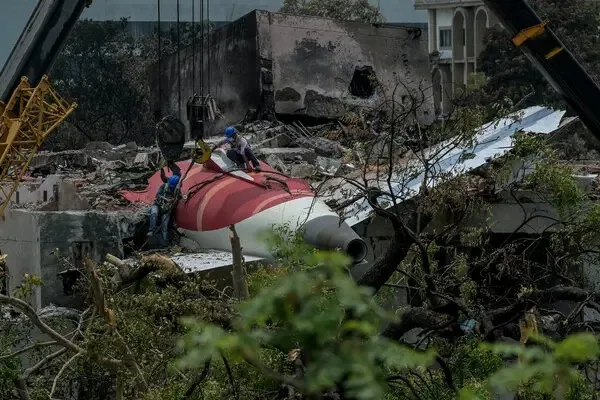
One month after the catastrophic crash of Air India Flight AI171, a Boeing 787-8 Dreamliner (registration VT-ANB) in Ahmedabad, which resulted in the deaths of at least 270 people, India’s Aircraft Accident Investigation Bureau (AAIB) has released a detailed preliminary report. The 15-page document offers the first substantial clues into what may have caused one of the deadliest aviation disasters in India’s history. With investigators meticulously analysing cockpit voice recordings, flight data, and wreckage patterns, the report raises critical questions about the sequence of events that led to the tragedy and highlights a mysterious dual-engine failure that baffled the experienced flight crew.
The Fatal Flight: A Timeline of Tragedy
On June 12, 2025, Air India Flight AI171 departed from Ahmedabad’s Sardar Vallabhbhai Patel International Airport at 13:39 IST, en route to London Gatwick Airport. The flight carried 242 passengers and crew members, including nationals from India, the United Kingdom, Portugal, and Canada. The Boeing 787-8 Dreamliner, a modern wide-body jet known for its advanced technology, was expected to complete a routine international journey.
However, just 32 seconds after becoming airborne, the aircraft suffered a catastrophic failure, losing power to both engines and crashing into the hostel complex of BJ Medical College, less than a mile from the runway.
The impact was devastating. The crash killed nearly all 242 individuals onboard and an additional 30 people on the ground, including residents and students in the densely populated area. Only one passenger survived, albeit with severe injuries. The wreckage was spread across a 1000 ft by 400 ft area, with fires consuming much of the debris, complicating rescue efforts and leaving a scene of unimaginable destruction.
A Mysterious Engine Shutdown
The AAIB’s preliminary report identifies a critical anomaly: both of the aircraft’s General Electric GEnx-1B engines experienced an abrupt fuel cutoff within seconds of each other, just moments after takeoff. The Cockpit Voice Recorder (CVR) captured a chilling exchange between the pilots. One pilot asked, “Why did you cut off?” to which the other responded with confusion, denying any intentional action. This exchange suggests that the crew was unaware of any deliberate action that could have caused the engines to stop.
Further analysis of the Enhanced Airborne Flight Recorder (EAFR) revealed that the fuel control switches, which regulate the flow of fuel to the engines, had been moved from the “RUN” to the “CUTOFF” position. This action effectively starved the engines of fuel, causing them to shut down. The report notes that the crew immediately attempted to recover by switching the fuel controls back to “RUN,” activating the automatic relight system. While one engine showed brief signs of restarting, it was too late to regain sufficient power to maintain flight. The second engine failed to stabilise, and the aircraft, unable to sustain altitude, plummeted.
The Crew: Experienced and Prepared
The flight was commanded by Captain Sumeet Sabharwal, a 56-year-old veteran pilot with over 15,600 flight hours, including 8,500 hours on the Boeing 787 Dreamliner. His co-pilot, First Officer Clive Kundar, aged 32, had accumulated 3,400 flight hours and was also highly experienced. Both pilots were well-rested, medically fit, and certified to operate the aircraft. No evidence suggests that fatigue, health issues, or lack of training contributed to the crash.
The takeoff proceeded normally, with the aircraft reaching its rotation speed (Vr) of 155 knots at 13:38:39 IST. The Dreamliner lifted off the runway as expected, but just three seconds later, at an altitude of less than 200 feet, both engines simultaneously lost power. The sudden failure left the crew with mere seconds to respond to an unprecedented crisis.
Frantic Efforts to Recover
As both engines shut down, the aircraft’s Ram Air Turbine (RAT) automatically deployed, a backup system designed to provide limited electrical and hydraulic power in the event of a complete engine failure. The EAFR data indicates that the pilots immediately attempted to relight the engines, a standard procedure in such emergencies. The Auxiliary Power Unit (APU) also initiated an automatic start to provide additional power, but these efforts were futile in the brief time available.
Cockpit communications grew increasingly urgent. At 13:39:05 IST, the crew issued a “MAYDAY” distress call, signalling their desperate situation to air traffic control. Despite their efforts, the aircraft could not maintain its climb and began to descend rapidly. Within seconds, it struck the residential complex, obliterating multiple buildings and creating a scene of widespread devastation.
Devastation on the Ground
The crash site was catastrophic. The Boeing 787-8 disintegrated upon impact, scattering debris across a 1000 ft by 400 ft area. The tail section of the aircraft was found embedded in the wall of one building, while the engines and landing gear were strewn across rooftops and streets. Fires erupted immediately, fueled by the aircraft’s remaining jet fuel, which hindered rescue operations.
Wreckage analysis revealed that the aircraft struck the buildings at an 8-degree nose-up attitude, suggesting that the pilots were attempting to climb or at least minimise the descent rate in their final moments. Both thrust levers were found in the forward take-off position, indicating that the crew did not manually reduce power. The flap lever remained at the 5-degree take-off setting, and the landing gear lever was still in the “down” position, consistent with the aircraft’s brief time airborne.
The human toll was staggering. In addition to the 242 fatalities onboard, 30 people on the ground, including students and residents of the hostel complex, lost their lives. Rescue teams, including airport fire services, local police, and emergency responders, arrived swiftly but faced overwhelming challenges due to the fires and extensive wreckage. The sole survivor, a passenger whose identity has not been disclosed, was found critically injured and remains under medical care.
A Potential Technical Culprit?
The AAIB report points to a possible technical anomaly involving the fuel control switches. In 2018, the U.S. Federal Aviation Administration (FAA) issued a Special Airworthiness Information Bulletin (SAIB) warning of potential disengagement of fuel control switch locking mechanisms in certain Boeing aircraft, including models similar to the 787. This issue could allow the switches to move unintentionally from “RUN” to “CUTOFF.” However, the SAIB was advisory, not mandatory, and no records indicate that VT-ANB underwent inspections or modifications to address this concern.
Maintenance records for the aircraft showed no prior issues with the fuel control switches or related systems. The Dreamliner had passed its most recent airworthiness checks, and both engines were operating within normal parameters before the flight. Investigators have ruled out sabotage, bird strikes, or external factors such as weather, as no evidence supports these scenarios. Fuel samples taken from the wreckage showed no signs of contamination, further narrowing the focus to a potential mechanical or systemic failure.
Eyewitness Accounts and Aftermath
Eyewitnesses on the ground reported seeing the aircraft flying unusually low after takeoff, with some noting an eerie silence, likely due to the loss of engine power. Moments later, a massive explosion rocked the area as the plane crashed into the residential complex. Survivors and first responders described a chaotic scene, with thick smoke, raging fires, and debris scattered across the site.
The crash has left the local community in shock, with families mourning the loss of loved ones and authorities working to provide support. The international scope of the tragedy, with victims from multiple countries, has drawn global attention, prompting condolences and offers of assistance from governments and aviation organisations worldwide.
Ongoing Investigation: A Complex Puzzle
The AAIB, in collaboration with experts from Boeing, General Electric, the U.S. National Transportation Safety Board (NTSB), and other international aviation authorities, is conducting a thorough investigation. Key components, including the engines, fuel filters, throttle systems, and flight control units, have been recovered and sent for forensic analysis. The flight recorders, though damaged, were successfully retrieved, and their data was extracted with specialised equipment provided by the NTSB.
Investigators are also reviewing the crew’s medical records, the aircraft’s maintenance history, and statements from surviving witnesses and air traffic controllers. The AAIB is exploring whether the fuel control switch issue identified in the 2018 FAA bulletin played a role, as well as examining other potential factors, such as electrical or software malfunctions in the Dreamliner’s advanced systems.
Key Findings from the Preliminary Report
The AAIB’s preliminary findings provide a foundation for the ongoing investigation but leave many questions unanswered:
Dual Engine Failure: Both engines shut down due to an abrupt fuel cutoff seconds after takeoff, an extremely rare occurrence.
No Deliberate Action: Cockpit recordings and data suggest the pilots did not intentionally move the fuel control switches to “CUTOFF.”
Crew Response: The pilots acted swiftly to attempt an engine relight and issued a distress call, but the rapid sequence of events left insufficient time for recovery.
Maintenance History: No prior issues with the fuel control switches or related systems were documented in the aircraft’s maintenance records.
FAA Advisory: The 2018 FAA SAIB on fuel control switch vulnerabilities was not acted upon for VT-ANB, as it was not mandatory.
No External Factors: Investigators have found no evidence of sabotage, bird strikes, weather issues, or fuel contamination.
A Tragedy Yet to Be Fully Understood
The preliminary report emphasises that the investigation is far from complete. While the dual engine shutdown is the focal point, the exact cause, whether mechanical, electrical, or procedural, remains elusive. The AAIB has stated that its goal is not to assign blame but to uncover the truth and recommend measures to prevent future tragedies.
The Air India crash has sent shockwaves through the aviation industry, prompting renewed scrutiny of the Boeing 787’s systems and the implementation Cam Scanner of advisory safety bulletins. As families grieve the loss of loved ones and the sole survivor fights for recovery, the global aviation community awaits the AAIB’s final report, expected to provide a clearer picture of what led to this devastating disaster.
For now, the haunting question captured in the cockpit, “Why did you cut off?” remains unanswered, a stark reminder of the fragility of even the most advanced aviation technology and the profound human cost of its failure.