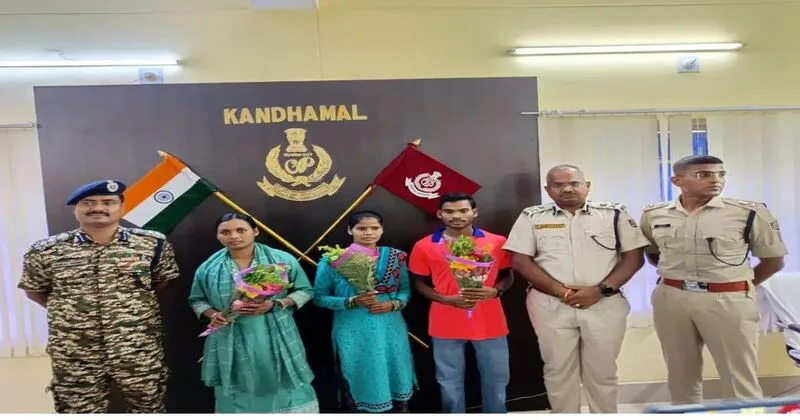
In a major breakthrough in the fight against red terrorism in Odisha, three hardcore Maoists—two of them women—surrendered before the police authorities in Kandhamal district on July 7. The surrender marks a significant victory for the sustained anti-Maoist operations being carried out across the region and the growing impact of the Odisha government’s surrender and rehabilitation policy for Maoists.
The surrender took place in the presence of Southern Range Inspector General of Police (IGP), Niti Shekhar, CRPF 127 Battalion Commandant Pankaj Verma, and Kandhamal Superintendent of Police Harish BC at the District Police Office (DPO) in Phulbani. All three surrendered cadres belong to Chhattisgarh and were operating in Odisha as part of their organizational roles in the outlawed CPI (Maoist).
Identities of the Surrendered Maoists:
1. Made Beti alias Champa (30) – A native of Dugumarka village in Sukma district of Chhattisgarh, she served as a Divisional Committee Member (DVCM) in the Bansadhara-Ghumsar-Nagavali (BGN) Division of the Maoist organization. She had been active since 2009 and carried a reward of ₹5 lakh on her head.
2. Raju Dodi alias Ajay (35) – Hailing from Gotada village in Bijapur district, Chhattisgarh, he joined the Maoist movement in 2016 and was serving as an Area Committee Member (ACM) in the 8th Company of the Kalahandi-Kandhamal-Boudh-Nayagarh (KKBN) division.
3. Admo Madvi alias Manju (27) – From Pangud village in Bijapur district, Chhattisgarh, she became part of the Maoist outfit in 2011 and was functioning as an ACM under the same 8th Company of KKBN division.
According to police, these cadres were tasked with reactivating the critical Maoist corridor linking Jharkhand and Chhattisgarh through the southern-central region of Odisha. All three have been involved in numerous violent incidents in both Chhattisgarh and Odisha, including attacks on security forces and extortion operations.
The surrendered Maoists cited multiple factors behind their decision to abandon the path of violence. A primary reason was the increasing intensity and frequency of anti-Maoist combing operations in interior Kandhamal, including a recent exchange of fire on June 30, 2025, which resulted in the death of two Maoists.
Disillusioned by the intensified and sustained combing operations and due to the attractive surrender policy of the Government three hardcore Maoists namely Made Beti @ Champa (DVCM) of BGN Division, Raju Dodi @ Ajay (ACM), and Admo Madvi @ Manju (ACM) of KKBN Division… pic.twitter.com/xHM9ZquG7W
— SP KANDHAMALA (@spkandhamala) July 7, 2025
In their statements to the police, the surrendered cadres expressed deep disillusionment with the Maoist organization. They pointed to rampant sexual exploitation of women cadres, intimidation and extortion of local communities, and the forced recruitment of youth under false promises. They also mentioned the authoritarian behavior of senior leaders, promotion of illegal cannabis cultivation, interference in electoral processes, and deviation from the original ideology as key reasons for their surrender.
The trio expressed their willingness to reintegrate into society and lead a normal life. They acknowledged the efforts of the police and district administration, particularly the outreach efforts by SP Kandhamal, which included posters and personal assurances offering safe surrender and rehabilitation.
While welcoming the surrendered cadres into the mainstream, IGP Niti Shekhar urged all disillusioned Maoist members to abandon violence and return to normal life. He emphasised that the anti-Maoist operations will continue with full force until the problem is fully eradicated from Odisha. He also reiterated the Union Government’s goal of eliminating the Maoist threat by 2026.
“So far, 15 Maoists have been neutralized in Kandhamal district in 2025 alone through either surrender or encounters,” said IG Shekhar. “This has substantially weakened the operational strength of the Maoist organization in the region.”
The surrender of these three hardcore Maoists is seen as a morale boost for security forces and a promising sign that government initiatives for peace and development are gaining ground in Maoist-affected areas.