Operation Sindoor: 30-second warning, says Shehbaz aide
June 5, 2026
  • Read Ecopy
  • Circulation
  • Advertise
  • Careers
  • About Us
  • Contact Us
Android AppiPhone AppArattai
Organiser
  • ‌
  • Bharat
    • Assam
    • Bihar
    • Chhattisgarh
    • Jharkhand
    • Maharashtra
    • View All States
  • World
    • Asia
    • Europe
    • North America
    • South America
    • Africa
    • Australia
  • Editorial
  • International
  • Opinion
  • RSS @ 100
  • More
    • Op Sindoor
    • Analysis
    • Sports
    • Defence
    • Politics
    • Business
    • Economy
    • Culture
    • Special Report
    • Sci & Tech
    • Entertainment
    • G20
    • Azadi Ka Amrit Mahotsav
    • Vocal4Local
    • Web Stories
    • Education
    • Employment
    • Books
    • Interviews
    • Travel
    • Law
    • Health
    • Obituary
  • Subscribe
    • Subscribe Print Edition
    • Subscribe Ecopy
    • Read Ecopy
  • ‌
  • Bharat
    • Assam
    • Bihar
    • Chhattisgarh
    • Jharkhand
    • Maharashtra
    • View All States
  • World
    • Asia
    • Europe
    • North America
    • South America
    • Africa
    • Australia
  • Editorial
  • International
  • Opinion
  • RSS @ 100
  • More
    • Op Sindoor
    • Analysis
    • Sports
    • Defence
    • Politics
    • Business
    • Economy
    • Culture
    • Special Report
    • Sci & Tech
    • Entertainment
    • G20
    • Azadi Ka Amrit Mahotsav
    • Vocal4Local
    • Web Stories
    • Education
    • Employment
    • Books
    • Interviews
    • Travel
    • Law
    • Health
    • Obituary
  • Subscribe
    • Subscribe Print Edition
    • Subscribe Ecopy
    • Read Ecopy
Organiser
  • Home
  • Bharat
  • World
  • Operation Sindoor
  • Editorial
  • Analysis
  • Opinion
  • Culture
  • Defence
  • International Edition
  • RSS @ 100
  • Magazine
  • Read Ecopy
Home Bharat

Ops Sindoor exposed nuclear vulnerability of Pakistan: Shehbaz Aide admits BrahMos strike left only 30 seconds to react

During India’s Operation Sindoor, Pakistan had only 30–45 seconds to determine whether an incoming BrahMos missile was nuclear, according to a top aide to PM Shehbaz Sharif. The disclosure reveals critical gaps in Pakistan’s defence readiness and the region’s brush with nuclear escalation

WEBDESKWEBDESK
Jul 5, 2025, 10:15 am IST
in Bharat, World
Follow on Google News
FacebookTwitterWhatsAppTelegramEmail

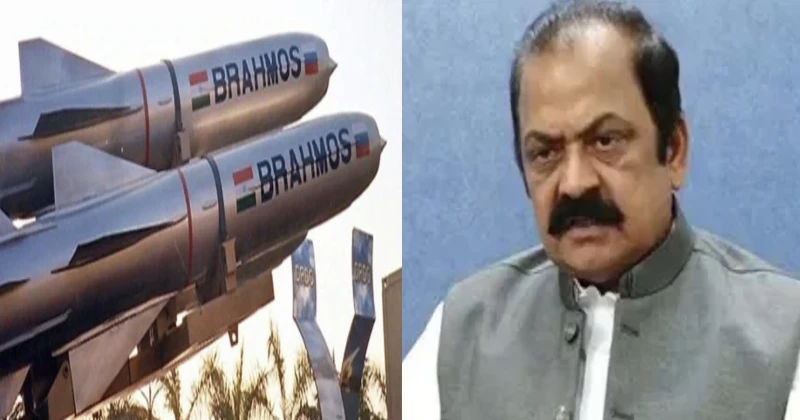
A revelation by Rana Sanaullah, Special Assistant to Pakistani Prime Minister Shehbaz Sharif, has highlighted how dangerously close South Asia came to the brink of nuclear war. During India’s precision military campaign — Operation Sindoor — Sanaullah admitted that Pakistan’s military had only 30 to 45 seconds to assess whether the BrahMos missile launched by India carried a nuclear warhead.

“When India fired BrahMos at Nur Khan airbase, Pakistan’s military had only seconds to determine if it was nuclear. That’s a dangerous situation,” said Sanaullah in a stunning interview, acknowledging the unprecedented panic that gripped Pakistan’s top military brass.

The BrahMos cruise missile — a joint Indo-Russian weapon now largely domestically produced in India — struck the Nur Khan airbase in Chaklala, Rawalpindi, a vital PAF installation housing key assets including VIP aircraft and Turkish-supplied Bayraktar TB2 drones. The high-velocity precision strike reportedly destroyed runways, aircraft hangars, and radar systems, neutralizing the base’s operational capabilities.

This was not the first time India targeted the base — the Indian Air Force’s 20 Squadron had also attacked it during the 1971 war — but the 2025 BrahMos strike marks a new era of asymmetric escalation, leaving Pakistan with little to no response time.

Operation Sindoor: Retaliation to Pahalgam Terror Attack

The Indian military offensive, codenamed Operation Sindoor, was launched in the aftermath of the brutal terrorist attack in Pahalgam, J&K, where 26 Indian and foreign tourists were killed by terrorists linked to Lashkar-e-Taiba and Jaish-e-Mohammad — both Pakistan-backed terror groups.

India responded with a swift, multilayered offensive targeting over a dozen terror camps and military installations across Pakistan. Among the high-value targets were Nur Khan, PAF Sargodha, Bholari, Jacobabad, Sukkur, and Rahim Yar Khan — all of which reportedly suffered damage, according to satellite imagery released by Indian defence agencies.

Indian forces claimed to have killed over 100 terrorists, destroyed active camps of LeT, JeM, and Hizbul Mujahideen, and incapacitated command and control infrastructure used to launch attacks into Kashmir.

Sanaullah’s admission of near-catastrophic miscalculation reveals the extent of Pakistan’s vulnerabilities. He conceded that the Indian strike forced Pakistan into a “panic mode”, as military command had to determine within seconds whether India had launched a nuclear-capable missile.

“I’m not saying India did good by not using a nuclear warhead. But such confusion could have sparked a global war,” he said. This comment directly contradicts years of bravado from Rawalpindi, which has often projected nuclear capability as a deterrent shield against Indian retaliation. The revelation confirms that India’s rapid, precise, and conventional first-strike capability has outpaced Pakistan’s nuclear response chain, creating a dangerous imbalance.

Perhaps the most curious revelation came when Sanaullah credited former US President Donald Trump with “saving the world” by mediating an emergency ceasefire during the height of Operation Sindoor.

“There could have been an atomic war… If Donald Trump played a role and saved the world from disaster, then that role must be independently evaluated and appreciated,” he stated, even claiming Prime Minister Shehbaz Sharif has nominated Trump for the Nobel Peace Prize.

This claim, however, is being firmly rejected by Indian officials, who maintain that it was Pakistan’s Director General of Military Operations (DGMO) who made the first contact to seek de-escalation. India has reiterated its long-standing policy of rejecting third-party mediation, especially in matters of national security involving Pakistan.

Sanaullah’s statement comes just two weeks after Pakistan’s Deputy Prime Minister Ishaq Dar broke rank with previous denials and confirmed that India had indeed attacked two major airbases, causing significant damage — a statement that flew in the face of the Pakistani military’s earlier dismissals as “fabrications” by Indian media.

India’s use of air and ground-based BrahMos missiles proved decisive, not just tactically but psychologically, exposing how deeply unprepared Pakistan was for modern, high-speed warfare. In response to the Indian strikes, Pakistan attempted retaliatory action by launching missiles and drones at military targets in western India. However, Indian air defences successfully intercepted all incoming threats, including drones aimed at Rajasthan and Gujarat installations.

Within four days, both nations agreed to a ceasefire, reportedly under immense pressure from international players — though India maintains it acted purely out of strategic prudence after achieving its objectives.

The Nur Khan strike and Sanaullah’s confession are not just isolated headlines. They represent a major geopolitical flashpoint that exposed Pakistan’s declining strategic deterrence and India’s growing conventional supremacy.

India’s rapid precision strike capability, bolstered by platforms like BrahMos, Rafale jets, and advanced ISR (Intelligence, Surveillance, Reconnaissance) satellites, has shifted the balance in New Delhi’s favour. Pakistan’s nuclear bluff was tested — and, for now, it blinked.

In light of this, calls for an independent investigation into Trump’s alleged role, and Pakistan’s own internal assessment of its rapid response systems, are growing louder. But the bigger story is clear: South Asia was 30 seconds away from nuclear war, and only India’s strategic restraint and technological superiority prevented a disaster.

Topics: Shehbaz SharifDonald TrumpUS PresidentRana SanaullahOperation SindoorBrahMos cruise missile
ShareTweetSendShareSend
✮ Subscribe Organiser YouTube Channel. ✮
✮ Join Organiser's WhatsApp channel for Nationalist views beyond the news. ✮
Previous News

Karnataka: Negligence in five tiger deaths, Forest Minister Eshwar Khandre recommends suspension of DCF Chakrapani

Next News

Sankalp Diwas: Tribute to the Embodiment of Matrushakti of Bharat – founder of Rashtra Sevika Samiti Vandaniya Mausi ji

Related News

Bangladesh’s reported JF-17 push has triggered fresh scrutiny after India’s Ops Sindoor exposed the vulnerabilities of Pakistani-Chinese defence systems and precision strike capabilities

Shadows of Operation Sindoor: Questions loom over Bangladesh’s JF-17 ambitions amid Sino-Pakistani tech vulnerabilities

Rajnath Singh releases book on Operation Sindoor; The publication chronicles unparalleled valour of the Indian soldiers

Operation Safed Sagar; a turning point in the history of military aviation

Operation Safed Sagar: How Kargil war shaped India’s precision strike doctrine

Strait of Hormuz at the centre of global energy crisis as US-Iran tensions reshape West Asia

West Asia Crisis: Why opening the Strait of Hormuz could be the key to lasting peace between Iran & US

1 Year of Operation Sindoor | India’s Strategic Shift: A step in the right direction

India is rapidly reshaping its defence doctrine through drone swarm warfare, indigenous manufacturing and AI-enabled surveillance systems

From Operation Sindoor to AI Warfare: How India is building a drone swarm shield across two fronts

Load More

Latest News

RSS Sarsanghchalak Dr Mohan Bhagwat

The time of Bharat has arrived; we need to expedite our preparation: Dr Bhagwat at RSS Karyakarta Vikas Varg 2

Padma Bhushan awardee and noted industrialist Kumar Mangalam Birla Kumar Mangalam Birla addressing the Samapana Samaroh (Valedictory Function) of the Rashtriya Swayamsevak Sangh Karyakarta Vikas Varg – Dwitiya at Nagpur, on June 4, 2026

“RSS always stood by the society and nation”, Kumar Mangalam Birla at RSS Karyakarta Vikas Varg 2 in Nagpur

Arunachal Pradesh seals all 15 illegal Mosques; Bandh called off by APIYO

MK Stalin with Sonai Gandhi; MK Stalin with Rahul Gandhi (File Photos) (Left to Right)

Tamil Nadu: DMK says no to INDIA Alliance meet in Delhi, blames Congress for political backstabbing

Union Finance Minister Nirmala Sitharaman

Karnataka: All-Women team powers Yadgir’s groundnut revolution; Nirmala Sitharaman inaugurates NABARD Unit

Keralam: Jamaat-e-Islami event features Hamas and Muslim Brotherhood ideologues, raises concerns over Political Islam

Representative Image (This is an AI Generated image)

Uttar Pradesh CM Abhyudaya Scheme: Apply for free civil services, JEE and NEET coaching from June 5

House worth Rs 2 crore of drug peddler bulldozed in J&K

Anti-narcotics campaign in J&K: Police demolish Rs 2 crore residential property linked to drug peddler Sheikh Tasaduq

As fuel shortages rippled across Asia, New Delhi expanded supplies to its neighbours while Beijing sought to turn energy security into strategic influence.

The Hormuz Test: How India’s energy assistance outshines China’s conditional approach

Demographic changes in Bharat’s border districts have raised concerns about migration, security, and social cohesion

Demographic Shift in Border Areas of Bharat: The dangerous design

Load More
  • Privacy
  • Terms
  • Cookie Policy
  • Refund and Cancellation
  • Delivery and Shipping

© Bharat Prakashan (Delhi) Limited.
Tech-enabled by Ananthapuri Technologies

  • Home
  • Search Organiser
  • Bharat
    • Assam
    • Bihar
    • Chhattisgarh
    • Jharkhand
    • Maharashtra
    • View All States
  • World
    • Asia
    • Africa
    • North America
    • South America
    • Europe
    • Australia
  • Editorial
  • Operation Sindoor
  • Opinion
  • Analysis
  • Defence
  • Culture
  • Sports
  • Business
  • RSS @ 100
  • Entertainment
  • More ..
    • Sci & Tech
    • Vocal4Local
    • Special Report
    • Education
    • Employment
    • Books
    • Interviews
    • Travel
    • Health
    • Politics
    • Law
    • Economy
    • Obituary
  • Subscribe Magazine
  • Read Ecopy
  • Advertise
  • Circulation
  • Careers
  • About Us
  • Contact Us
  • Policies & Terms
    • Privacy Policy
    • Cookie Policy
    • Refund and Cancellation
    • Terms of Use

© Bharat Prakashan (Delhi) Limited.
Tech-enabled by Ananthapuri Technologies