Yamuna Cleanliness Drive: Sanatan Wisdom of sustainability
June 6, 2026
  • Read Ecopy
  • Circulation
  • Advertise
  • Careers
  • About Us
  • Contact Us
Android AppiPhone AppArattai
Organiser
  • ‌
  • Bharat
    • Assam
    • Bihar
    • Chhattisgarh
    • Jharkhand
    • Maharashtra
    • View All States
  • World
    • Asia
    • Europe
    • North America
    • South America
    • Africa
    • Australia
  • Editorial
  • International
  • Opinion
  • RSS @ 100
  • More
    • Op Sindoor
    • Analysis
    • Sports
    • Defence
    • Politics
    • Business
    • Economy
    • Culture
    • Special Report
    • Sci & Tech
    • Entertainment
    • G20
    • Azadi Ka Amrit Mahotsav
    • Vocal4Local
    • Web Stories
    • Education
    • Employment
    • Books
    • Interviews
    • Travel
    • Law
    • Health
    • Obituary
  • Subscribe
    • Subscribe Print Edition
    • Subscribe Ecopy
    • Read Ecopy
  • ‌
  • Bharat
    • Assam
    • Bihar
    • Chhattisgarh
    • Jharkhand
    • Maharashtra
    • View All States
  • World
    • Asia
    • Europe
    • North America
    • South America
    • Africa
    • Australia
  • Editorial
  • International
  • Opinion
  • RSS @ 100
  • More
    • Op Sindoor
    • Analysis
    • Sports
    • Defence
    • Politics
    • Business
    • Economy
    • Culture
    • Special Report
    • Sci & Tech
    • Entertainment
    • G20
    • Azadi Ka Amrit Mahotsav
    • Vocal4Local
    • Web Stories
    • Education
    • Employment
    • Books
    • Interviews
    • Travel
    • Law
    • Health
    • Obituary
  • Subscribe
    • Subscribe Print Edition
    • Subscribe Ecopy
    • Read Ecopy
Organiser
  • Home
  • Bharat
  • World
  • Operation Sindoor
  • Editorial
  • Analysis
  • Opinion
  • Culture
  • Defence
  • International Edition
  • RSS @ 100
  • Magazine
  • Read Ecopy
Home Bharat

Yamuna Cleanliness Drive: Sanatan Wisdom of sustainability

As the largest consumers of the world give lectures on the dangers of global warming, the world needs to look up to the Sanatan way of nature conservation and maintaining ecological balance — a Bharatiya civilisation that has forever revered, nourished, and protected the natural resources, thinking of the good of all humankind.

Paryavaran Sanrakshan Gatividhi TeamParyavaran Sanrakshan Gatividhi Team
Jul 1, 2025, 10:00 pm IST
in Bharat, Special Report
Follow on Google News
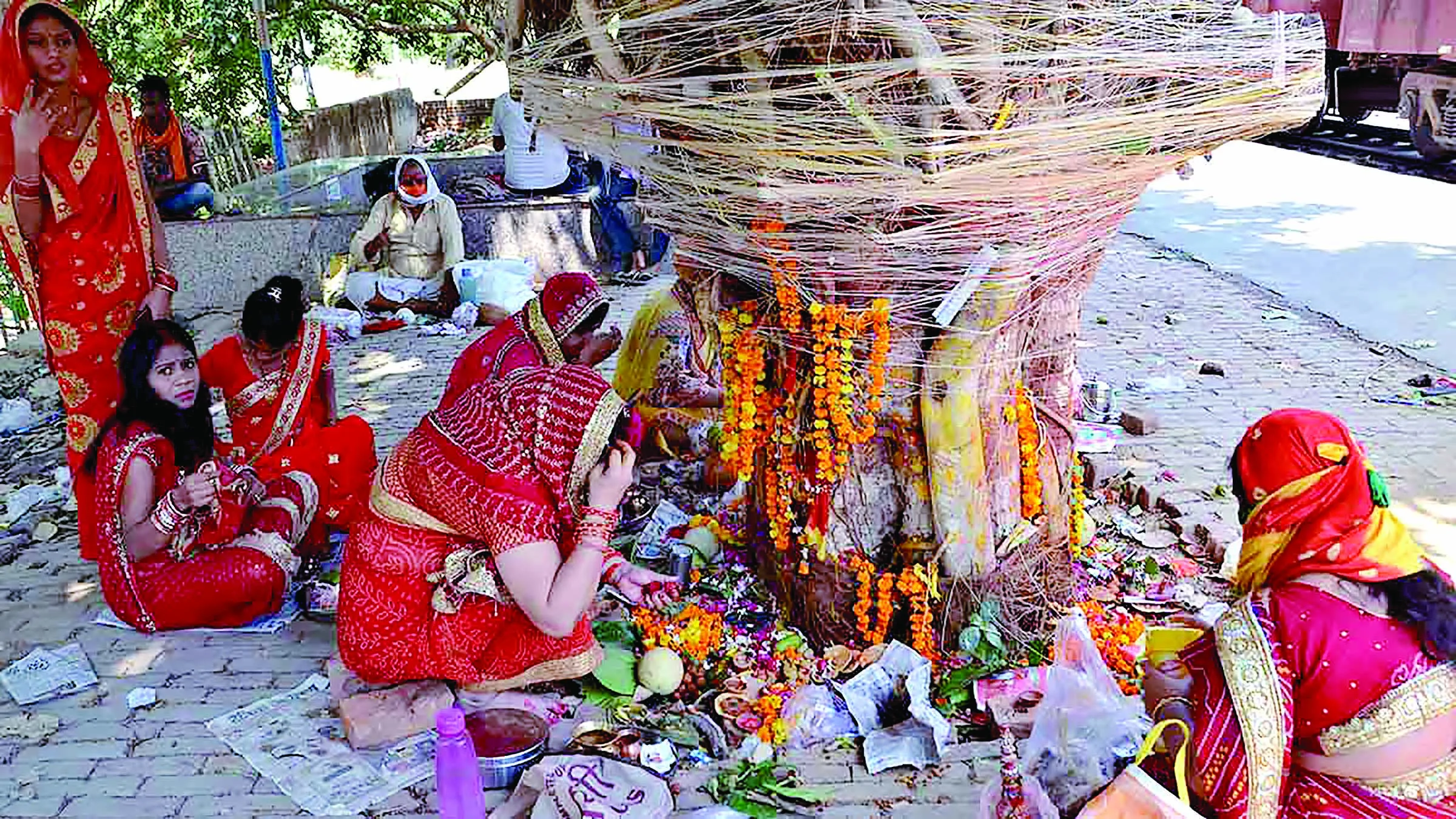
Sanatan believes life cannot exist without trees, so they express gratitude by worshipping them. In Sanatan traditions trees represent the unification of Trinity (Brahma, Vishnu, and Shiva)

Sanatan believes life cannot exist without trees, so they express gratitude by worshipping them. In Sanatan traditions trees represent the unification of Trinity (Brahma, Vishnu, and Shiva)

FacebookTwitterWhatsAppTelegramEmail

Bharat is the seventh-largest country in the world, with a total geographical area of 3,287,263 square kilometers. Despite comprising only 2.4 per cent of the world’s total area, Bharat is home to over eight per cent of the world’s biodiversity. With its four global biodiversity hotspots, Bharat ranks among the top 100 mega-diverse countries in the world. The nation’s vast range of geological and climatic conditions has given rise to a variety of forests, grasslands, wetlands, deserts, mountainous, and marine ecosystems spread across ten bio-geographic zones. These ecosystems nurture more than 91,200 animal species and 45,500 plant species, including many endemic species that are found nowhere else in the world. Moreover, Bharat is also home to several charismatic and iconic  species, including 70 per cent of the world’s tigers, as well as a significant population of Asian elephants and one-horned rhinoceroses.

Cow worship is part of Sanatan, her dung enriches soil, and produces biogas, a clean fuel that protects nature and reduces pollution

Today, most of the country’s biodiversity is protected under a network of 769 protected areas, covering about 162,072 square kilometers, which is less than five per cent of Bharat’s total geographical area. Approximately 70 per cent of Bharat’s population lives in rural areas, and most of them depend on biodiversity-based livelihoods. Around 400 million people reside in approximately 1,73,000 villages located near forests. Due to widespread poverty and lack of alternative income sources, their dependence on forest resources is extremely high. In spite of this extensive dependence on natural resources, the pressures of a growing population, and economic development, if Bharat’s biodiversity is still preserved today, the credit goes to Bharat’s Sanatan practices and beliefs that place high value on the protection and coexistence with nature and wildlife.

Oneness With Nature: Integral To Bharatiyata

Living in harmony with nature has been an integral part of Bharatiya Samskriti. It is abundantly reflected in the traditional practices, religious beliefs, rituals, folklore, arts and crafts, and the everyday lives of Bharatiya people. While conservation and sustainable use of natural resources is a relatively new concept in the modern and western world, Bharat has a long-standing tradition and cultural ethos of nature conservation.

This culture of preservation dates back to the Sanatan Vedic period. All four Vedas—Rigveda, Samaveda, Yajurveda, and Atharvaveda—are filled with hymns that highlight the supremacy of nature. The Rigveda mentions the Sun, Moon, wind, rain, rivers, trees, and mountains as deities, seen as sources of health, wealth, and prosperity. Similarly, the Atharvaveda highlights the importance of nature and contains several hymns in praise of the Earth.

With remarkable foresight, the Tirukkural, an ancient Tamil poetic work, emphasises the need to live in harmony with nature, describing how “shimmering waters, open spaces, hills, and forests form a fortress for human protection.” Likewise, the Sikh community’s principal scripture mentions, “Air is the Guru, Water the Father, and Earth the Great Mother of all.”

Sanatan Bharatiya sects also advocate for nature conservation. Buddhism believes in tolerance, love, compassion, forgiveness, and non-violence toward all beings. Jainism adopts the path of absolute non-violence, prohibiting the killing of any living creature on Earth.

Significance of Trees

Trees have been revered in Bharatiya sanskriti because they are essential not only for humans but also for the existence of animals, birds, insects, and micro-organisms. All four Vedas extensively describe various trees, herbs, fruits, flowers, and their significance. Trees and plants are regarded as living beings, and harming them is prohibited Sanatan Dharma. Many tree species such as Peepal, Goolar, Neem, Bel, Banyan, Ashoka, and Amla hold special places in our sanskriti and traditions.

In Buddhism, Sal and Peepal trees hold significant importance. It is believed that Bhagwan Buddha was born and attained Parinirvana under Sal trees and achieved enlightenment under the Peepal tree in Bodh Gaya. In Jain tradition, sacred trees are associated in various forms with Tirthankaras: Banyan with Rishabhdev, Sal with Sambhavanath and Mahavir etc. Ber trees are revered in Sikhism because Guru Nanak Dev Ji planted a Ber tree near the Bein River in Sultanpur Lodhi, and Guru Gobind Singh once stayed under a Ber tree in a village named Seelona in Ludhiana district. Both sites have now been converted into places of worship. Just as Bharatiya flora is closely tied to Sanatan beliefs and traditions, so too are various animals and wildlife. Our Sanatan traditions accord space and respect to wild and domestic animals. Many animals like tigers, elephants, bulls, horses, peacocks, swans, owls, vultures, rats, etc. are considered sacred and worshipped by Hindus.

Hindus Perceive divinity in all living beings, which is why animal deities occupy an Important place in Sanatan Dharma

In the present scenario, rapid economic development has significantly impacted the environment. While on one hand, economic progress has encouraged consumerism and exerted immense pressure on natural resources, on the other, environmental imbalance has increasingly marginalised sections of society that are largely dependent on these natural resources. Their lives and livelihoods today face a serious threat. In such circumstances, it becomes crucial to secure access to basic human needs like food, water, air, and other natural resources.

Today, as awareness grows in modern societies to address emerging environmental and ecological challenges, many countries around the world are formulating policies for environmental protection. While these policies often lean on modern science, they are directly or indirectly rooted in traditional knowledge systems developed in Sanatan times, which teach the values of simple living. Presently, it is imperative that we follow the principles of our ancestors, who perhaps had a better understanding of the environment than we do. Bharatiya traditions, customs, and religious beliefs teach us about the conservation of flora and fauna. They help us understand the basic ecological principle that every living entity in the biosphere plays a vital role in the cycle of energy and nutrients, thereby sustaining the continuity of life on Earth.

 

Topics: bharatiya sanskritiBhagwan BuddhaSanatan Vedic periodYamuna Cleanliness
ShareTweetSendShareSend
✮ Subscribe Organiser YouTube Channel. ✮
✮ Join Organiser's WhatsApp channel for Nationalist views beyond the news. ✮
Previous News

BJP Tamil Nadu president writes to NHRC seeking probe into custodial death of temple security staff Ajith Kumar

Next News

Kerala: Ex-PFI cadres find safe haven in Left Parties; CPI worker jailed in murder case, probe reveals terror links

Related News

Buddhism, which originated from Bharat, has advocated for global peace. It offers a solution for ongoing wars

Buddha Purnima: Message of middle path: Essential not optional

Japanese delegation from Yamanashi Prefecture, led by Vice-Governor Junichi Ishidera, and Uttar Pradesh officials headed by Tourism and Culture Minister Jaiveer Singh

Uttar Pradesh and Japan strengthen ties through culture, tourism, and people-to-people collaboration

Consul General Pratik Mathur Marks Piprahwa Relics Exposition in China

India’s Consul General in Shanghai visits Tiger Hill Pagoda to mark Buddha relics exhibition launch

“India reclaims its soul”: PM Modi hails return of Bhagwan Buddha’s sacred Piprahwa relics after 125 years

Grand International Exposition of Sacred Piprahwa Relics related to Lord Buddha, titled "The Light & the Lotus: Relics of the Awakened One"

Sacred Piprahwa relics of Bhagwan Buddha take centre stage as PM Modi to inaugurate international exposition

Representative image

Indubitably, Sanskrit language is one of the wonders of the world

Load More

Latest News

India’s Permanent Representative to the United Nations Ambassador Harish Parvathaneni

India slams Pakistan at UNSC for peddling false narratives on Jammu & Kashmir

Keralam: Pathanamthitta temple property occupied beyond lease period reclaimed by devotees

A series of high-level engagements signals New Delhi's growing focus on building interoperable security networks across the Indo-Pacific

India strengthens Indo-Pacific security architecture with new defence and maritime partnerships

Prime Minister Narendra Modi

“Makes every Indian proud”: PM Modi hails India’s 7.7 per cent GDP growth in FY 2025-26

Once known for maoist violence, Minpa now leads healthcare revolution with telemedicine services in Sukma

From Maoist Stronghold to Healthcare Hub: How Chhattisgarh’s Minpa is transforming through telemedicine & development

Dr Surendra Jain, Joint General secretary, VHP

VHP Demands Audit of Waqf Properties Amid Encroachment Claims: “Land should go to rightful owner,” says Surendra Jain

A Special NIA Court has framed charges against banned PFI and 20 office bearers, including E. Abubakar and O.M.A. Salam, under UAPA and IPC

PFI Terror Case: Special NIA court charges Abubakar, Salam & others for alleged conspiracy to wage war against India

Prime Minister Narendra Modi with women during an event (Old image used for representative purposes)

The Nari Shakti Decade: How 12 years of policy reforms under Modi govt transformed lives of women in Bharat

Ritabrata Banerjee, expelled by Mamata Banerjee from TMC, has been appointed as the Leader of the Opposition in Bengal assembly.

TMC House Divided: Mamata’s party battles Itself as LoP row exposes deepening cracks after BJP’s big blow

Lucknow’s UP 112 Headquarters hosts West Bengal team for policing innovation study

UP 112 Model: West Bengal police visits Lucknow to replicate Yogi’s emergency response model

Load More
  • Privacy
  • Terms
  • Cookie Policy
  • Refund and Cancellation
  • Delivery and Shipping

© Bharat Prakashan (Delhi) Limited.
Tech-enabled by Ananthapuri Technologies

  • Home
  • Search Organiser
  • Bharat
    • Assam
    • Bihar
    • Chhattisgarh
    • Jharkhand
    • Maharashtra
    • View All States
  • World
    • Asia
    • Africa
    • North America
    • South America
    • Europe
    • Australia
  • Editorial
  • Operation Sindoor
  • Opinion
  • Analysis
  • Defence
  • Culture
  • Sports
  • Business
  • RSS @ 100
  • Entertainment
  • More ..
    • Sci & Tech
    • Vocal4Local
    • Special Report
    • Education
    • Employment
    • Books
    • Interviews
    • Travel
    • Health
    • Politics
    • Law
    • Economy
    • Obituary
  • Subscribe Magazine
  • Read Ecopy
  • Advertise
  • Circulation
  • Careers
  • About Us
  • Contact Us
  • Policies & Terms
    • Privacy Policy
    • Cookie Policy
    • Refund and Cancellation
    • Terms of Use

© Bharat Prakashan (Delhi) Limited.
Tech-enabled by Ananthapuri Technologies