India rejects SCO statement over terror silence
July 1, 2026
  • Read Ecopy
  • Circulation
  • Advertise
  • Careers
  • About Us
  • Contact Us
Android AppiPhone AppArattai
Organiser
  • ‌
  • Bharat
    • Assam
    • Bihar
    • Chhattisgarh
    • Jharkhand
    • Maharashtra
    • View All States
  • World
    • Asia
    • Europe
    • North America
    • South America
    • Africa
    • Australia
  • Editorial
  • International
  • Opinion
  • RSS @ 100
  • More
    • Op Sindoor
    • Analysis
    • Sports
    • Defence
    • Politics
    • Business
    • Economy
    • Culture
    • Special Report
    • Sci & Tech
    • Entertainment
    • G20
    • Azadi Ka Amrit Mahotsav
    • Vocal4Local
    • Web Stories
    • Education
    • Employment
    • Books
    • Interviews
    • Travel
    • Law
    • Health
    • Obituary
  • Subscribe
    • Subscribe Print Edition
    • Subscribe Ecopy
    • Read Ecopy
  • ‌
  • Bharat
    • Assam
    • Bihar
    • Chhattisgarh
    • Jharkhand
    • Maharashtra
    • View All States
  • World
    • Asia
    • Europe
    • North America
    • South America
    • Africa
    • Australia
  • Editorial
  • International
  • Opinion
  • RSS @ 100
  • More
    • Op Sindoor
    • Analysis
    • Sports
    • Defence
    • Politics
    • Business
    • Economy
    • Culture
    • Special Report
    • Sci & Tech
    • Entertainment
    • G20
    • Azadi Ka Amrit Mahotsav
    • Vocal4Local
    • Web Stories
    • Education
    • Employment
    • Books
    • Interviews
    • Travel
    • Law
    • Health
    • Obituary
  • Subscribe
    • Subscribe Print Edition
    • Subscribe Ecopy
    • Read Ecopy
Organiser
  • Home
  • Bharat
  • World
  • Operation Sindoor
  • Editorial
  • Analysis
  • Opinion
  • Culture
  • Defence
  • International Edition
  • RSS @ 100
  • Magazine
  • Read Ecopy
Home Bharat

“India will not endorse silence on terror”: Rajnath Singh refuses to sign SCO statement over Pahalgam Attack omission

India refused to sign the SCO joint declaration after it omitted the Pahalgam terror attack and referenced Balochistan unrest, subtly implicating India. Defence Minister Rajnath Singh condemned the Pakistan-China axis for diluting the global terror narrative and promoting double standards

WEBDESKWEBDESK
Jun 26, 2025, 04:30 pm IST
in Bharat, World, Defence, International Edition
Follow on Google News
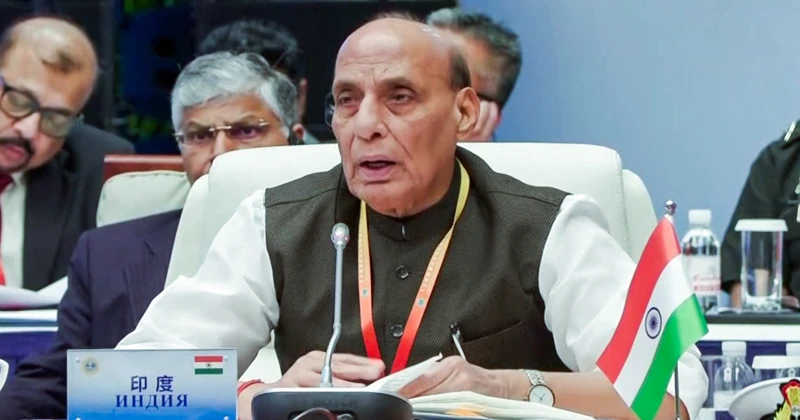
Defence Minister Rajnath Singh at SCO Summit

Defence Minister Rajnath Singh at SCO Summit

FacebookTwitterWhatsAppTelegramEmail

At the Shanghai Cooperation Organisation (SCO) Defence Ministers’ Meet in Qingdao, India decisively refused to endorse a joint declaration that ignored the April 22 Pahalgam terror attack in J&K an act of religiously targeted mass murder while subtly pointing fingers at India over unrest in Balochistan and Pakistan-occupied Kashmir.

The rejection, led by Defence Minister Rajnath Singh, came after India objected to the deliberate omission of key cross-border terrorism incidents, including the Pahalgam massacre, in which 26 civilians were gunned down by The Resistance Front (TRF), a known proxy of the Pakistan-based Lashkar-e-Taiba (LeT). Simultaneously, the inclusion of the Jaffar Express hijacking in Pakistan’s Balochistan was seen as an attempt to engineer moral equivalence and shift the blame for regional instability onto India.

Senior government officials confirmed that India refused to sign the draft document because it neither upheld the principle of zero tolerance for terrorism nor identified the real perpetrators of cross-border terror. The move marks a significant assertion of India’s moral and strategic red lines in multilateral forums increasingly influenced by a Pakistan-China alliance.

During his address, Defence Minister Rajnath Singh left no ambiguity regarding India’s zero tolerance for terrorism and its commitment to justice for the victims of the Pahalgam attack, “During the Pahalgam terror attack, victims were shot after being profiled on religious identity. The Resistance Front, a front for Lashkar-e-Taiba, claimed responsibility. The modus operandi and pattern match earlier LeT attacks.”

Singh said that India responded decisively through Operation Sindoor, a counter-terror operation that targeted training camps and terror infrastructure across the Line of Control. His remarks served both as a reminder of India’s strategic resolve and a direct rebuttal to China and Pakistan’s attempt to manipulate the narrative at the SCO platform.

India’s delegation expressed strong objections to the inclusion of the Jaffar Express hijacking in Pakistan’s Balochistan in the final draft, which did not contextualise the Baloch insurgency as a domestic Pakistani issue but subtly implied cross-border instigation — a thinly veiled swipe at India.

Officials familiar with the matter revealed that the final draft, shaped significantly by Chinese and Pakistani diplomats, tried to shift global attention away from Pakistan-sponsored terrorism in India and toward unrest in Balochistan and PoJK. The implication, Indian officials warned, was not only dishonest but dangerous, as it undermines a collective response to terrorism.

“Any document that fails to acknowledge a major terror attack in South Asia while simultaneously framing Baloch unrest as regional destabilisation lacks balance and integrity. India cannot associate with such a document,” said a senior Indian official.

In his speech, Singh directly called out countries that continue to weaponise terrorism, “Some countries use cross-border terrorism as an instrument of policy. They provide shelter, safe havens and even diplomatic cover to terrorists. There should be no place for such double standards in an organisation committed to peace.”

While Singh did not name Pakistan or China explicitly, his remarks clearly targeted the Pakistan-China axis that has repeatedly blocked India’s efforts to list major terrorists under the UN Sanctions Committee, and that continues to portray India’s counterterror operations as regional aggression.

Singh also stressed that those who organise, finance, and support terrorism must face consequences, calling for the global community to reaffirm its commitment to fight terror in all its forms, irrespective of political motives or strategic alliances.

This is not the first time India has adopted a bold stance within SCO. In 2023, under India’s chairmanship, the country had successfully pushed a joint declaration on countering radicalisation and terrorism, setting high standards for future cooperation. The Qingdao summit, however, marked a clear regression.

“India has always stood for cooperative multilateralism but not at the cost of truth. If multilateral declarations can’t name terror, they only empower it,” said a retired Indian diplomat. India’s refusal to be a signatory to a compromised document is being seen by strategic observers as a major inflection point — especially at a time when China is increasingly using SCO as a theatre for narrative management and geopolitical messaging.

In a parallel development, this episode also undermines the domestic narrative pushed by Congress leader Rahul Gandhi, who for over six months has alleged that India’s actions in Kashmir and Balochistan are contributing to instability in the region. Ironically, the same position was now echoed by the draft SCO document, indirectly indicting India while absolving its enemies.

“What Rahul Gandhi has been saying aligns disturbingly with the language pushed by China and Pakistan. Thankfully, the government has made it clear that national security cannot be compromised for political positioning,” said a national security analyst.

Also Read: Ahmedabad Plane Crash: Black box data downloaded in Delhi, confirms union government

Beyond counterterrorism, Singh’s address covered the changing landscape of global threats, ranging from cyber warfare, drone-based drug smuggling, and hybrid warfare, to transnational terrorism. He stressed that traditional national borders no longer offer sufficient security, and that SCO must evolve accordingly.

Singh underlined India’s commitment to capacity building in Afghanistan, stronger connectivity with Central Asia, and responsible cooperation on climate change, pandemics, and food security — but emphasised that all cooperation must be anchored in sovereignty, territorial integrity, and rule of law.

He concluded by stating, “Peace and prosperity cannot co-exist with terrorism and the proliferation of Weapons of Mass Destruction. The SCO must uphold the highest standards of accountability.”
 

Topics: Rajnath SinghPoJKBalochistanShanghai Cooperation OrganisationSCOSCO summitPahalgam Terror Attack
ShareTweetSendShareSend
✮ Subscribe Organiser YouTube Channel. ✮
✮ Join Organiser's WhatsApp channel for Nationalist views beyond the news. ✮
Previous News

Captain Shubhanshu Shukla’s Axiom 4 Mission: India’s return to space with grit, skill, and pride

Next News

Kerala: Are we in democratic era or Indira Gandhi’s? Governor Arlekar hit at SFI-KSU for slamming Bharatamba image

Related News

LeT terrorists & Pahalgam masterminds attend the funeral ceremony of cricketer Shoaib Akhtar's brother

Pakistan: LeT terrorists & Pahalgam masterminds attend Shoaib Akhtar brother’s funeral; Video exposes terror link

Pakistan’s Defence Minister, Khawaja Muhammad Asif

Pakistan Defence Minister Khwaja Asif sparks fury in POJK, labels Mirpuris &  Rawalakot residents ‘Non-Kashmiris’

Families besiege Quetta’s Huda Jail over alleged secret trial of Dr Mahrang Baloch

Pakistan’s ‘Faceless Trial’: Families besiege Quetta’s Huda jail over alleged secret trial of Dr Mahrang Baloch

The Political Winter of Pakistan occupied Jammu & Kashmir – A Crisis of Oppression and Global Apathy

PoJK witnesses expanding protest movement amid calls for rights, development & political accountability

State-Sponsored Terror in PoJK: How Islamabad uses brutal military force to crush the citizens’ rightful revolt

Government employess of Balochistan begin indefinite strike against Pakistan

Balochistan on Boil: Govt employees start indefinite strike against Pakistan; 400 LPG bowsers stranded in Tuftan

Load More

Latest News

Alang's Comeback: How Modi Government Strengthened India's Maritime Economy

Congress’ assault on Alang China sponsored? How Modi’s vision saved India’s maritime lifeline

Ancient Hindu temples break through watery graves to reclaim Sanatan Dharma’s indestructible legacy

Representative Image

Radical Islamist drivers weaponise public transit to target and exploit Hindu women

Central Sanskrit University launches India's First AI engineering Programme

Central Sanskrit University launches India’s 1st AICTE-approved AI engineering programme with Indian knowledge systems

General Dhiraj Seth assumes charge as the 31st Chief of the Indian Army; Succeeds General Upendra Dwivedi

Representative Image

From Aadhaar to UPI: How Digital India’s 11 year journey rewired governance, welfare and economy

Delhi-NCR Fight Against Vehicular Pollution: How Rs. 9,585cr central govt. scheme aims to improve city’s air quality

US President Trump signs the US–Iran Peace Agreement at Versailles, France

West Asia Conflict: The deal out of exhaustion

FCRA: Enforcement, not harassment

Born on July 6, 1901, in Kolkata, Dr Syama Prasad Mookerjee is remembered as a visionary leader, an educationist, and the founder of the Bharatiya Jana Sangh, who sacrificed his life for the unity & integrity of the nation

Dr Syama Prasad Mookerjee: Symbol of conviction, courage and commitment

Load More
  • Privacy
  • Terms
  • Cookie Policy
  • Refund and Cancellation
  • Delivery and Shipping

© Bharat Prakashan (Delhi) Limited.
Tech-enabled by Ananthapuri Technologies

  • Home
  • Search Organiser
  • Bharat
    • Assam
    • Bihar
    • Chhattisgarh
    • Jharkhand
    • Maharashtra
    • View All States
  • World
    • Asia
    • Africa
    • North America
    • South America
    • Europe
    • Australia
  • Editorial
  • Operation Sindoor
  • Opinion
  • Analysis
  • Defence
  • Culture
  • Sports
  • Business
  • RSS @ 100
  • Entertainment
  • More ..
    • Sci & Tech
    • Vocal4Local
    • Special Report
    • Education
    • Employment
    • Books
    • Interviews
    • Travel
    • Health
    • Politics
    • Law
    • Economy
    • Obituary
  • Subscribe Magazine
  • Read Ecopy
  • Advertise
  • Circulation
  • Careers
  • About Us
  • Contact Us
  • Policies & Terms
    • Privacy Policy
    • Cookie Policy
    • Refund and Cancellation
    • Terms of Use

© Bharat Prakashan (Delhi) Limited.
Tech-enabled by Ananthapuri Technologies