

According to American economist Jeffrey Sachs, Washington’s global dominance is over, and we have entered a multipolar world in which countries such as India, Russia, and China can become important pillars of the new world order; however, China must abandon its expansionist policies and take constructive steps for regional stability, or India will have to form a strategic alliance with America and Europe to protect its interests. However, India will not abandon Russia either. Simultaneously, America and Europe rely heavily on India. America and Europe will need India to stop China.
Why have the Western world and China become worried about India?
China’s open support for terrorism and the Western world’s reaction to the recent Indian airstrikes deep into the heart of terrorist-afflicted Pakistan make it abundantly evident that they are not afraid of India’s growth but rather of the independence and power it has been displaying recently. Although the world has acknowledged India’s spiritual strength and there is no other option, the western world is concerned about how India’s strength is manifesting itself in every area with indeginization. The Western world is infatuated with countries that rely on them for everything, sacrificing their culture and selling natural resources at a lower cost. The Western world is aware of how India’s rise will alter the global order.
The more India grows, the more peace and cooperation there will be in the world, free from terrorism and the exploitation of other countries’ natural resources. India has demonstrated its policy of selfless assistance without any form of undue advantage by providing corona vaccines to a number of countries during the challenging corona phase, assisting in the rescue of citizens of numerous countries stranded in conflict zones, and supporting countries during natural disasters, including Turkey, a country that supports and sympathizes with terrorism.
Why is “Self-Reliant India” a necessity?
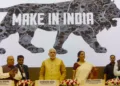
India’s journey towards “Self-reliant India” and the policies that support it are demonstrating the benefits to our economy. Our economy is growing more robust to withstand the shocks of an unpredictable world and events. The “Make in India” movement seeks to promote the growth of the Indian manufacturing industry as well as the establishment of manufacturing hubs by global corporations in India. We can refer to the entire process as “Make in India” if a foreign company manufactures its goods in India and uses it to sell them both domestically and internationally.
Though not every item can be manufactured, and we must rely on few raw materials from other countries, whatever can be manufactured through technological development should be done indigenously, and as a customer, every Indian should purchase “Make in India” products. If the product is not manufactured in India, make sure we get it from a friendly nation rather than an enemy nation. We should avoid products from China, Pakistan, Bangladesh, Turkey, Malaysia, and Azerbaijan. Let us assist the nations that help us in good and bad times. Any purchase from an enemy nation is a direct aid to naxalism, terrorism, and attacks on our defense forces and citizens, thus we need to further develop our strength with speed and precision in manufacturing and service sector.
The United States, for instance, was a global economic power until manufacturing was done in the United States; now, the United States is in the middle of a cycle where it is under 19 trillion dollars of debt, and the country is looking to get manufacturing back to the United States.
As of right now, China is by far the world’s manufacturing powerhouse, accounting for nearly 26% of global manufacturing output and 32 per cent of exported manufactured goods. However, this is the result of years and years of Chinese government and industries spending and effort to make China the most desirable location for businesses that depend on manufacturing their goods, such as automakers, who view China as the best place to manufacture their goods. With India emerging as a favored alternative, the China Plus+1 model requires enterprises to diversify their manufacturing operations by establishing or expanding production facilities in countries other than China. This strategy mitigates the risks of being unduly reliant on a single country while also capitalizing on India’s rising customer base, skilled labor pool, and favorable commercial incentives. India is pursuing multi-pronged strategies to attract foreign investment, such as inviting bids for frontier sectors like semiconductor manufacturing and extraction of critical minerals blocs, and offering industry-specific incentives and financial packages.
India’s manufacturing industry is a key component of the economy, contributing significantly to GDP and jobs. The sector currently accounts for approximately 17 per cent of the nation’s GDP and employs more than 27.3 million people. Although India’s present share of global manufacturing is 2.87 per cent, its development rate is rapid and promising. Many companies have recently shifted away from China for a variety of reasons, the three most important of which are that labor costs are becoming too high. The average Chinese person earns 17,000 USD, which, in the eyes of companies, is too high; average India earns 8,550 USD per year, which is barely more than half of the average Chinese citizen’s salary; however, this is still slightly higher than the average salary of ASEAN countries. India compensates by having the world’s second largest workforce, after only China, with over 550 million workers. This has significantly boosted India’s manufacturing game in recent years. Another reason is that India is a Western ally against China, which is where most of these auto and other companies are based. As a result, these companies feel much more comfortable setting up factories and assisting an ally in developing and becoming wealthy rather than assisting an adversary. If this trend continues, it is anticipated that by 2025, we will surpass Japan as the third-most powerful manufacturing hub in the world in terms of manufacturing output, surpass the USA by 2028 in the same sector, and become the second-largest exporter of manufactured goods by 2030. Although we can compete with China in the manufacturing market and game, we presently need to concentrate on overcoming Japan rather than China in the manufacturing game because we are still a growing manufacturing force.
What are the hurdles to advancing manufacturing capabilities, and how are they being addressed?
One of the biggest hurdles in implementing the ‘Make in India’ strategy is the necessity for strong infrastructure and logistics skills. Adequate transportation networks, dependable power supplies, and well-developed industrial parks are required for efficient manufacturing operations. To solve these difficulties, the government has launched major infrastructure development projects, such as new roads, ports, and airports, as well as the creation of industrial corridors. Furthermore, initiatives such as the National Investment and Infrastructure Fund (NIIF) have been launched to attract investment and mobilize resources for infrastructure development.
Another obstacle to the implementation of the ‘Make in India’ strategy is the presence of complex regulatory procedures and bureaucratic delays. This may dissuade corporations from setting up manufacturing facilities in India. To address this issue, the government has launched a number of measures to streamline regulatory processes, decrease paperwork, and automate approvals. The implementation of a single-window clearing system has simplified the process of getting required licenses and permits. Furthermore, efforts have been undertaken to improve regulatory organizations’ transparency and accountability in order to create a more conducive business environment.
The availability of a competent workforce is critical to the success of the ‘Make in India’ program. However, there is a shortage of appropriately skilled people in certain industries. To address this issue, the government has launched skill development programs to increase the workforce’s employability. To close the skills gap, these programs include vocational training, apprenticeships, and industry-specific skill development. Collaboration between industry and educational institutions has also been promoted in order to connect the curriculum with industry requirements and ensure that graduates are prepared for employment.
Another problem is boosting R&D efforts in the manufacturing sector. Innovation and technological developments are critical to the growth and competitiveness of Indian industries. To address this, the government has implemented a variety of policies and incentives to support R&D, including tax breaks for R&D investments, the establishment of technology incubation centers, and the promotion of industry-research collaborations. These steps are intended to develop an innovative culture, accelerate technological advancements, and position India as a global leader in innovation-driven manufacturing. By tackling these difficulties and implementing effective solutions, the ‘Make in India’ initiative seeks to foster manufacturing growth and attract investment.
As India continues on its journey to industrial excellence, the ‘Make in India’ initiative will have a significant impact on the country’s manufacturing future. The plan aims to develop India into a global manufacturing hub by encouraging an innovative and efficient culture. With continuous reforms and a persistent commitment to growth, ‘Make in India’ will continue to fuel economic progress and provide sustainable employment opportunities, assuring the country’s long-term prosperity.
To meet domestic and international requirements, industries, states, and stakeholders of the New National Education Policy must align their efforts with the central government’s policies and actions. This will enable rapid development of research-oriented, innovative, qualitative, quantitative, and efficient manufacturing capabilities, as well as supply chain management and logistic infrastructure. The faster India rises, the better for the globe. Let national education policy be implemented qualitatively and quickly throughout India to produce youths with a research and innovative mindset, which is critical for the manufacturing sector to emerge as a worldwide power.