November 26 is considered as Constitution Day.
The Constitution of independent Bharat was adopted on November 26, 1949. Bharat proudly stood up again as an independent, sovereign, republican nation among the comity of nations.
The preamble of the Constitution begins with “We the people of India”. The term ‘people’ does not imply ‘crowd’. “People are a group naturally moving in a specific direction”.
It is not that our country became a republic because of the Constitution, but because we, the people of Bharat, have been of a republican mentality since time immemorial, hence our Constitution turned out to be of a republican form of government. A republic implies democracy. Democracy means continuous exchange of ideas, discussion-deliberation, complete freedom of expression, a complete freedom of worship, a mentality of listening to the opinions of others, not only tolerance of opinions but also respect for opinions. These democratic values are seen to be deeply rooted in the lives of the people of Bharat.
‘Civilisation’ has constantly been evolving in Bharat since the Vedic period. Numerous divergent opinions occurred during this period. Many sects, sub-sects, and religions came into existence. Different philosophical perspectives emerged. Many languages and artistic forms developed. We embrace all of them as ours. This diversity does not become an obstacle during a pilgrimage.
Bharatiya society has been living democratic values for thousands of years. This ‘democratic living of society’ was encapsulated in words by the framers of the Constitution. After a long period of slavery, Bharatiya values appeared before the world in the form of Constitution. This has been an epoch-making work. The collective intelligence of all the learned people in the Constituent Assembly has been put to work for this.
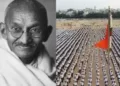
Prior to the establishment of the RSS in 1925, Dr Hedgewar participated in the Non-Cooperation Movement of 1921, launched by Gandhi ji, and consequently endured a year-long imprisonment
Our Constitution is based on the three principles of liberty, equality and fraternity. Dr Keshav Baliram Hedgewar, who worked tirelessly to ensure Bharat’s independence, visibly took efforts to instill these values in the organisation from the very inception while expanding and developing the Rashtriya Swayamsevak Sangh.
1. He decided to start the Sangh only after discussing with many leaders who were active in the freedom movement.
2. The name of the organisation was decided after six months. 26 people were present at the meeting. Three names were suggested. 1. Rashtriya Swayamsevak Sangh, 2. Jaripatka Mandal, 3. Bharatoddharak Mandal. There was an open discussion and exchange of ideas; voting was held. 20 people were in favour of the name ‘Rashtriya Swayamsevak Sangh’. Two-three speeches were given explaining the importance of the three words Rashtriya Swayamsevak Sangh. After this name was agreed upon, Doctor ji gave a short speech.
3. Doctor Ji conducted an experiment after the finalisation of this name. He asked few prominent swayamsevaks to think as if the responsibility of expanding the Sangh work is solely theirs and write a dissertation on what the goals, policies and rules of the Sangh should be, who should be admitted to the Sangh, etc.
4. Some swayamsevaks thought of going to Ramtek for the sake of proper arrangements. The orderliness of the yatra is not a matter for the Sangh alone. Doctor Ji called a joint meeting with the trustees of the orphanage, office bearers of Bajrang Mandal, and Sangh swayamsevaks. It was agreed that it was essential to pay attention to the arrangements for the Ramtek yatra. Some uniform was also fixed.
5. The work started increasing; it became necessary to set up an organisational structure. Revered Sarsanghchalak Dr Hedgewar, and as his assistant Shri Balasaheb Huddar as the Sarkaryavah and Martandrao Jog as the Sarsenapati were appointed. Doctor Ji was given ‘Sarsanghchalak Pranam’ at the Shakha. The entries in Doctor Ji’s register of that day are worth seeing.
- I am fully aware that I am not the founder of the Sangh, but you people.
- I will continue to do this work as long as you wish and command.
- But if you feel that I am not worthy of this work and that I am causing harm to the Sangh, then another suitable person should be elected for this position.
6. Around 1929, the Shakhas were flourishing, and the enthusiasm of young karyakartas was increasing. The karyakartas began requesting Doctor Ji to organise a big gathering. A great show of power should be done on the day of Shivarajyabhishekam – the coronation day of Shivaji Maharaj. The confidence and enthusiasm of the swayamsevaks would increase, was their natural logic. Doctor Ji’s mind was telling him otherwise – “We should not do anything in a hurry that would attract attention from the foreign British government”. But he did not impose the decision through a blunt refusal to the young Swayamsevaks. He wrote a letter to the hon’ble Sanghchalaks to ask whether organising a big programme would be beneficial at this juncture. After their response, it was decided not to organise a big gathering for the time being.
7. Doctor Ji fell ill; everyone realised that death was near. Doctor Ji must have felt it too! He asked Yadavrao Joshi, who was sitting nearby, “When a senior office bearer of the Sangh passes away, will you cremate him with a military protocol? The Sangh is a big family, it should be simple and ordinary like that of the head of the family.”
The purpose of narrating seven selected incidents from the life of Doctor Ji is to remind us of how vigilant he was to instill democratic values in the organisation.
As per the traditions evolved by Doctor Ji, the entire work of the Sangh is based on democratic values from top to bottom. At every level, deliberation, discussion, free expression of opinions, complete freedom about way of worship in personal life, collective decisions and their implementation by consensus is the natural way of functioning.
Two meetings, namely Akhil Bharatiya Karyakari Mandal (All India Executive Committee) and Akhil Bharatiya Pratinidhi Sabha (All India Representative Council), are held every year without fail. A record of all the proceedings is kept. The minutes of the previous year’s meeting are read and approved. There is an open discussion on the resolutions. No one is stopped from expressing opinion. The resolutions are made public. Organisational elections are held every three years.
In 1948, the government of independent Bharat banned the RSS on absolutely false charges of assassinating Gandhi Ji. This ban was tolerated by strictly following the law. Satyagraha had to be carried out. There is no violent incident anywhere even as an exception.
“The current Sarsanghchalak decides the name of the new Sarsanghchalak after discussing with the Hon’ble Kshetra Sanghchalaks. There is no distinction between Adhikaris (office bearers) and swayamsevaks (volunteers) in the Sangh; everyone is a swayamsevak.”
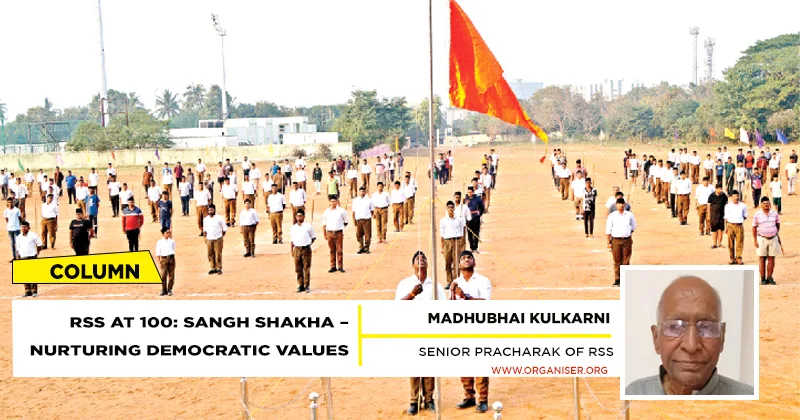
Shakha is the representative form of Sangh. The Sangh Shakha does not have a door. It is an open national school. The Shakha has a working committee of eight to ten people. In the Sangh, it is called a Shakha (group/team). The working committee meets weekly or fortnightly. Everyone participates in the discussion, exchange of ideas and decision-making process. The past review and the next plans are considered. A record of new swayamsevaks is kept.
Outreach to the houses of the Shakha locality (called Basti) and informing them about Sangh is done effortlessly. Shakha celebrates its annual festival. The annual report is presented before everyone.
Dr Hedgewar undertook a solemn commitment to consolidate society, eschewing contentious debates and adversarial postures, in accordance with the principles of “Vadonavalambya” and “Sarvesham Avirodhena”
Democratic values are easily nurtured among Swayamsevaks. Its result was seen during the emergency crisis. All human rights based on democratic values were suspended. Even the doors for seeking justice from the court were closed. In order to lift the emergency and restore democratic values, Satyagraha was started on behalf of the ‘Lok Sangharsh Samiti’. Delving into Satyagraha was like jumping into pitch darkness. Nobody knew what would happen next. In this uncertain situation, more than one lakh swayamsevaks participated in Satyagraha. The emergency had to be lifted. Everyone was released from prison. Democratic values were restored. Some people died in jail. No government property was vandalised anywhere.
Dr. Babasaheb Ambedkar’s thoughts on the three principles of freedom, equality and fraternity are worth studying. (Reference: Bol Mahamanavache (Words of the Mahamanav) – Page No. 125)
“In my philosophy, the place of law is assumed only to protect against the encroachment of freedom and equality. But I consider the place of law to be miniscule. Because I do not believe that the law will be able to withstand the violation of freedom and equality. I want to give the highest place to fraternity. Because when freedom and equality are denied, fraternity will protect. Empathy is another name for fraternity. And fraternity or humanity is another name for dharma. Since law is beyond dharma, it is easier to break. On the other hand, as empathy or dharma is sacred, it is considered the duty of everyone to respect it.”
Instilling in every individual the belief that fraternity is a principle of dharma is a great work for nation. “The resolve to promote fraternity which assures the dignity of the individual, the unity and integrity of the nation” is expressed in the Preamble of the Constitution.
Only the development of fraternity can assure life values of freedom and equality.
The purpose of running or operating a Sangh Shakha is to awaken and strengthen the feeling of fraternity in the Hindu society. ‘All Hindus are brothers, say this to each and everyone’ is sung in the Shakha. The group chanting ‘Bharat Mata Ki Jai’ inculcates a sense of brotherhood..