In the volatile landscape of South Asian geopolitics, Pakistan’s greatest lasting threat is not its runaway economy or political turbulence. It is the ideological radicalisation nurtured in its own midst, that is, in an alarming subgroup of religious seminaries called ‘Madrasas’. Although madrasas have long been institutions of Islamic education and social charity, in Pakistan, some have evolved into ideational production factories for extremism and terrorism. This is not an ancillary issue. It is structural, well-entrenched, and critical to comprehending Pakistan’s internal deterioration and its destabilising influence on regional security.
As of October 2023, various international reports estimates suggest that there are around 30,000 to 40,000 madrasas operating in Pakistan. At face value, these madrasas appear to be important educational institutions. In a country with over 22 million children out of their school-going years, madrasas, in fact, provide an opportunity for some poor disadvantaged kids. They feed, shelter, and educate kids from poverty-ridden families. Madrasas being the alternative schools thus fill in the gap created by an under-resourced and decaying public school system, for a state that has now, in an overwhelming sense, abdicated responsibility for educating the generation that is to come. That very gap, in fact, permits jihadi ideologies to set roots and blossom, recruit, in some cases, the vulnerable youngsters into mechanisms of jihadi violence. One such madrasa student, was Ajmal Kasab, perpetrator of the 26/11 Mumbai attacks, who studied at Darul Uloom Karachi madrasa.
The problem is not with every madrasa, but a particular extremist brand that espouses extremism. Although most madrasas deliver positive religious instruction along the lines of traditional Islamic ideals, institutions with connections to such hardline groupings as Deobandi and Ahl-e-Hadith have uniformly been linked to extremism. The organizations tend to promote a biased, exclusivist definition of Islam in which Shias, Sufis, liberal Sunnis, and non-Muslims are called “Kafirs” i.e. heretics. The indoctrination takes place early in life, driven by sectarian animosity and anti-India feelings, laying a political basis for militancy. Madrasas are now nurseries for organizations like Lashkar-e-Taiba (LeT), Jaish-e-Mohammed (JeM), and the Taliban, with special concentration in areas like southern Punjab and Khyber Pakhtunkhwa. Students reportedly move from Quranic studies to militant training, as evident from the case of Masood Azhar, the founder of JeM. His group has masterminded major attacks, such as the 2001 Indian Parliament attack and the 2019 Pulwama bombing. The Pakistani state’s complicity in allowing such elements to operate without any curb is based on their perceiving these extremist madrasas as “strategic assets.” This enables them to continue their activity, perpetuating an ideology-driven cycle of violence.
The disturbing part is the normalisation of extremist ideology in Pakistan’s official discourse, and the state’s complicity in that process. There was a frightening statement made by Pakistan’s Defence Minister stating: “madrasa students are our second line of defence. Although it may seem patriotic to say at home, it disturbs the world: Pakistan still considers a sector of religious education part of its national defence. Such statements undermine our intentions to reform madrasas, and our intentions to promote deradicalization. Our assurance to tame madrasas, and to turn our backs on militancy, was merely cosmetic and intended primarily for the pleasure of Western donors. The potent religious lobby with the backing of influential clerics is fighting back against genuine change. As long as foreign funds are flowing into unregulated seminaries, spreading sectarianism and violence, a radicalizing education system will be built with little oversight.
The implications go far beyond Pakistan’s borders. The ideological export of extremism has already cost thousands of lives in India, Afghanistan, and even in Europe and North America. From the streets of Mumbai to the deserts of Helmand, the fingerprints of madrasa-linked terror groups are unmistakable. But the blowback within Pakistan has been equally devastating. Shiite processions, Sufi shrines, and even schoolgirls in the tribal regions have all been targeted by militants born from this ecosystem. When you train young minds to hate, you cannot always control where that hate is directed.
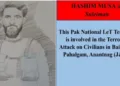
The result of this stagnation is significant. Locally, it empowers extremist groups who oppose contemporary education, breed sectarian intolerance, and attack minorities. Pakistan has endured successive episodes of sectarian militancy, bombings of shrines, and attacks against religious minorities, all the foundations of which are radical seminaries. The consequences are even deeper, with terror groups attached to madrasas being blamed for acts such as the 2001 Indian Parliament attack, the 2008 Mumbai attacks, and the 2019 Pulwama attack. These have driven South Asia to the edge of war and placed regional cooperation in jeopardy. The world community, particularly India, should accept that this is not an internal problem of Pakistan; regional and international security is at risk through the export of extremism, which compromises international norms and sovereignty. General Asim Munir is noted for having received early religious education at a traditional Islamic seminary, the Markazi Madrasah Dar-ul-Tajweed, in Rawalpindi, ergo his radicalism and the subsequent Pahalgam attacks.
There is still a slim window of opportunity for overhauling Pakistan’s madrasa system, which needs to be all-encompassing and determined. One, the state needs to impose compulsory registration, uniform curricula, and state accreditation on all madrasas. Two, financing needs to be regulated, with transparency for foreign funding. Three, extremist material needs to be removed, and critical thinking needs to be incorporated into religious education. Fourth, militant-linked madrasas need to be closed down, with a clear rupture from jihadist ideology and prosecution of their operators under anti-terrorism legislation. This final point is key and difficult, demanding a radical change in Pakistan’s strategic posture, which has wrongly compartmentalized extremism for political purposes.
The state must abandon the notion that extremism can be contained, controlled, or used selectively. History has repeatedly disproved this notion and has shown that militant proxies inevitably outgrow their patrons. The same groups nurtured to bleed India have turned their guns inward. The same networks that fought the Soviets in Afghanistan now undermine the Pakistani state itself. The blowback has already begun, in the form of attacks on Pakistani security forces, the Tehrik-e-Taliban Pakistan’s resurgence, and rising sectarian violence. Unless the Pakistani establishment makes a clean break with its past, the same seminaries it once nurtured will continue to produce enemies not just of its neighbours, but of the state itself.
India should persist in bringing up this issue on bilateral, regional, and multilateral platforms. Diplomatic pressure needs to go hand-in-hand with relentless bringing to light Pakistan’s hypocrisy, its public declarations against terror as opposed to the silent sanction of ideological militarism. Parallelly, civil society forces such as Islamic thinkers, education reformists, and local NGOs need to be assisted so that they could reclaim religious instruction from radicals’ hands.
The Defence Minister’s observation that madrasa students are Pakistan’s “second line of defence” starkly illustrates Islamabad’s worldview, with a sobering conclusion: the war on terror has been less about eliminating extremists and more about holding them in reserve for strategic need. Pakistan is confronted with a choice: to be a victim of terrorism or an abettor of it. It can choose to raise its kids as modern citizens or ideological fighters. The world, and generations to come of Pakistanis, are observing. For peace, prosperity, and international credibility, Pakistan needs to de-militarize religion, converting madrasas from incubators of war into centers of scholarship, not militancy.