
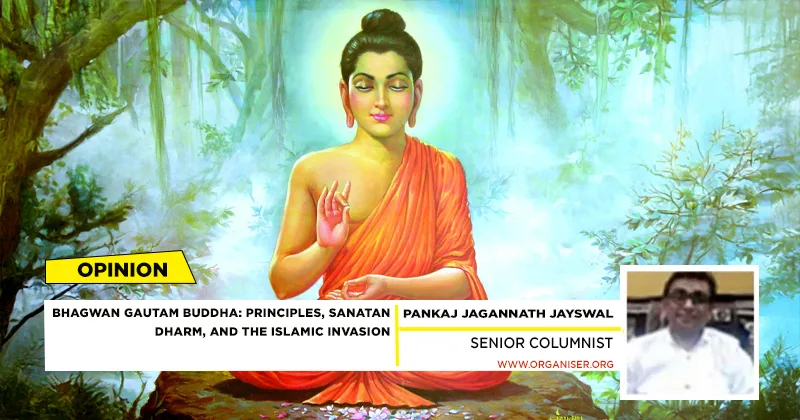
Bhagwan Gautam Buddha was hijacked by Sanatan Dharm detractors and anti-humanitarian activists and organizations in order to sow seeds of discord and hatred among various segments of society for political and selfish purposes. These anti-humanitarians are actively working against Bhagwan Buddha’s immense knowledge and teachings. Dr. Babasaheb Ambedkar preferred Buddhism because it is consistent with the ideas of Sanatan Dharm. Let us explore his key concepts, his relationship with Sanatan Dharm, and how Islam destroyed Buddhism.
The “Middle Way” concept as expressed by Bhagwan Buddha
Buddha Purnima, honors Gautam Buddha’s birth, enlightenment, and parinirvana. It was Gautam Buddha who discovered Buddhism. He preached a middle path between sensuous indulgence and rigorous asceticism that leads to Nirvana, which is the freedom from ignorance, yearning, rebirth, and sorrow. His teachings are summed up in the Noble Eightfold path, which combines ethical training with meditative practices such as sense restraint, kindness to others, mindfulness, and meditation.
The Buddha saw his analysis of dependent origination as a “Middle Way” between “eternalism” ( the belief that some essence endures eternally) and “annihilationism” (the belief that we vanish completely at death). According to this viewpoint, people are simply a causal succession of ephemeral psychophysical aspects known as ananta, which lack an independent or permanent self. Instead, the Buddha believed in Sanatan Dharm Principles that everything in our experience is transient, and that there is no unchanging aspect of a person. According to Richard Gombrich, the Buddha’s position is simply that “everything is process”.
There are two extremes: hedonism (excessive sensual pleasures, materialism, luxury) and asceticism (severe fasting and mortification). Both extremes are detrimental to one’s mental and physical wellbeing. Therefore, the Middle Way should be taken. Take the noble eightfold path: right perspective, right intention, right speech, right action, right livelihood, right effort, right mindfulness, and right concentration. But don’t insist on what’s good and bad, or you’ll end yourself falling into one extreme. Fundamentally, the greater your want, the more misery you will experience. This involves the drive to be right. To insist on being right is arrogant; arrogance leads to despair or wrath, both of which cause pain. Suffering disappears when desire stops.
Bhagwan Gautam Buddha and his connection to Sanatan Dharm
Before his Awakening, the Buddha had mastered Sanatan Dharm principles and techniques, including its yoga and philosophy. To quote the Dalai Lama himself: “Some people attack me for claiming that Buddhism is a branch of Hindu Dharm. But claiming that Hindu dharm and Buddhism are diametrically opposed would be contrary to reality.”
-Reference: Sanskrit Reader 1: A Reader in Sanskrit Literature, pp17, Heiko Kretschmer
T.W. Rhys-Davids : Buddhism, p.116-117, quoted :
“Buddhism is returning home to India after a thousand-year exile and, like the proverbial prodigal son, is welcomed with open arms. The average Hindu’s religious tolerance contributes to the positive reaction. More importantly, Buddha and Buddhism are deeply ingrained in Hindu consciousness. Buddha was Hindu. Buddhism has Hindu origins and growth, including art and architecture, iconography, language, beliefs, psychology, names, nomenclature, religious vows, and spiritual discipline…. Hinduism is not entirely Buddhist, but Buddhism is part of the ethos that is fundamentally Hindu.” Buddhism is regarded a part of Hindu heritage since Buddha never stated that he was founding a new religion; rather, he modified an existing one. Buddha became a Hindu monk, and he then taught everyone how to become monks. He never abandoned the Gods and Goddesses. He prioritized the Buddha (the enlightened), as was always the case.
In Hindu Dharm, we chant: Gurur Brahma, Gurur Vishnu, Gurur Devo Maheshwaraha, Guru Saakshat Para Brahma, Tasmai Sree Gurave Namaha. This translates to “First is the Guru.” Buddha reestablished the same thing. Instead of Guru, he mentioned Buddha. Buddha denotes a fully grown enlightened individual. Another Buddhist passage reads, “Rakhantu sabba devta, bhavtu sabba Mangalam.” This means that everyone should have prosperity and tranquility. “Sarve sukhino Bhavantu” means “let all the people of the world be happy” in the Vedas.
The Tripitaka, commonly known as the Pali Canon, is a collection of scriptures that include the Bhagwan Buddha’s spoken teachings. It is organized into three “baskets” of teachings: the Abhidhamma Pitaka (philosophical teachings), the Vinaya Pitaka (monastic regulations), and the Sutta Pitaka (discourses).
Jataka Tales: Jataka tales are stories about the Buddha’s previous lives that resemble Hindu beliefs and deities. They frequently contain characters and settings from Hindu literature.
Pali Canon References: The Pali Canon, one of the earliest collections of Buddhist teachings, contains references to Hindu customs and gods, demonstrating that the Buddha’s life was inextricably linked to Hinduism.
The notions of Karma and Dharma, which are key to Buddhism, are equally prominent in Hindu philosophy. Buddha’s teachings on knowing were a reformulation of Hindu thought, not a complete departure from it.
Whatever is said in the Upanishads is exactly what Buddha said! Buddha never claimed that all Rishis or saints were wrong. He said, “There have been many Buddhas before me, and many will come after me.” Take refuge in the Buddha. And there is a Buddha inside you. Take refuge in the Buddha-nature within you.
“मोक्षार्थं संस्थितानां तु मोहायाखिलदेहिनाम्।
बुद्धत्वं समनुप्राप्य भविष्याम्यन्यजन्मना॥”
The translation is: “For the purpose of deluding beings, and for those seeking liberation, I will incarnate as Buddha in another birth.” Context: According to the Padma Purana, Buddha is an incarnation of Vishnu who takes birth to provide a route to freedom (Moksha) as well as to change current practices. This is consistent with the concept of Dharma as practiced in Sanatan Dharma. “O Vishnu, we bow down to Thy Buddha avatara, that Great Deva who did come down here to put a stop to the slaughtering of the innocent animals and to the performance of wicked sacrificial ceremonies which had become corrupted and improper!” – Devi Bhagvata Purana 10.5.
The Lord described the attributes of Vishnu’s 10 avatars, starting with Matsya. Buddha should be depicted as serene, with long ears and a fair complexion, wearing a garment, sitting on a lotus with its petals upwards, and bestowing favor and protection.” – Agni Purana 49.1–8
Islamic invaders harmed Buddhism
Muslim conquerors mercilessly destroyed the majority of Buddhism in India, attacking the country’s prestigious universities, massacring monks, and burning libraries, among other things. They did the same to Hindus, but there were Hindus all over ancient India; they couldn’t get them all. Buddhism was also more centralized in monasteries since it was far more reliant on monks and less widely distributed among the general public, making it significantly more vulnerable to disruption. Buddhism likewise generally renounced fighting at that time, but Hindu Dharm had a great warriors to defend it.
It is time to unify Hindus and Buddhists for a peaceful and prosperous world, with humanity in mind.