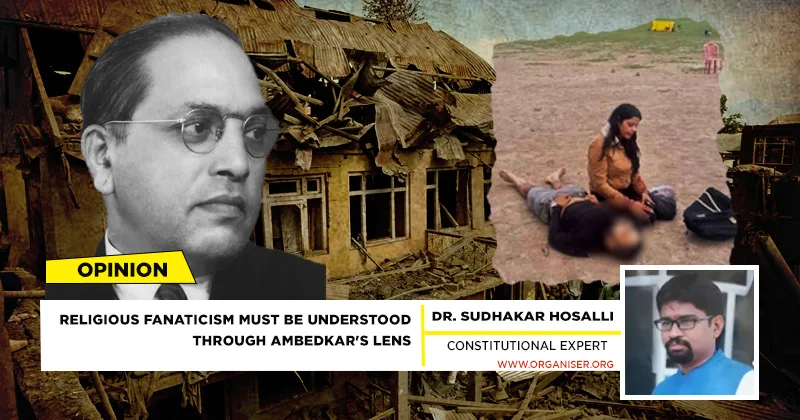
Religious fanaticism must be understood through Ambedkar's lens
September 13, 2026
  • Read Ecopy
  • Circulation
  • Advertise
  • Careers
  • About Us
  • Contact Us
Android AppiPhone AppArattai
Organiser
  • ‌
  • Bharat
    • Assam
    • Bihar
    • Chhattisgarh
    • Jharkhand
    • Maharashtra
    • View All States
  • World
    • Asia
    • Europe
    • North America
    • South America
    • Africa
    • Australia
  • Editorial
  • International
  • Opinion
  • RSS @ 100
  • More
    • World Hindu Congress 2026
    • Op Sindoor
    • Analysis
    • Sports
    • Defence
    • Politics
    • Business
    • Economy
    • Culture
    • Special Report
    • Sci & Tech
    • Entertainment
    • G20
    • Azadi Ka Amrit Mahotsav
    • Vocal4Local
    • Web Stories
    • Education
    • Employment
    • Books
    • Interviews
    • Travel
    • Law
    • Health
    • Obituary
  • Subscribe
    • Subscribe Print Edition
    • Subscribe Ecopy
    • Read Ecopy
  • ‌
  • Bharat
    • Assam
    • Bihar
    • Chhattisgarh
    • Jharkhand
    • Maharashtra
    • View All States
  • World
    • Asia
    • Europe
    • North America
    • South America
    • Africa
    • Australia
  • Editorial
  • International
  • Opinion
  • RSS @ 100
  • More
    • World Hindu Congress 2026
    • Op Sindoor
    • Analysis
    • Sports
    • Defence
    • Politics
    • Business
    • Economy
    • Culture
    • Special Report
    • Sci & Tech
    • Entertainment
    • G20
    • Azadi Ka Amrit Mahotsav
    • Vocal4Local
    • Web Stories
    • Education
    • Employment
    • Books
    • Interviews
    • Travel
    • Law
    • Health
    • Obituary
  • Subscribe
    • Subscribe Print Edition
    • Subscribe Ecopy
    • Read Ecopy
Organiser
  • Home
  • Bharat
  • World
  • Operation Sindoor
  • Editorial
  • Analysis
  • Opinion
  • Culture
  • Defence
  • International Edition
  • RSS @ 100
  • Magazine
  • Read Ecopy
Home Politics

Religious fanaticism must be understood through Ambedkar’s lens

As the Indian government intensifies its crackdown on terror, voices from across the nation are calling for a deeper reckoning with the radical Islamist ideology that continues to justify such acts of violence—an ideology that Dr. B.R. Ambedkar had starkly warned against

Dr Sudhakara HosalliDr Sudhakara Hosalli
May 5, 2025, 08:30 pm IST
inPolitics, Bharat, Opinion, Jammu and Kashmir
Follow on Google News
Facebook
Twitter
WhatsAppTelegramEmail

The brutal massacre of Hindus in Kashmir by terrorists has reignited a fierce and widespread resistance against terrorism across the country. While the swift and stringent political and strategic measures undertaken by the Indian government are commendable, they alone are insufficient to address the gravity of the situation.

It is now clear that these recurring acts of terrorism and extremist attacks are not mere isolated incidents—they stem from a deeply rooted ideological agenda. Recently, someone rightly observed: “The deaths of Hindus are not due to religion, but because of irreligion.”

The core doctrine of radical Islam, which preaches that killing a ‘kafir’ earns one divine reward, becomes an unwavering life-purpose for the fanatic. Once this belief takes root, the annihilation of Hindus—labelled as ‘kafirs’—remains a perpetual goal. Ambedkar had warned against such dangers in no uncertain terms. Today’s indifference to his insights has tragically normalized the loss of Hindu lives.

These attacks are not just against individuals; they are part of a systematic dismantling of the Indian Constitution itself. The ideological elements embedded in the enforcement of Sharia law contradict the spirit of our Constitution. If the Constitution collapses, how will India survive? How will Hindus sustain their existence?

Ambedkar had explicitly warned that Muslim invasions of India were not merely economic or political expeditions. They were rooted in a religious mandate to destroy the indigenous Hindu faith and its practices. Tragically, due to our failure to internalize this warning, Hindus today are gradually being stripped of their very right to exist.

When a jihadist strips a civilian before executing him, it is not just the victim who is left exposed—so is the entire idea of secular India. This should awaken not only Hindus but all those who uphold the values enshrined in our Constitution. We must strive to understand Islamic ideology through the prism of Ambedkar’s writings.

Ambedkar’s Perspective on Islamic Invasions

In Vol. 6 of his writings and speeches (pages 418-420), Dr. B.R. Ambedkar writes with brutal honesty that Muslims, more than any other group, had the greatest disdain for the principle of equality. Unlike other foreign invaders, Muslim aggressors came to India not just to rule, but to obliterate Hinduism and its cultural roots.

Historical accounts affirm this. Mahmud of Ghazni, for instance, saw his invasions as holy wars. His court historian, Al-Utbi, writes: “He destroyed temples filled with idols and established Islam in their place. He killed the sinners and idol worshippers, captured cities, and then returned home boasting of the victories he had won for Islam.”

Similarly, Muhammad Ghori’s campaigns were driven by religious zeal. Historian Hasan Nizami describes how Ghori used his sword to “cleanse” India of its “impurities”—Hindu beliefs, temples, and deities.

Tamerlane (Timur), in his autobiography, openly declared that his invasions were intended to convert infidels and cleanse the land of polytheism. Every victory for Islam, he believed, sanctified the death of non-believers and transformed invaders into holy warriors in the eyes of God.

Ambedkar pointed out the deeper truth: while Muslim rulers like Ghazni, Ghori, Timur, Babur, Nadir Shah and Ahmad Shah Abdali came from different ethnic groups—Turks, Afghans, and Mughals—they were united in one goal: to destroy Hinduism. Ironically, while they fought each other bitterly, they shared a common objective when it came to India.

A History Written in Blood

The first act of religious aggression by Muhammad bin Qasim, who invaded Debal, was to forcibly convert Hindu Brahmins. When they resisted, he ordered the execution of all males over the age of 17 and enslaved the women and children. Temples were plundered, wealth was seized, and a fifth of the loot was sent to the state treasury while the rest was distributed among the soldiers.

Mahmud of Ghazni, in 1001 CE, humiliated King Jayapala by parading him through the streets after his defeat—an act meant to terrorize the Hindu populace and signal Islamic dominance.

When Muhammad Bakhtiyar Khilji conquered Bihar, he destroyed the ancient learning center of Nalanda. According to ‘Tabaqat-i-Nasiri’, thousands of Brahmins were slaughtered, and the libraries were burned. So complete was the destruction that no one remained to explain the contents of the surviving manuscripts.

Despite repeated invasions over centuries, India has miraculously preserved its civilizational core. This endurance is credited to the philosophical depth and resilience inherent in Hindu culture. But today, we face a renewed threat. The Hindu community, especially its intellectual class, must re-examine history and draw strength from it to counter these modern challenges.
Topics: HindusDr BR AmbedkarPahalagam Terrorist Attack
Share1
Tweet
SendShareSend
✮ Subscribe Organiser YouTube Channel. ✮
✮ Join Organiser's WhatsApp channel for Nationalist views beyond the news. ✮
Previous News

Dismantling Terrorism: What should be the role of civil society in national security during the time of war? 

Next News

MHA orders states to conduct mock drills for effective civil defence on May 7, engage students and civilians

Related News

RSS Sarsanghchalak Dr Mohan Bhgawat answer the questions in London at Universal Oneness event

RSS@100 event in London: Dr Mohan Bhagwat answers from Hindutva to Youth to Loyalty to Britain

(Left) RSS Sarsanghchalak Dr Mohan Bhgawat (Right) Bawa Jain, Secretary General, World Council of Religious Leaders

Mohan Bhagwat’s ‘If any Hindu thinks there is no Muslim in Bharat’ remark: Bawa Jain says it opens a new dialogue

Shocking: Islamic cleric attributes his own misogynistic claims to the founder of Islam

Hindu minor, Sourabh Chandra Roy, was allegedly dragged into a mosque in Bangladesh’s Lalmonirhat

Bangladesh: Hindu minor allegedly dragged into Mosque and brutally beaten in Kaliganj

‘Conversion Drive’ sparks Hindu protest in West Bengal: Argentina missionary confronted in Hingalganj

“Hindus and Sikhs may follow different religions, but we share same values & spirit: Sikh Leader Kashmir Singh Dhaliwal

Load More

Latest News

Vande Mataram: The eternal mantra of national consciousness

A representative image

Team Skill India set for biggest ever WorldSkills push, to compete in 11 new categories at WorldSkills Shanghai 2026

AI-generated representative image

Fragile Five to Fastest-Growing Major Economy – Incredible India’s Transformation in 12 Years

India joins 24 nations in global 6G push

India joins 24 nations in global 6G push, endorses call for secure and resilient networks

Ministry of Defence's ten-year defence diplomacy framework “RAKSHA”, at Kartavya Bhawan in New Delhi. (Source: AI generated Image)

RAKSHA: Ten years of Defence diplomacy turned a decade boosting export and global cooperation

(Left) Naga leader Dr. S. C. Jamir: (Right) RSS Sarsanghchalak Dr Mohan Bhagwat

Bridging Perspectives: Dr SC Jamir meets RSS’ Dr Bhagwat, highlights mutual respect, secularism, and Naga aspirations

Tiger Bright coffee from Koraput’s tribal farmers featured in BRICS Summit media kits in New Delhi

From Eastern Ghats to BRICS: Koraput Coffee puts Odisha’s tribal enterprise on global map

The RSS has spent a century building influence through organisation, social networks and ideological formation beyond the electoral arena

RSS at 100: How the Sangh built a century-long network of influence beyond Indian politics

India on a Platter: BRICS Dinner Menu Celebrates Regional Culinary Heritage

BRICS Dinner Menu: From Khandvi, mushroom kebabs to pulao global leaders get a taste of Bharat’s culinary heritage

Exterior of the Lokayukta Building

Karnataka Lokayukta records 1,248 cases in four years, 887 linked to bribery

Load More
  • Privacy
  • Terms
  • Cookie Policy
  • Refund and Cancellation
  • Delivery and Shipping

© Bharat Prakashan (Delhi) Limited.
Tech-enabled by Ananthapuri Technologies

  • Home
  • Search Organiser
  • Bharat
    • Assam
    • Bihar
    • Chhattisgarh
    • Jharkhand
    • Maharashtra
    • View All States
  • World
    • Asia
    • Africa
    • North America
    • South America
    • Europe
    • Australia
  • Editorial
  • Operation Sindoor
  • Opinion
  • Analysis
  • Defence
  • Culture
  • Sports
  • Business
  • RSS @ 100
  • Entertainment
  • More ..
    • Sci & Tech
    • Vocal4Local
    • Special Report
    • Education
    • Employment
    • Books
    • Interviews
    • Travel
    • Health
    • Politics
    • Law
    • Economy
    • Obituary
  • Subscribe Magazine
  • Read Ecopy
  • Advertise
  • Circulation
  • Careers
  • About Us
  • Contact Us
  • Policies & Terms
    • Privacy Policy
    • Cookie Policy
    • Refund and Cancellation
    • Terms of Use

© Bharat Prakashan (Delhi) Limited.
Tech-enabled by Ananthapuri Technologies