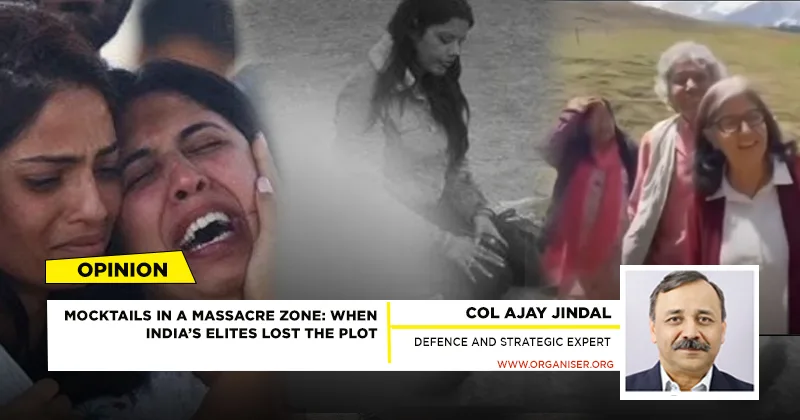
The blood was still fresh on the grass in Pahalgam. Twenty-six unarmed Hindu tourists—fathers, sons, husbands—were gunned down at Pahalgam’s Baisaran — dubbed “mini Switzerland”, in a targeted massacre that sent shockwaves across the country. Survivors recounted how the gunmen identified people by religion before executing them in cold blood. The visuals from the site pierced the nation’s collective soul. But barely twenty-four hours after the bloodshed, a very different kind of video began circulating.
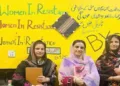
In Srinagar, high-profile Indian women from elite circles were seen dancing and laughing in a luxury hotel. One referred to the Pahalgam massacre as a “small incident,” while another chirped about settling down in Kashmir. One can’t help but ask—settle down where, madam? In the very Valley that is still struggling with deep ideological fault lines, where your tourist privilege may not shield you from harsh realities if you attempt permanence?
Video Link 1: Elite’s Indifference
In another video, a group of elite women posed near the massacre site as if it were just another scenic backdrop.
Video Link 2: Dismissing Pahalgam Incident as a Minor Event
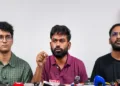
And then there were men from Mumbai, similarly elite, dismissing the massacre as “blown out of proportion.”
Video Link 3: Mumbai Elite Minimizing the Attack
These are not isolated voices. They are part of a worrying pattern—a deep disconnect between India’s social and political elite and the visceral realities experienced by the rest of the nation. This callousness is not just morally appalling—it is geopolitically dangerous.
The Disconnect of the 1 per cent
There is something profoundly disturbing about this aloof detachment from the national mood. At a time when the country is in mourning when even Kashmiris across communities have prayed for the dead and demanded accountability, this 1 per cent elite is seen indulging in tone-deaf celebrations and casual dismissals.
Yes, citizens have a right to question intelligence failures. That is a hallmark of democracy. But there is a difference between seeking accountability and appearing indifferent to national pain. Worse, some from this elite are actively feeding conspiracy theories.
One political leader—on video—cast doubts on survivor accounts that the attackers identified victims by religion.
Video Link 4: Congress Leader Questions Survivor’s Account
A child was paraded by the Kerala Congress unit to criticise the government’s response, turning grief into political capital.
Video Link 5: Child Paraded to Criticise Government – Kerala Congress
The result? These statements are being gleefully repackaged by Pakistan’s propaganda machinery.
Video Link 6:Echoes Across the Border: How Indian Elites Empower Pakistan’s Propaganda
Weaponising Indian Liberalism
Pakistani media, political commentators, and ex-military officers wasted no time in jumping onto this manufactured “doubt.” Retired Major General Raza Muhammad stated that no bodies were shown, implying a staged incident. Senator Mushahid Hussain Syed revived the tired trope of India staging attacks to malign Pakistan, referencing events from the 1990s and early 2000s. They even pointed to a blurred image as “proof” that the massacre was fake.
How did they get this narrative ammunition? From India’s own—those who call themselves secular, liberal, and enlightened voices. Those who questioned Pulwama in 2019 without waiting for forensic confirmation are now repeating the same cycle. Back then, too, Pakistan used Indian commentators to deflect blame, saying, “Even Indian media and intellectuals don’t believe this wasn’t an inside job.” Now, post-Pahalgam, the pattern repeats.
Pakistan’s state-aligned channels are running these videos of Indian elites as proof that “even Indians don’t believe this was terrorism.” This is not critique—it is betrayal. If the elites can’t stand with their own people in the face of a clear massacre, if they cannot name Islamist terror when it slaughters innocents, then they have forfeited moral credibility.
Kashmir is Not a Utopia
To those gushing about Kashmir’s beauty and talking about “settling down” in the Valley—wake up. You are tourists, not pioneers. The idea that Kashmir is a paradise ready for cultural appropriation is not only naïve, it is offensive.
According to preliminary investigations, at least two of the attackers were locals from Kulgam. The house used to store explosives was destroyed after a blast. This was not the work of foreign ghosts—it was homegrown, deeply embedded terror.
A recently surfaced image of the terrorist hideout in Kulgam reveals a disturbing detail—it was not some barren cave or desolate shack. It was stocked with LPG cylinders, suitcases, bedding, buckets, food, and water. In other words, someone was feeding this hate from within India—while wearing a mask of friendliness.
Video Link 7:The Mask of Friendliness: Who’s Feeding the Killers Within?
Media and the Mirage of Neutrality
Some Indian media houses need to look inward. Referring to Jammu and Kashmir as “Indian-controlled Kashmir” plays straight into Pakistan’s lexicon. No Pakistani outlet ever uses the term “Pakistan-controlled Kashmir.”

Why should Indian media adopt the enemy’s terminology in the name of neutrality? This isn’t journalistic objectivity—it’s ideological dissonance disguised as fairness.
Water, Terror, and Strategic Retaliation
The Indian government’s consideration of punitive steps—including reassessing the Indus Waters Treaty—is entirely justified. How can a nation continue honouring water-sharing treaties with a neighbour that exports terror?
Yet even here, reflexive opposition was quick to pounce. Congress veteran Mani Shankar Aiyar questioned the logic of the retaliation in a viral video. These habitual contrarians, shaped by years of ideological mimicry, oppose not because of principle—but out of impulse.
The Curse of Colonial Hangover
This elite aloofness is not new. It is the latest mutation of an old colonial disease—the desire to appear “above” the native emotional response. To be cool, rational, Westernised, and detached, while the rest of the nation bleeds and mourns.
In doing so, they become unwitting collaborators of hostile forces. They amplify enemy propaganda under the banner of “internal critique.” But let’s be clear—this is a fringe, not the mainstream. It is a 1 per cent masquerading as the moral conscience of the country.
This is not about silencing dissent. It’s about timing, tone, and truth. Critique, yes. Demand accountability, always. But do not mock a nation’s grief. Do not offer cover fire to those who kill our people.
A Time to Choose
India is a civilisation where people cancel personal celebrations if there is death in the neighbourhood. That is the depth of our empathy. It is part of our cultural code. In such a society, laughing at massacre sites and calling mass murder “minor” is not just tone-deaf—it is obscene.
Can you imagine celebrating at a luxury resort while the nation mourns? Can you fathom calling the slaughter of 27 innocent Indians a “small incident”? This is not a harmless privilege—it is toxic detachment.
Enough is Enough
The Pahalgam massacre wasn’t just another terror attack. It was a test. A test of our moral compass. Of our national unity. And while most of India passed—with empathy, anger, and resolve—its elites failed, spectacularly.
They failed the victims. They failed the truth. And in doing so, they endangered the very idea of India. It’s time we, the 99 per cent, say what needs to be said: The party is over. Either the elite reconnect with the nation—or the nation will move forward without them.