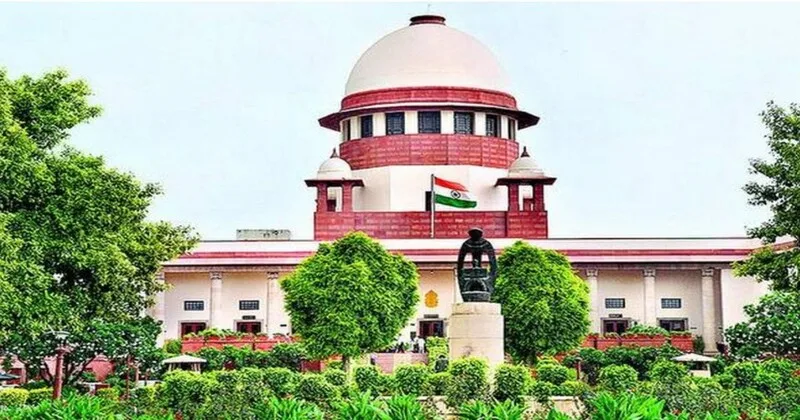
In recent years, the Indian judiciary, especially the Supreme Court, has come under growing scrutiny for what many perceive as an inconsistent and, at times, prejudiced approach, particularly when it comes to issues concerning the Hindus. While the Constitution of India guarantees equality before the law under Article 14 and freedom of religion under Articles 25 and 26, several judgments and judicial responses have sparked concerns about whether these principles are applied uniformly across communities.
The Waqf Amendments: Two Laws, Two Responses
In 2013, when the Congress-led government introduced the Waqf Amendment Act, many Hindu lawyers challenged the law, labeling it as anti-Hindu and unconstitutional. However, the Supreme Court refused to hear the matter and directed the petitioners to the High Court. The Court’s response was cold and indifferent.
Contrast this with the scenario in 2025, when the BJP government amended the same Waqf Act. This time, Muslim petitioners approached the Supreme Court with their grievances. Surprisingly, the Court prioritized the matter and began urgent hearings. This difference in urgency and receptiveness raises legitimate questions about judicial impartiality.
Representation in Waqf Boards: A Matter of Equality?
The Modi government’s proposal to include two non-Muslims on the Waqf Board aimed to ensure fair representation, particularly because of repeated allegations that Waqf Boards have encroached upon Hindu lands. However, the Supreme Court raised objections to this move.
The irony lies in a 2024 ruling, “Vinod Kumar M.P. v. Malabar Devaswom Board” where the Court held that appointments to temple trusts should not be limited by caste, religion, or language. If inclusivity in temple administration is mandated by the Court, why should the Waqf Board be exempt from similar expectations?
Double Standards on Religious Claims and Evidence
The 2025 Waqf Amendment also scrapped the contentious “Waqf by User” clause, which allowed Islamic institutions to claim ownership of land used for religious purposes without documentary proof. The Supreme Court criticized the move, asking how Muslim institutions could provide 500-year-old documents.
Yet, in the landmark “Ram Janmabhoomi” case, the same Supreme Court demanded rigorous historical and archaeological proof from the Hindu side to establish Shri Ram’s birthplace. The Hindu parties submitted ancient texts, including “Skanda Purana”, Edward’s Pillar, and Hans Baker’s map, and eventually won. But the contrasting burden of proof is hard to ignore.
Pending Cases and Delayed Justice for Hindus
Several major disputes involving Hindu temples remain unresolved. These include the “Kashi Vishwanath v Gyanvapi Mosque” case, “Krishna Janmabhoomi v Shahi Idgah” case, “Bhojshala Temple” in Dhar, the “Harihar Temple” in Sambhal, and others. Despite compelling evidence submitted by Hindu petitioners, the judiciary has moved at a snail’s pace.
In contrast, the Court took swift action in the “Sabarimala” case (2018), striking down a centuries-old tradition restricting women of a certain age from entering the temple. When Muslim women filed similar PILs seeking entry into mosques, the Supreme Court chose not to prioritize or even regularly hear those cases—six years later, the matter is still pending.
Temple Autonomy vs. Waqf Control: A Legal Paradox
In “Seshammal v. State of Tamil Nadu” (1972), and later in “A.S. Narayana Deekshitulu” (1996) and “N. Adithayan v. Travancore Devaswom Board” (2002), the Supreme Court held that temple administration is a secular function and should comply with constitutional mandates.
Yet, when it comes to Waqf Boards, purely administrative and managerial bodies, the same principle is not applied. The contradiction becomes evident when the judiciary questions non-Muslim appointments in Waqf administration but supports state control and intervention in temple management.
Uneven Standards in Religious Sacrifices
The Supreme Court and various High Courts have been proactive in banning animal sacrifices in Hindu temples. For instance, the “Subhash Bhattacharjee v. State of Tripura” (2019) and 2014 Himachal Pradesh High Court rulings banned such practices, citing cruelty. However, similar scrutiny is absent during Eid al-Bakrid when mass animal slaughter occurs. This selective application of compassion reinforces perceptions of bias.
Temple Wealth Under State Control, Churches and Mosques Exempt
Unlike mosques and churches, which enjoy autonomy, Hindu temples in India are heavily regulated by the state governments. Their revenues are diverted to secular causes, while communities have little say in how their sacred institutions are managed. Despite repeated pleas by Hindu groups, the Supreme Court has largely remained indifferent and has often redirected petitioners to lower courts.
The Big Picture: PILs, NGOs, and Judicial Activism
The judiciary’s apparent inconsistencies also stem from the nature of litigation. Public Interest Litigations (PILs), often filed by NGOs with specific ideological leanings, tend to shape the judicial narrative. Noted lawyer Harish Salve has warned that some of these NGOs operate with foreign funding and anti-national motives, and courts often fall prey to their legal maneuvering due to the absence of investigative checks.
Former Arunachal Pradesh Chief Minister Kalikho Pul once alleged the existence of influential lobbies operating within the judiciary. Whether these allegations have deepened mistrust in the institution.
The Structural Flaws: Colonial Hangover and Collegium System
India’s judiciary is a colonial legacy, designed for imperial convenience, not for social especially Hindu justice. The Collegium system, lacking transparency and accountability, has become an elite institution. Judges work fewer days compared to other professionals, and delays in delivering justice are commonplace, as seen in the “Nirbhaya” and “Priyanka Reddy” cases.
Moreover, there seems to be ideological subjectivity among judges. In the “Triple Talaq” case, for example, the Muslim and Sikh judges supported the practice, while the Hindu judges raised questions on it. This suggests that personal beliefs, rather than objective constitutional interpretation, may influence verdicts.
But labeling the Supreme Court as overtly “anti-Hindu” may oversimplify a complex issue, but the emerging trends of selective intervention, inconsistent judgments, and an apparent hesitancy to address Hindu concerns reveal a deeper structural imbalance. A growing section of the Hindu community feels sidelined, sensing that their religious and cultural matters are often handled with less seriousness and urgency.
To preserve its credibility and fulfill its constitutional mandate, the Indian judiciary must undergo honest introspection. It must rise above ideological leanings, shed its colonial-era framework, and ensure that all religious communities—majority or minority—receive equal and unbiased treatment. Only through such reform can the Supreme Court reaffirm its role as a truly impartial and just arbiter of the Constitution.