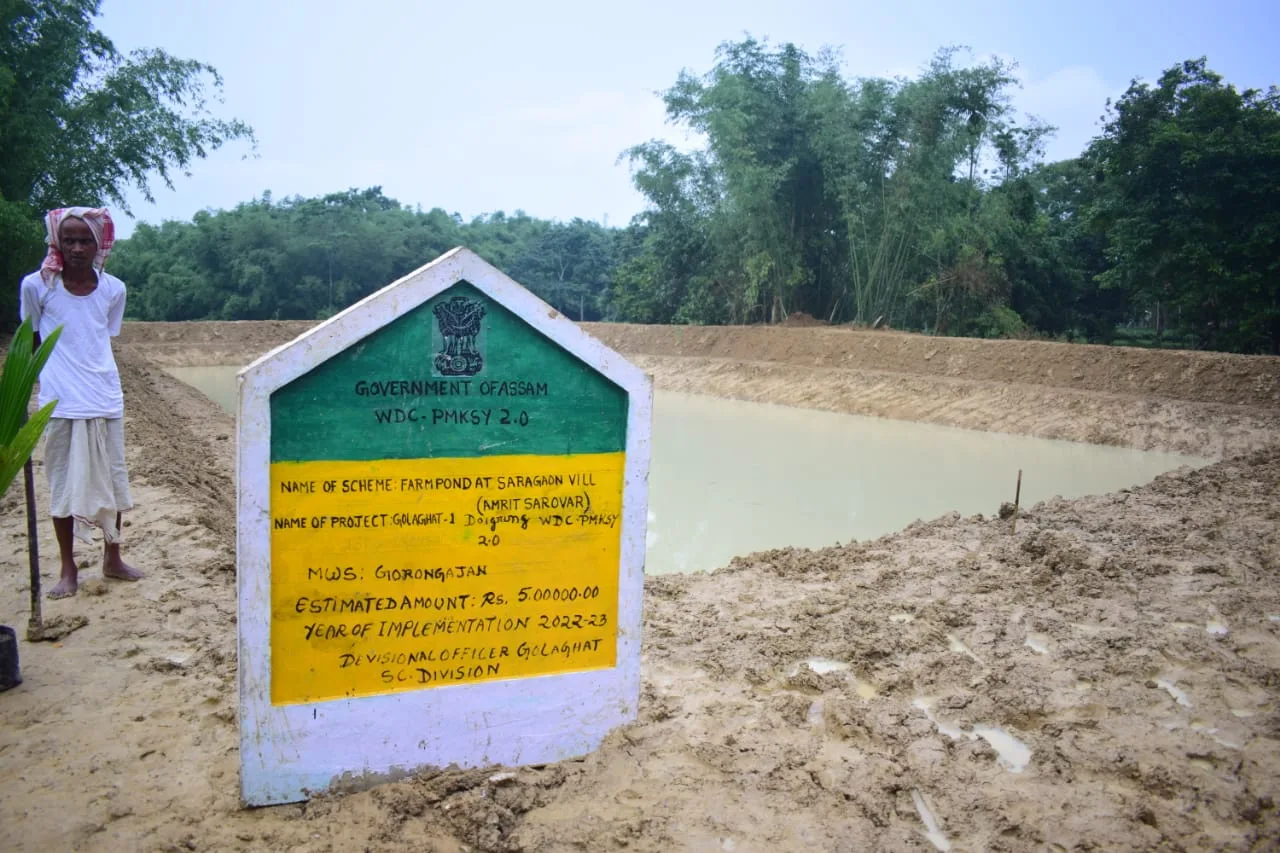
India’s water challenges have been a long-standing issue, exacerbated by the depleting groundwater resources and the increasing pressure on rural water availability. Addressing these challenges requires a multifaceted approach that combines structural interventions with active community participation. In response to these growing concerns, the Government of India launched the Mission Amrit Sarovar in 2022, a flagship initiative under the Azadi Ka Amrit Mahotsav. The mission’s primary objective is to conserve water and rejuvenate India’s traditional water bodies by engaging local communities in the restoration of ponds and lakes, thus ensuring sustainable water management for present and future generations.
Comprehensive approach to water conservation
Launched with a vision to create 50,000 Amrit Sarovars by August 15, 2023, the initiative has now evolved into a nationwide movement. Its scope has expanded beyond just constructing water bodies; it embodies a blend of ecological restoration, community empowerment, and national pride. The mission represents not only a physical restoration of water bodies but also an institutional shift towards decentralised governance, where communities take the lead in managing their water resources.
As of March 2025, the mission has surpassed expectations, with over 68,000 Amrit Sarovars constructed or rejuvenated, significantly enhancing surface and groundwater availability. This initiative, which operates under the Mahatma Gandhi National Rural Employment Guarantee Scheme (MGNREGS), has also become a symbol of the government’s commitment to long-term environmental sustainability and the welfare of rural communities.
National call to action
The concept of Amrit Sarovars goes beyond the mere construction of water reservoirs; it is deeply rooted in the vision of creating sustainable, productive assets that benefit the environment and society. The mission was formally announced by Prime Minister Narendra Modi on April 24, 2022, during the celebration of National Panchayati Raj Day at Palli Gram Panchayat in Jammu’s Samba district. The initiative aims to rejuvenate 75 water bodies in each district across the country, with a focus on constructing ponds with a minimum surface area of one acre, which can hold up to 10,000 cubic meters of water. These reservoirs are intended to help conserve water, ensure a steady supply for agriculture, improve groundwater levels, and serve as socio-cultural hubs.
Each Amrit Sarovar is also designed to be a symbol of national pride, often named after freedom fighters, historical figures, or local heroes. This fosters a sense of ownership and respect among the local population, further strengthening community participation.
The mission’s core objectives are clear:
1. Conserve water and promote sustainable water management practices.
2. Strengthen decentralized governance and empower Gram Panchayats.
3. Foster employment opportunities through MGNREGA and related schemes.
4. Revive traditional water structures and encourage community-led water conservation.
Institutional convergence and implementation
To ensure the success of Mission Amrit Sarovar, a multi-ministerial and multi-stakeholder approach has been adopted. The Ministry of Rural Development anchors the initiative, with support from six other ministries: Ministry of Jal Shakti, Ministry of Panchayati Raj, Ministry of Environment, Forest & Climate Change, Ministry of Railways, Ministry of Culture, and Ministry of Road Transport and Highways. Additionally, the Bhaskaracharya National Institute for Space Applications and Geo-informatics (BISAG-N) provides technical support, leveraging remote sensing and geospatial technologies for site selection, progress tracking, and real-time monitoring.
Each district is tasked with constructing or rejuvenating at least 75 Amrit Sarovars. These water bodies are designed to serve as community-managed spaces, with local self-governments (Gram Panchayats) playing a pivotal role in their development and maintenance. To facilitate transparency and effective coordination, the National Informatics Centre (NIC) has developed a digital platform—amritsarovar.gov.in—which tracks the progress of each Sarovar.
Assuring ‘Jan Bhagidari’
At the heart of Mission Amrit Sarovar is the concept of Jan Bhagidari (people’s participation). The success of the mission depends largely on active involvement from the community at all levels—starting from the planning stage to the execution and subsequent maintenance of these water bodies. Every Amrit Sarovar is assigned two dedicated “Prabharis” at the Panchayat level: one as the Panchayat Pratinidhi (citizen supervisor) and another as the Panchayat level officer. These individuals ensure that the project is executed faithfully, and the interests of the local community are upheld.
Moreover, user groups are formed from the community to manage the Sarovars and ensure their sustainability. These groups are made up of local stakeholders such as farmers, fishermen, and members of Self Help Groups (SHGs). They are responsible for the upkeep of the water bodies, including regular silt removal after the monsoon season and the promotion of water-efficient practices.
The government also encourages local community members to contribute to the development of Amrit Sarovars through Shramdaan (voluntary labour), donation of construction materials, and financial contributions via Corporate Social Responsibility (CSR) funds.
Phases of implementation
The mission’s implementation is divided into multiple phases, with the first phase aiming to complete 50,000 Amrit Sarovars by August 15, 2023. This target was met ahead of schedule, with 59,492 ponds constructed by May 2023. The second phase, which began in September 2023, continues with an emphasis on community participation, ecological balance, and water availability. As of April 2025, 3,182 new sites have been identified for rejuvenation under Phase II.
State-wise performance
The performance of the states varies, with Uttar Pradesh leading the charge, having completed over 16,000 Amrit Sarovars by March 2025. Other top-performing states include Madhya Pradesh, Karnataka, Rajasthan, and Maharashtra. These states have made significant strides in improving water availability and boosting rural livelihoods.
Economic and ecological impact
The Amrit Sarovars have had a far-reaching economic impact on rural communities. By providing reliable sources of water for irrigation, fishing, livestock rearing, and aquaculture, these water bodies have supported local economies and improved agricultural productivity. Furthermore, the increase in groundwater recharge—thanks to the efforts of the mission—has been considerable. According to the Central Ground Water Board (CGWB), groundwater recharge from conservation structures like ponds and tanks increased from 13.98 billion cubic meters (BCM) in 2017 to 25.34 BCM in 2024, marking a significant achievement in sustainable water management.
Success Stories
Mission Amrit Sarovar has been transformative for many communities. In the Andaman and Nicobar Islands, a pond near a graveyard was rejuvenated under the mission, benefiting 200 villagers by providing water for irrigation and livestock. Similarly, in Bihar’s Jamui district, the rejuvenation of the Indpe Gadrahi Pokhar pond has transformed it into a community hub, providing not only water but also opportunities for boating and fishery activities. In Arunachal Pradesh, a fish pond has significantly boosted aquaculture, benefiting local farmers and fishers.
Mission Amrit Sarovar stands as a shining example of cooperative federalism, environmental stewardship, and local democracy. Through its emphasis on community participation, sustainable water management, and ecological restoration, the mission has brought about a paradigm shift in how India approaches water conservation. It embodies the spirit of Jan Andolan (people’s movement), with citizens at the forefront of ensuring water security for generations to come. As India moves forward into its Amrit Kaal, the success of this mission will likely inspire more community-centered development models, establishing a blueprint for sustainable and inclusive progress in the years ahead.