
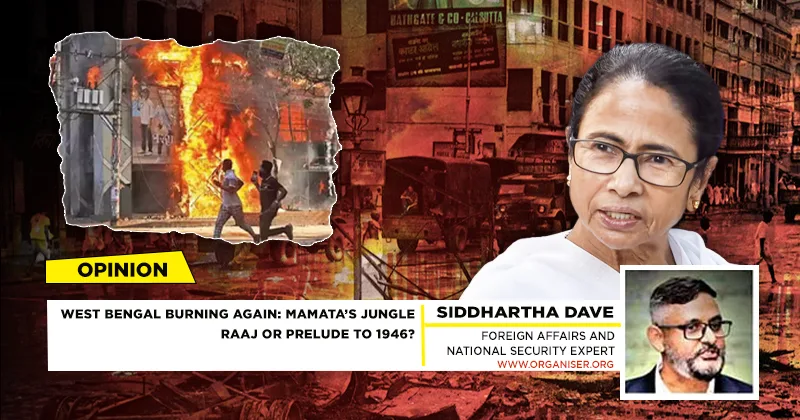
West Bengal, once celebrated as the cradle of Indian Renaissance and the fountainhead of revolutionary spirit, today finds itself mired in a vortex of political anarchy and democratic decline. The current situation is not an isolated breakdown of law and order—it is an alarming echo of the traumatic events of 1946, when Huseyn Shaheed Suhrawardy allowed Direct Action Day to descend into a planned massacre. Fast forward to 2024, and one cannot help but draw unsettling parallels. Chief Minister Mamata Banerjee’s selective silence, her blatant appeasement politics, and continued defiance of India’s constitutional framework evoke disturbing reminders of that dark chapter in Bengal’s history.
Let there be no illusions—this is far more serious than inter-party competition or ideological clashes. This is a full-scale institutional crisis, a silent but brazen war waged against the Indian Union from within. Mamata Banerjee, who once rose through the democratic ladder, now positions herself as the most vocal and unapologetic challenger of the Indian Republic. Her repeated defiance of central laws, open ridicule of judicial pronouncements, and systematic subversion of federal institutions present a dangerous template for regional autocracy.
The murder of a father-son duo, Hargobindo Das (72) and Chandan Das (40) in the state, which should have jolted any responsive government into action, was met with eerie silence. Instead of empathy or accountability, the Trinamool Congress (TMC) resorted to its default playbook—denial, deflection, and demonisation. They went to the extent of absurdly blaming the Bharatiya Janata Party (BJP) and the Border Security Force (BSF) for engineering violence, in a calculated attempt to politicise and discredit the only institutions trying to maintain order.
Let us not forget—the BSF was deployed on orders from the Kolkata High Court to restore order in violence-hit districts like Murshidabad. And yet, Mamata’s government vilified them, questioning their very presence and role. This unrelenting attack on central forces is not just petty politicking—it is a systematic erosion of India’s federal integrity. What are the implications if state governments start rejecting the legitimacy of central forces, courts, and laws? We are witnessing an emerging blueprint for legal secession.
Violence: The Default Setting of Bengal Politics
West Bengal has long been plagued by political violence. What began with the Congress regime of Siddharth Shankar Ray during the turbulent days of Naxalism intensified under the iron-fisted rule of the Communist Party of India (Marxist), and now continues with new-found brazenness under TMC. The players may have changed, but the playbook remains disturbingly familiar. The only variation? The tools and the beneficiaries. Once it was Congress, then CPM, now TMC—but the grassroots enforcers, the street-level foot soldiers of violence, remain largely the same. Their loyalties shift only with the changing winds of power.
The BJP, despite being the primary opposition force, has refrained from adopting similar methods. Its commitment to constitutional values and democratic procedures has often been mistaken for weakness. But true strength lies in restraint. In the face of continuous provocation, the BJP has attempted to work through courts, commissions, and public mobilisation. However, public patience is wearing thin, and Bengal’s electorate—especially the beleaguered Hindu majority—expects not just representation, but resolute protection.
In this context, many look to the BJP as the reincarnation of Gopal Patha, the heroic Hindu dairy trader who, during the 1946 pogrom, organised self-defence to resist the genocidal mobs unleashed by Muslim League. The hope is not for violence, but for valor—channelled constitutionally. A democratic counter-force that asserts itself with moral clarity and legal firmness.
Cut Money, Corruption, and Collapse of Governance
While political violence is Bengal’s oldest malady, corruption is its most widespread contagion. The recent Supreme Court ruling nullifying the appointments of over 25,000 teachers and staff, due to fraudulent recruitment practices, is a stunning indictment of TMC’s institutional collapse. The apex court’s directive to recover salaries paid unlawfully should have triggered mass resignations and accountability. Instead, what we saw was defiance, arrogance, and Mamata’s trademark rhetorical deflections.
The term “cut money” has entered the everyday lexicon of Bengalis. It refers to the extortion culture institutionalised by TMC at all levels. Whether it’s building a house, opening a shop, or seeking a job—nothing moves without greasing the palms of the party cadre. It is a systemic extraction racket that preys on the poorest and rewards the politically connected.
Tragically, Bengal’s once-revered intelligentsia, the so-called Bhadralok, have either turned collaborators or indifferent spectators. This elite, which once produced luminaries like Rammohan Roy, Tagore, and Aurobindo, has surrendered to political convenience. From the Congress to the Communists and now to TMC, the Bhadralok has adapted its loyalty while continuing to sneer at BJP, which it still sees as an alien force. Decades of Marxist indoctrination and selective secularism have left this class morally bankrupt.
Mamata Banerjee’s governance today represents a direct challenge to the unity and integrity of Bharat. Her open defiance of the Citizenship Amendment Act, her government’s resistance to implementing the National Education Policy, and the constant portrayal of central schemes as threats to Bengal’s identity—all indicate a deeper project of Balkanisation. Her ministers have repeatedly made inflammatory remarks against national heroes, Hindu symbols, and constitutional authorities.
What we are witnessing is not administrative failure but ideological rebellion. Sandeshkhali, RG Kar Medical College, Basirhat, and dozens of other hotspots now stand as living testimonials to lawlessness, communal appeasement, and elite indifference. Had such chaos prevailed in any BJP-ruled state, media and civil society would have unleashed a storm. But Mamata continues to operate with impunity, thanks to a compromised ecosystem—from ground-level cadre to drawing-room intellectuals to newsroom editors.
The Road Ahead: BJP’s Moment of Reckoning
The BJP is now more than just an alternative—it is the last line of defence against Bengal’s civilisational decay. With a vote share only a few percentage points behind TMC, it has both the mandate and the responsibility to lead a democratic resurgence. But this cannot be achieved through electoral calculations alone. It requires a deeper cultural connect, mass mobilisation, and narrative correction.
Bengal needs a new ideological movement—one rooted in Sanatan values, nationalist pride, and fearless truth-telling. The spirit of Bengal must rise again, not merely as a political reaction, but as a civilisational renewal. From the sacred chants of the Ganga to the fiery slogans of Subhas Chandra Bose, Bengal has always led from the front. That leadership must now re-emerge, reclaiming the state from fear, factionalism, and falsehoods.
The rest of Bharat cannot remain silent spectators. It must stand shoulder to shoulder with Bengal’s nationalists, intellectuals, workers, and youth who dream of a state that is once again the pride of the nation.
Jai Hind. Jai Maa Bharati.