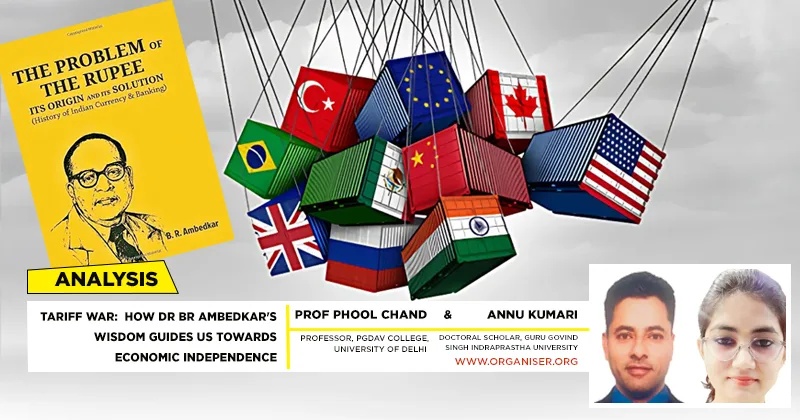
When American President Donald Trump rolled out his “reciprocal tariffs” policy this week, the world watched global trade get tossed into a whirlwind. This long-threatened approach has triggered a trade war, made the global trade landscape much more uncertain and shaken the markets and the trade protocols of the World Trade Organisation (WTO). In the context of the global economy recovering from the Russia- Ukraine war and the Israel- Hamas conflict, the scholars of foreign policy and geo-politics have termed it as a hard disruption from decades of multilateralism.
China, WTO and Trump
The World Trade Organisation (WTO) runs on the principles of non-discrimination, especially the Most Favoured Nation (MFN) clause, which functions on the condition that countries cannot play favourites and must offer the same trade terms to all members. Trump’s tariff policies have directly violated this principle in more than one way: Firstly, it imposed targeted tariffs on China, the EU, Bharat, and others; Secondly, it ignored WTO rulings when they went against US actions; and the US blocked appointments to the WTO’s appellate body.
Since it acceded to the WTO in 2001, China has benefited from WTO provisions that granted developing nations certain trade advantages, such as lower tariff barriers and longer timelines for implementing market-opening commitments. China maintained extensive state control over key industries despite WTO rules favouring open-market competition. Its state-owned enterprises (SOEs) received government subsidies, enabling them to undercut foreign competitors. This was particularly evident in the steel, aluminium, and solar panels sectors, where Chinese firms flooded global markets with artificially cheap products. Western nations, particularly the US, have long accused China of engaging in unfair practices such as forced technology transfers, whereby foreign companies operating in China had to share proprietary technologies with local firms. WTO has also categorised China as a non-market economy.
US policymakers have argued that China indulges in exchange rate manipulation, as it artificially devalued its currency to make its exports more competitive, violating fair trade principles. Although the WTO does not explicitly regulate currency policies, this practice contributed to trade imbalances between China and the rest of the world.
Trade Wars, Markets and Emerging Economies
The collapse in multilateral frameworks, as symbolised by the WTO, leaves emerging economies like Bharat facing risks and opportunities. The more pressing question today is how to stay resilient in a fragmented global order.
For countries like Bharat, this situation represents a diplomatic challenge and an economic dilemma. Bharat has been the island of economic recovery and business opportunity in the post-Covid-19 world. In light of this, how can the economy be shielded when one of the biggest trade partners is swinging tariffs like a wrecking ball?
Currency, Strategic Autonomy and Ambedkar
It is imperative that, for maintaining financial and economic stability amid Trump’s tariffs, the policymakers and the functionaries of the governments step in and ensure the stability of the currency to protect investor confidence and keep imports affordable. The evolving tariff actions need deeper and critical economic and philosophical scrutiny. The economic wisdom and the propositions laid by Dr BR Ambedkar become strikingly relevant in this context. Dr Ambedkar today, is less known as an economist and is more synonymous with social reform, social justice and the constitution. However, the economic philosophy of Dr Ambedkar, chiefly drawn from The Problem of Rupee, may offer the autonomy as well as the opportunity that Bharat requires to respond to the complexities of finance. The Problem of Rupee was a 257-page long thesis presented at the London School of Economics by Ambedkar for his doctoral studies. Ambedkar identified that colonialism sustained itself by keeping the exchange rate in its favour, and common standards of currency value were manipulated.
At a time when Bharat may negotiate with the US administration to seek a favourable trade position, the importance and urgency of revisiting and rereading Ambedkar’s economic philosophy has increased manifold. Bharat needs to protect the interests of Agriculture, dairy, and small and cottage industries and tariffs on agriculture, dairy and products of the employment-oriented small-scale sector should not be lowered. Secondly, Ambedkar had documented the harsh economic realities of colonial Bharat and was also a firm believer in economic independence and advocated the adoption of policies leading towards lesser dependence on other countries. Ambedkar would have provided vocal support to the policies of Make in India and Atmanirbhar as adapted by the present government. Thirdly, Ambedkar recorded and witnessed the economic exploitation of the whole country, and his writings are reflective of the deep care about protecting the underprivileged from economic shocks and inflationary policies (especially food and fuel) that hit the deprived the hardest. At the level of economic policy, this should translate into utilising subsidies, improving distribution systems, or investing in domestic alternatives to imported goods.
Dr Ambedkar had documented the harsh economic realities of colonial Bharat and was also a firm believer in economic independence and advocated the adoption of policies leading towards lesser dependence on other countries
Ambedkar would also push for strong institutions to handle these decisions with foresight and independence. As the intellectual force behind the creation of the Reserve Bank of India, Ambedkar knew that an independent, capable central bank was essential to managing the external economic disruptions Bharat faces today. That means letting institutions like the RBI and the finance ministry work together to keep the Bharatiya economy steady and fair for its citizens. Finally, and importantly, whether the rupee is rising or falling, Ambedkar’s lens of economic justice would require that any policy response should put vulnerable people first. Trade wars and tariffs aren’t just geopolitical games; they affect farmers, small businesses, workers, and families.
Trump’s tariffs may have been very disruptive, but they serve as a wake-up call. It should be read as a movement away from cooperative globalisation to a reordering of globalisation, if not de-globalisation, that has brutally weakened the WTO’s authority and legitimacy. For Bharat, the lesson is twofold: first, economic nationalism in America is reshaping the global trading environment. Bharat must make a movement towards strategic autonomy in its trade negotiations and pursuit of economic interests. Second, Bharat must navigate this new world of uncertainty using Ambedkar’s philosophy to march towards self-reliant economic strategies that protect its interests and provide an alternative global trade environment for the global north and south. Ambedkar’s philosophy serves as a reminder that the currency policy isn’t about impressing Wall Street but protecting Main Street.