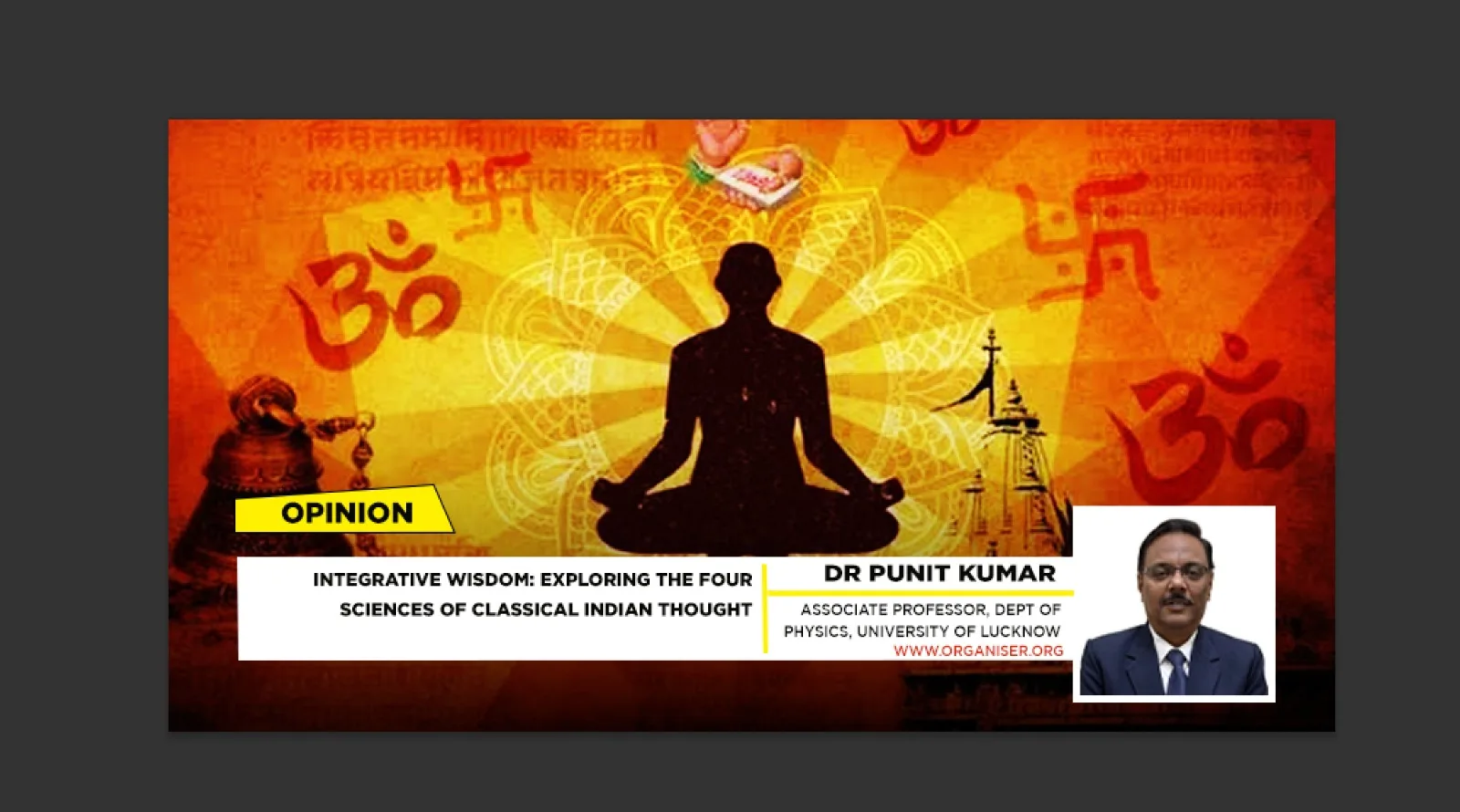
In ancient India, the pursuit of knowledge was not a fragmented or isolated endeavour, but a holistic system deeply rooted in cultural, philosophical, and societal values. Knowledge was broadly categorized into four foundational disciplines, Trayi, Varta, Dandaniti, and Anvikshiki, each representing a vital dimension of life. These were not merely academic branches, but practical frameworks that guided daily living, governance, economic activity, and spiritual understanding. This classification finds significant mention in ancient treatises like Kautilya’s Arthashastra, where it is stated that a wise ruler must be well versed in all four sciences to ensure balanced governance and personal integrity.
Trayi, representing the three Vedas (Rigveda, Samaveda, and Yajurveda), formed the spiritual and ethical core of society. Varta encompassed agriculture, animal husbandry, and trade, laying the foundation for economic sustainability. Dandaniti, the science of public administration and law enforcement, provided the tools for maintaining social order. Anvikshiki, often referred to as the science of inquiry or logic, encouraged critical thinking and philosophical exploration.
These four disciplines reflect a deeply integrated vision of knowledge, where spiritual wisdom, material well being, societal governance, and rational inquiry coexisted in harmony. Their continued relevance today speaks volumes about the enduring genius of India’s ancient intellectual heritage.
Trayi: The Three Vedas – A Spiritual and Philosophical Foundation
The term Trayi refers to the triad of the most ancient and revered scriptures in Indian tradition, Rigveda, Samaveda, and Yajurveda, which together form the spiritual backbone of Vedic literature. These texts are comprehensive repositories of knowledge encompassing spirituality, ritual practice, cosmology, ethics, and philosophy. As foundational texts, the Trayi shaped the worldview, practices, and cultural ethos of ancient Indian civilization and continue to inspire spiritual thought.
The Rigveda is the oldest of the three and consists primarily of hymns (suktas) dedicated to various deities such as Agni (fire), Indra (rain and war), Varuna (cosmic order), and others. Composed in poetic Sanskrit, it emphasizes the power of the spoken word, or mantra shakti, and highlights the role of rituals in maintaining harmony between human beings and the cosmic forces. The hymns of Rigveda also provide deep insights into early Vedic cosmology, social order, and philosophical questions about creation and existence.
The Samaveda, often described as the Veda of melodies, is largely derived from the Rigveda, but is set to music. Its focus is on the musical and rhythmic aspects of Vedic chanting, making it the foundation of Indian classical music. The chanting of Samaveda was considered essential for invoking divine energies during rituals. It emphasizes the aesthetic and emotional dimensions of spiritual practice, acknowledging that the experience of the divine is not only intellectual but also sensory and emotional.
The Yajurveda is more practical and procedural in nature. It contains ritual formulae and instructions necessary for conducting various yajnas, or Vedic sacrifices. The text is divided into the Shukla (White) and Krishna (Black) Yajurveda, which differ in their structure and content. The Yajurveda is invaluable for understanding the ritual mechanics, symbolism, and metaphysical significance of Vedic ceremonies, including offerings, mantras, and the roles of priests.
Trayi represents a holistic epistemological system that aligns human activity with cosmic order. It continues to be a source of inspiration for spiritual seekers, scholars, and cultural practitioners, reminding humanity of the importance of harmony between ritual, reason, and reflection in the pursuit of truth.
Varta: The Science of Agriculture, Animal Husbandry, and Commerce
In the ancient Indian framework of knowledge, Varta holds a pivotal place as the science that governs the economic and material well-being of society. Derived from Sanskrit, the term ‘Varta’ means livelihood or occupation, and in the classical context, it refers to the disciplines of agriculture, animal husbandry, and commerce. These were considered the foundational pillars of a prosperous and self-sustaining society. Varta is thus a practical science, directly linked to the generation and management of wealth, a necessity for both household and state welfare.
Agriculture formed the bedrock of Varta. Ancient Indian texts, including the Arthashastra and various Smritis, describe detailed methods for soil classification, seasonal cropping, crop rotation, irrigation, and storage. Vedic literature also contains hymns and rituals dedicated to agricultural deities, underscoring the sacredness of farming. Farmers were encouraged to follow ecologically sound practices to maintain soil fertility and ensure sustainable yields. This scientific approach ensured food security and agrarian stability, which were essential for any functioning polity.
Animal husbandry was closely linked with agriculture and equally emphasized in Varta. The domestication and breeding of animals like cows, buffaloes, horses, elephants, and goats were crucial not only for food and dairy, but also for ploughing fields, transportation, warfare, and trade. Ancient Indian treatises outlined protocols for the care, feeding, and medical treatment of livestock, reflecting an advanced understanding of veterinary science. Animals were seen as essential assets in rural economies and were often regarded with great cultural and religious reverence.
Commerce was the third vital element of Varta. It covered a wide range of economic activities including trade, barter systems, currency use, market regulation, taxation, import-export dynamics, and pricing mechanisms. Merchants, or vaishyas, formed an important part of society, responsible for distributing goods and maintaining economic flow. Marketplaces (haats), trade guilds (shrenis), and trade routes, including maritime links, facilitated economic prosperity and cultural exchange. Ethical trade practices were enforced through state oversight and moral codes, ensuring fair trade and consumer protection.
Kautilya’s Arthashastra considers Varta as one of the three key pillars of statecraft, alongside Dandaniti (governance) and Anvikshiki (logic and philosophy). The prosperity of a kingdom, according to Kautilya, depends on its economic vitality, which in turn rests on the sound application of Varta.
In modern terms, Varta represents an ancient model of integrated rural economy, highlighting the interdependence of food production, animal resources, and market systems. Its relevance persists today in the form of sustainable farming, agri-business, rural entrepreneurship, and ethical trade policies, making Varta not just a relic of the past but a guiding philosophy for future economic development.
Dandaniti: The Science of Governance and Public Administration
Dandaniti, derived from the Sanskrit words ‘danda’ (punishment, or authority) and ‘niti’ (policy, or conduct), represents the ancient Indian science of governance, encompassing public administration, political science, law, and order. It outlines a systematic approach to statecraft, legal enforcement, social control, and diplomacy, ensuring the stability and prosperity of a kingdom. As one of the four primary disciplines of knowledge in ancient India, Dandaniti was seen as essential for maintaining dharma (righteousness) and societal harmony.
At its core, Dandaniti focuses on law and order. Ancient texts like the Manusmriti and Arthashastra detail legal frameworks for civil, criminal, and family law. They emphasize the importance of codified laws, fair judicial procedures, impartial judges, and appropriate punitive measures. The use of danda was considered necessary not for oppression, but for protecting the weak, deterring crime, and upholding justice. The principle was to align governance with ethical and moral standards.
Administrative organization was another key component of Dandaniti. The Arthashastra by Kautilya (Chanakya) presents a detailed blueprint of governance, including the appointment of ministers, revenue collection, tax systems, espionage networks, and public welfare schemes. The king was advised to appoint qualified officers, maintain accountability, and ensure the welfare of all classes. The administration was expected to be efficient, transparent, and people-centric.
Dandaniti also extended to defense and warfare. Strategic planning for national security, border management, military organization, and intelligence gathering formed vital aspects of governance. Kautilya elaborates on the use of diplomacy, treaties, and war tactics such as Utsāha (initiative), Mantra (strategy), and Danda (force). He emphasizes that a ruler must be both compassionate and decisive, using power judiciously to prevent internal dissent and external invasion.
In essence, Dandaniti is a sophisticated political philosophy that integrates ethics with power, discipline with compassion, and order with welfare. It has inspired generations of political thinkers and continues to offer timeless lessons on leadership, justice, and state administration.
Anvikshiki: The Science of Inquiry and Rational Thought
Anvikshiki, in the ancient Indian tradition, represents the science of logical reasoning, philosophical analysis, and systematic inquiry. Deriving from the Sanskrit root ‘anviksha’ meaning ‘to observe, examine, or investigate’, Anvikshiki emphasizes the use of critical thinking and rational reflection to explore the nature of reality, knowledge, and ethical conduct. This discipline played a central role in the intellectual culture of ancient India, fostering independent thought and open debate.
Historically, Anvikshiki was recognized as a distinct field of study alongside the three other core sciences: Trayi (Vedas), Varta (economics and agriculture), and Dandaniti (governance). As stated in Kautilya’s Arthashastra, ‘Anvikshiki is the lamp of all sciences, the means of all actions, and the support of all dharma. This recognition highlights Anvikshiki’s unique role in providing intellectual clarity and moral insight across diverse fields of knowledge.
One of Anvikshiki’s key contributions was the development of philosophical systems such as Samkhya, Yoga, Nyaya, Vaisheshika, and Lokayata (Charvaka). These schools presented diverse perspectives on metaphysics, epistemology, cosmology, and consciousness. For example, Samkhya proposed a dualistic framework of Purusha (consciousness) and Prakriti (matter), while Nyaya focused on logic, valid knowledge (pramana), and reasoning techniques. Even the skeptical Lokayata school contributed by questioning supernatural claims and advocating empirical observation.
Logic and debate were central to Anvikshiki. The discipline trained scholars in constructing valid arguments (nyaya), identifying fallacies (hetvabhasa), and engaging in formal debates (vada). Ancient Indian universities like Takshashila and Nalanda emphasized this intellectual training, producing philosophers, jurists, and logicians who mastered the art of dialectic reasoning. This tradition helped create a vibrant atmosphere of intellectual pluralism, where different viewpoints were respectfully examined and discussed.
Another significant dimension of Anvikshiki is its engagement with ethics and morality. It provided the tools to evaluate human conduct and societal norms based on reason and consequences, rather than blind adherence to authority or tradition. Moral dilemmas, duties, and the pursuit of dharma (righteous living) were explored through logical frameworks, enhancing both personal integrity and social harmony.
By encouraging equanimity in success and failure, Anvikshiki fosters mental discipline, self-awareness, and adaptability, qualities invaluable in any era. In today’s world, where information is abundant but wisdom is scarce, reviving Anvikshiki’s spirit of inquiry can empower societies to cultivate reasoned decision-making, ethical leadership, and intellectual freedom.
Contemporary Relevance
Together, these four sciences form a mutually reinforcing system. Trayi offers the values and moral compass, Varta ensures economic sustainability, Dandaniti upholds governance and societal order, and Anvikshiki sharpens the intellect and critical faculties needed to reflect upon and apply knowledge wisely. Their interrelation illustrates how ancient Indian thought promoted a balanced and integrated worldview that nurtured both the inner and outer dimensions of human life.
In the contemporary educational and policy making landscape, re-integrating these four disciplines could provide a transformative paradigm. Trayi encourages spiritual literacy and cultural rootedness. Varta supports vocational training and sustainable livelihoods. Dandaniti informs civics education and public ethics. Anvikshiki fosters scientific temper, analytical thinking, and emotional intelligence.
By embracing the timeless wisdom of these interconnected sciences, we can re-imagine modern education, governance, and economics through a human centered and holistic lens. This approach not only preserves cultural heritage, but also equips future generations to become ethical leaders, responsible citizens, and critical thinkers in a rapidly evolving world.