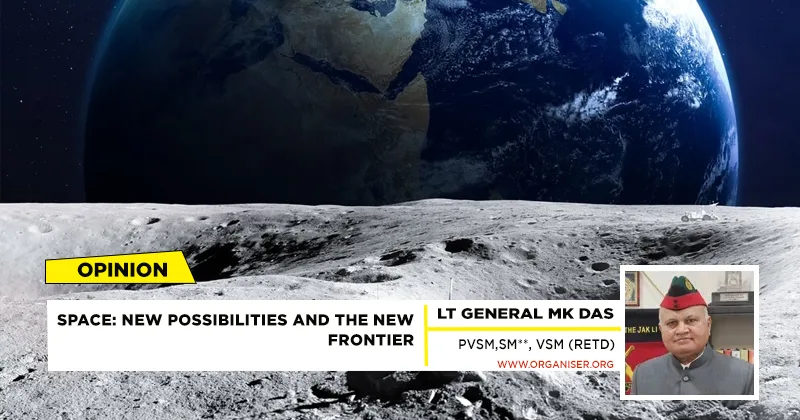
Two important events related to space have been in the news recently. One is docking and de-docking of SpaDex satellites by ISRO (Indian Space Research organisation). The second one is the return of NASA’s two struck astronauts, Butch Wilmore and Sunita Williams safely back to mother earth on March 19, by SpaceX crew capsule, after an extended stay of nine months in the space. The story of Sunita Williams, an astronaut of Indian origin from Gujarat has inspired millions of people. Space indeed is flavour of the times ahead and may well be the new frontier.
The exploration of the space became a regular feature right from the 1950s, with both Soviet Union and USA launching satellites into the spatial orbit. On April 12, 1961, Russian Yuri Gagarin became the first human to orbit Earth in Vostok 1, a flight that lasted 108 minutes. On 20 July 1969, Neil Armstrong, an American astronaut landed on Moon which has oft been quoted as “one giant leap for mankind”. Thereafter, space continued to be explored for peaceful purposes. Concurrently, the military usage of space was also explored, beginning with missile programmes.
Indian space programme was institutionalised in November 1969, with establishment of ISRO in Bengaluru, Karnataka. The Government of India constituted the Space Commission and Department of Space (DOS) and placed ISRO under its ambit in 1972. Possibly, India could think big after outstanding victory over Pakistan in December 1971 war. India’s space programme primarily focuses on developing indigenous technology, launching satellites for various applications and exploring space. DOS functions directly under the PMO. India was an under developed economy in the 1960s and 1970s and therefore it needed visionary leadership to venture into space exploration.
With modest beginnings, ISRO achieved some notable successes including Mars Orbiter Mission and Gaganyaan human spaceflight programme. ISRO has launched more than 120 indigenous satellites so far, starting with the famous Aryabhata in 1975 and thereafter INSAT (Indian National Satellite) & IRS (Indian Remote Sensing) series of satellites and many more. India has achieved major success in launching GSLV (Geosynchronous Satellite Launch Vehicle). ISRO has also launched 393 foreign satellites, most of them the launch station located at Sriharikota, Andhra Pradesh.
The annual budget of DOS in the year 2025-26 is Rs 13,416 crore, which possibly is the cost of one squadron of latest fighter jets. Compare this with $ 7.4 billion budget for NASA in the fiscal year 2024. Thus, India has been able to achieve much more from its space mission, as compared to the investment. For example, Chandrayaan-3 mission, India’s successful lunar landing cost approximately Rs 615 crore, which possibly is the cost of a single modern fighter jet.
India now is a major player in the global space industry, along with NASA (USA), Roscosmos (Russia), CNES (France) and ESA (Europe), along with private companies such as SpaceX (owned by Elon Musk), Blue Origin (Jeff Bezos) and Virgin Galactic (Richard Branson). Sunita Williams is returning by a SpaceX capsule. Thus, private industry has emerged as a major player in space exploration.
In India too, the private players and startups are getting actively engaged in space domain, with the incentives provided by the Modi government. Skyroot Aerospace became the first private Indian company to launch a rocket into space from Sriharikota on 18 November 2022. In addition, Agnikul Cosmos is in the advanced stages of developing their own launch vehicle. The new Indian Space Policy of 2023 allows private companies to launch and operate satellites. This policy also permits 100% FDI in the space sector. A large number of startups, promoted by venture capitalists have shown interest in the space industry. Essentially, economic viability of rare minerals and its exploration would be the key to success in the outer space.
China has one of the most active space programmes in the world, with its four launch stations. China has been launching the maximum satellites in the recent years, launching satellites for communications, navigation, remote sensing and scientific research facility. Besides the US and Russia, China has also launched human spaceflight successfully. China National Space Agency (CNSA) and People’s Liberation Strategic Support Force actively collaborate for the military application of the space. China reportedly possesses an accurate anti-satellite (ASAT) capability and therefore can be a threat in the future.
India was relatively slow in exploiting space technology for military purpose. In the last decade, the Modi government has pushed for pure military application or dual-purpose satellites. As of now, India has 3 exclusive defence satellites (GSAT series) and balance 6 are dual purpose satellites with military and civilian applications. China has overwhelming numerical and qualitative superiority over India in space strategic arena. ISRO is now therefore developing a satellite for the exclusive use of Indian Army.
Space Warfare is combat in outer space with one or more space players, including ground to space or space to space attacks, with kinetic and non-kinetic weapons. While, the space expertise primarily supports conventional military operations in land, sea and air, it is believed that the outer space itself could be the next theatre of future conflicts. ASAT weapons which are primarily surface to space or space to space missiles have been developed by US, Russia and China. India has also demonstrated ASAT capability in March 2019, making its intent clear to our future adversaries in the space.
India has established Defence Space Agency (DSA) in the year 2018 to enhance military space application and coordination. DSA has tri-service representation of Indian Army, Indian Air Force and Indian Navy. DSA also coordinates space application with other satellites which are meant for civilian application. In due course, India plans to have an exclusive Space Command for defence purpose. India clearly realises the importance of space as the new frontier.
The militarisation of space has some inherent challenges like that of space debris and cyber warfare. Space assets are vulnerable to cyber-attacks and China has acquired high capability in this field. The existing Outer Space Policy prohibits placement of weapons of mass destruction in the space but does not prohibit military activities in space. In due course, the international space treaty would be dominated by key players like USA and China. India as the leader of the Global South, too should also fight for democratisation of space for the larger good of the humanity.
India has ambitious plans for exploration of outer space in the future. Modi 3.0 Government has recently approved Chandrayaan-5 mission, with a 350 kg rover to land on moon. DSA has been tasked to have India’s own space station (Bharat Antriksh Station) by the year 2035. India is also working towards realising the dream of an Indian landing on Moon and safely returning, by the year 2040.
Indian space scientists and technicians, many of them women, have done the country proud. The success of India in general and ISRO in particular demonstrates the scientific prowess of a nation with complete support of the government and emergence of the private industry. This success story should inspire more government and non-government agencies to similarly excel in cutting edge technology and realising the developmental goals of Viksit Bharat @2047.