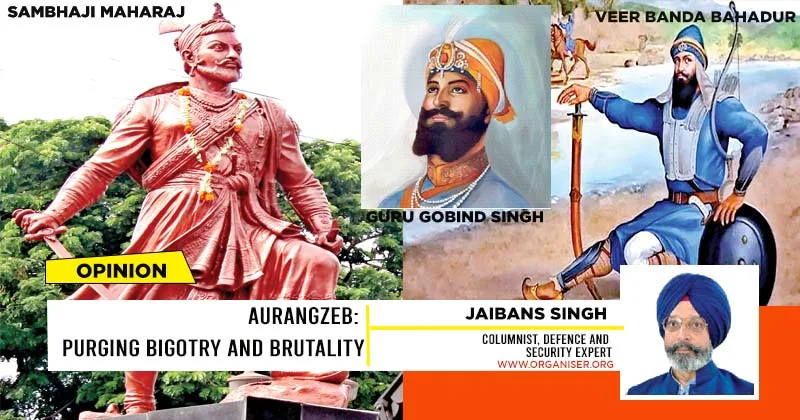
The period from mid-17th to the first quarter of the 18th Century is significant in the history of the Bharatiya civilisation. It was during this period that the people rose to challenge the rule of Islamic invaders that had been in place for more than six centuries by that time.
The peaceful and hard-working peasants took up arms and challenged the repressive authority of the Mughals. They became fierce and fearless warriors in a very short period of time under the dynamic leadership of two visionary warriors – Guru Gobind Singh of Punjab and Chhatrapati Shivaji Maharaj of Maharashtra. The similarity in qualities and patriotic vision of the Guru and Shivaji had a strong impact on the future of the nation.
The oppressive Ruler
Aurangzeb was not declared heir to the Mughal throne by his father. He wrested the throne and proclaimed himself the ruler after blinding and imprisoning his father and brutally killing his four brothers. He tortured to death his elder brother, Dara Shikoh, who was the legitimate and most acceptable heir to the throne.
Aurangzeb looked upon himself as a great warrior and strategist. His military victories, however, were against insignificant persons and petty kings. When his armies faced leaders and warriors like Guru Gobind Singh and Shivaji they were exposed as weak, cowardly and disorganised. In the last two decades of his reign, he remained immersed in his egoistic attempt to win the Deccan and ignored governance totally. As a result, the empire fell to immorality as was explained to him by Guru Gobind Singh in Zafarnama.
All Islamic rulers were known to be ruthless and brutal. Aurangzeb took this brutality to a whole new level. He pursued religious fundamentalism and extreme radicalism, whereby, unspeakable atrocity was inflicted upon his non-Muslim subjects. A chauvinist and bigot in true sense, he was also particularly cruel towards his perceived enemies, which is quite obvious by the vicious murders of Guru Tegh Bahadur, Dara Shikoh and Sambhaji.
Aurangzeb thought that his acts would cow down the people to submission but the reverse happened. The peace loving Sikh and Marathas farmers, on the call of their leaders, took up arms and became formidable warriors. They heralded not only his ignominious end but also the disintegration of his empire and his dreams to Islamise his subjects.
Guru Gobind Singh and Chhatrapati Shivaji
The two great warriors and visionary leaders belonged to different regions and communities and did not meet in their lifetime. Yet, they had many similarities in their personal traits and policies.
The Training: The parents of Guru Gobind Singh and Shivaji ensured a wholesome education for their wards that included study of languages, history, administration and most importantly, military training. Both were brilliant students, articulate philosophers and proficient in the use of arms. They grew up to be great leaders who could motivate their followers to achieve the impossible.
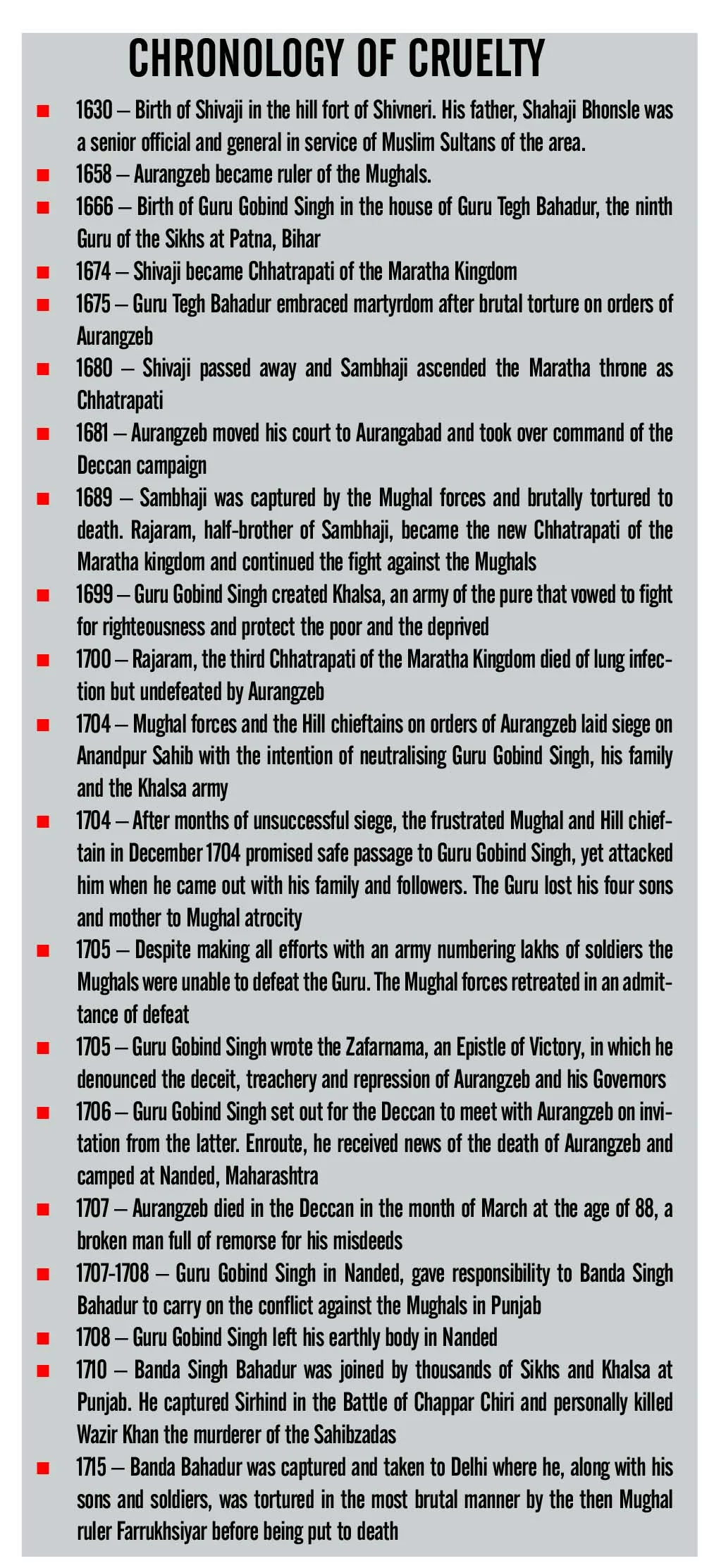
The Socio-Political Environment: The brutal murder of Guru Tegh Bahadur had a deep impact on Guru Gobind Singh. Similarly, Shivaji saw his father as a person subservient to an Islamic master, despite being a prominent military general and administrator. Both considered the situation to be unacceptable.
The Vision: Both fought against repression and injustice by the Mughal rulers while carrying a common vision of Swaraj (freedom) for their people and their land.
The Military Acumen:Adept in military tactics and strategy, Guru Gobind Singh conceived the Khalsa, and Shivaji built a small force called the Mavlas that expanded into a full-fledged army. Both were well-equipped and well-honed military units that were adept in fighting in the available terrain configuration. Cavalry formed their most potent segment; speed and surprise was their biggest asset. Troops were trained to fearlessly attack vastly superior forces and emerge victorious.
Strength and Resolve: Both remained immune to the show of might, the preferred method of Islamists to intimidate opposition. Their resolve bordered on the obstinate, they never gave up even under impossible situations. The strength and courage was unmatched.
Leadership Traits: They cared for their troops and subjects at all times as their own family. They set for their men very high moral standards in which respect and security of women and children was sacrosanct. They led by example. Their adversaries were exposed when seen in contrast to their high moral threshold.
Chhatrapati Sambhaji : A courageous King
Aurangzeb came to the Deccan almost at the same time as Sambhaji became Chhatrapati of the Marathas. Sambhaji knew Aurangzeb well since, at the age of nine, he had been taken political hostage by the Mughal court and later he was a prisoner in Agra along with his father; both had made a daring escape from Agra.
A big reason for Aurangzeb’s move to the Deccan was the alliance forged between Sambhaji and Prince Akbar, son of Aurangzeb. Aurangzeb attempted to capture the Maratha capital of Fort Raigad which led to the Mughal invasion of Konkan. Despite having a small force in comparison to the vast Mughal army, Sambhaji fought Guerrilla warfare. He disrupted enemy supply lines and conducted daring raids. Territory changed hands repeatedly during this interminable warfare. Aurangzeb was forced to contest every inch of territory at great cost in lives and money.
Sambhaji was captured by the Mughal forces of Muqarrab Khan at Sangameshwar in February 1689, after more than eight years of conflict with the Mughals. He was asked to surrender his forts and treasures and convert to Islam, which he refused. He was then brutally tortured for forty days. Ultimately he was decapitated and cut into small pieces. The Marathas were horrified by the brutal treatment given to their King. They rallied around Chhatrapati Rajaram and extracted terrible vengeance from the Mughals. Aurangzeb waged continuous war in the Deccan for more than a decade after the murder of Sambhaji and eventually died at the age of 88 without gaining control of the land. The constant warfare, drove his empire to bankruptcy.
Banda Bahadur : The Braveheart
Guru Gobind Singh, while in Nanded, met an ascetic named Madho Das. He made Madho Das his disciple, renamed him Banda Bahadur and gave him the responsibility of avenging the brutal murder of his younger sons, Sahibzada Zorawar Singh and Sahibzada Fateh Singh by Wazir Khan, the Governor of Sirhind. He also bade him to destroy the evil Mughal administration in Punjab and protect the poor people.
In Punjab, Sikhs joined Banda Singh Bahadur in vast numbers. The first major victory for him was the Battle of Chappar Chiri on May 24, 1710. Banda Singh Bahadur killed Wazir Khan, entered Sirhind and announced the establishment of Sikh rule to end the tyranny of the Mughals. This was the first territorial conquest of the Sikhs, which placed them in possession of significant areas south of river Satluj. He established his capital at Lohgarh and minted coins in the name of Guru Nanak.
In 1713, due to the pressure of a vastly powerful Mughal army from Lahore, the Sikhs under Banda Bahadur left Lohgarh and Sadhaura and went to the remote hills of Jammu where they built Dera Baba Banda Singh at Reasi.
Due to fervent appeals by the people, Banda Singh Bahadur came back to Punjab and continued to harass the Mughals. He greatly weakened their hold in Punjab. The Sikh soldiers fought with great bravery under sustained onslaught of the enemy. Sadly, the Mughal force was too big for them. The Sikhs made their last stand at Gurdas Nangal where the Mughal forces had laid siege for eight months. Finally, on December 17, 1715, Banda Bahadur was captured and taken to Delhi where he was tortured in the most brutal manner before being put to death. The brutal murder of Banda Singh Bahadur by Farrukhsiyar enthused the Sikhs into fighting back and it sealed the fate of the Mughal empire. The Sikh Misls soon held sway over Punjab and within a century, the Sikh Empire had been established in Punjab after having decimated the Mughal as well as the Afghans.
Lesson to be Learnt
By the middle of the seventeenth century, the Mughals had deteriorated into a repressive, intolerant regime whose ruler, Aurangzeb, had abandoned the legacy of partial tolerance and religious pluralism followed by his predecessors. The Governors of Aurangzeb adopted his repressive policies and caused terrible suffering to non-Muslims. His barbaric behaviour as manifested by the brutal executions of Dara Shikoh, Chhatrapati Sambhaji and Guru Tegh Bahadur had a lasting impact on the people who took up arms to end the tyrannical, immoral, brutal and exploitative regime.
The final nail in the coffin was the ruthless murder of Sahibzadas by the Mughal Governor of Sirhind. It galvanised the entire Sikh community into rising against persecution and injustice. Farrukhsiyar did not learn any lesson from the mistakes of Aurangzeb. He heaped the most unspeakable atrocity upon Banda Singh Bahadur and Sikhs captured by him while they withstood all torture with courage and stoicism.
The movement against the Mughals in Punjab gained momentum after this incident and the Mughals soon lost all authority in the region to the Misls. The Sikhs had to fight and defeat another evil empire of the Afghans before the successful creation of the enlightened Sikh Empire by Maharaja Ranjit Singh. The derived lesson is the need to strengthen the concepts of religious pluralism and unity in diversity that have been the benchmark of the Bharatiya civilisation for many millennia. Bharat may have transitioned to a vibrant form of democratic governance but deep state forces are always at work to create religious divides and spread hatred. Every Bharatiya needs to remain vigilant to secure the freedom that has been earned by Guru Gobind Singh, Chhatrapati Shivaji and many more with their unimaginable sacrifices.