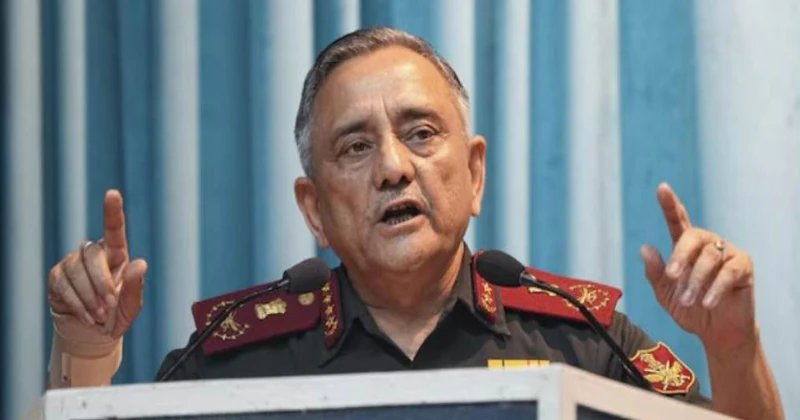
Technology can be enabler but it cannot replace people: CDS Anil Chauhan
July 15, 2026
  • Read Ecopy
  • Circulation
  • Advertise
  • Careers
  • About Us
  • Contact Us
Android AppiPhone AppArattai
Organiser
  • ‌
  • Bharat
    • Assam
    • Bihar
    • Chhattisgarh
    • Jharkhand
    • Maharashtra
    • View All States
  • World
    • Asia
    • Europe
    • North America
    • South America
    • Africa
    • Australia
  • Editorial
  • International
  • Opinion
  • RSS @ 100
  • More
    • Op Sindoor
    • Analysis
    • Sports
    • Defence
    • Politics
    • Business
    • Economy
    • Culture
    • Special Report
    • Sci & Tech
    • Entertainment
    • G20
    • Azadi Ka Amrit Mahotsav
    • Vocal4Local
    • Web Stories
    • Education
    • Employment
    • Books
    • Interviews
    • Travel
    • Law
    • Health
    • Obituary
  • Subscribe
    • Subscribe Print Edition
    • Subscribe Ecopy
    • Read Ecopy
  • ‌
  • Bharat
    • Assam
    • Bihar
    • Chhattisgarh
    • Jharkhand
    • Maharashtra
    • View All States
  • World
    • Asia
    • Europe
    • North America
    • South America
    • Africa
    • Australia
  • Editorial
  • International
  • Opinion
  • RSS @ 100
  • More
    • Op Sindoor
    • Analysis
    • Sports
    • Defence
    • Politics
    • Business
    • Economy
    • Culture
    • Special Report
    • Sci & Tech
    • Entertainment
    • G20
    • Azadi Ka Amrit Mahotsav
    • Vocal4Local
    • Web Stories
    • Education
    • Employment
    • Books
    • Interviews
    • Travel
    • Law
    • Health
    • Obituary
  • Subscribe
    • Subscribe Print Edition
    • Subscribe Ecopy
    • Read Ecopy
Organiser
  • Home
  • Bharat
  • World
  • Operation Sindoor
  • Editorial
  • Analysis
  • Opinion
  • Culture
  • Defence
  • International Edition
  • RSS @ 100
  • Magazine
  • Read Ecopy
Home Bharat

Technology can be enabler but it cannot replace people: CDS Anil Chauhan

CDS General Anil Chauhan stressed human presence in warfare, intelligence, and cognitive warfare, while US expert Vivek Lall highlighted speed, data sharing, and tech dominance in modern conflicts

WEBDESKWEBDESK
Mar 20, 2025, 08:00 am IST
in Bharat
Follow on Google News
FacebookTwitterWhatsAppTelegramEmail

Chief of Defence Staff (CDS) General Anil Chauhan said that technology can be an enabler but it cannot replace people. He noted that India has been facing asymmetric threats and it is called the “subconventional kind of conflict” in India.

In his remarks during the discussion on ‘Verses and Wars: Navigating Hybrid Theatres’ during the Raisina Dialogue on August 19, he said that India invented the “unconventional kind of conflict” term much before the West invented terms like global war on terror or asymmetric warfare or fourth generation warfare.

When asked about his experience in countering asymmetric threats as India has faced hybrid threats from both state and non-state actors, he responded, “India has been facing this asymmetric threat, or what you call this kind of a threat. We have called it always subconventional kind of conflict. We invented this particular term much before West invented terms like global war on terror or asymmetric warfare or fourth generation warfare or now hyper conflicts. So, we have called it conflict which is below the threshold of conventional kind of conflict. And as far as the lessons are concerned, I think the biggest lesson is that there is no substitute for boots on grounds. Technology can only be an enabler but it cannot replace people. think that’s very important.”

He stated that second important lesson is about shaping of the combat zone and called intelligence the third important lesson.

Elaborating on lessons learnt by India, he said, “Second important lesson is about shaping of the combat zone actually. In conventional conflicts, you shape the battlefield with fire actually. Over here, we are looking at shaping of the mindscape, not the landscape. So the battle of the minds becomes important as far as hybrid warfare is concerned.”

“The third important lesson is about intelligence that intelligence is important, both human and technical intelligence. And we’re not talking about the combat zone, but area around the combat zone also, this would be important. In such kind of hybrid warfare, I think we should also look at close collaboration between the state government and the local police. So it’s a kind of a whole of government approach which is able to look at such kind of warfare. This I think would be major lessons what India has learned in its battle against subconventional conflicts,” he added.

During the discussion, he said that the global security environment is marked by two things – uncertainty and rapid amount of change. He recalled that the types of war that were taught when he joined the army 43 years back was traditional wars.

“I think the global security environment is marked by two things. One is uncertainty and rapid amount of change. I joined the army about almost 43 years back and the types of war they taught us about, the traditional wars, you know, declared conflicts, they’re no longer there. But yet conflicts exists. It’s perennial and it is ubiquitous. We see it every day on our television screens. So, this is where the global security environment is,” he said.

He termed training people or understanding the conventional war along with a hybrid kind of war the biggest challenge that India faces.

On challenges faced by India, he said, “And as far as India is concerned, I think the biggest challenge which I face is to train people or to understand the conventional war as well along with this kind of hybrid kind of wars. That’s one big challenge. The second big challenge which I foresee is training people for all this kind of conflicts and wars.

“The third thing which I feel is disinformation. For a country like us, which is a multicultural, multi-religious, multi-ethnic society, disinformation is, I think, our internal strife could be a major challenge. So, that’s a big challenge for us, and this is beginning of what we can call is the battle of minds, actually, or the cognitive warfare. This, I think, is a major challenge. Last but not the least is the speed of technological advancement and absorbing those technologies into us, our system, and training people, retraining people, that I think is a major challenge,” he added.

During the discussion, Vivek Lall, Chief Executive, General Atomics Global Corporation, United States of America, called speed the essence of any endeavour these days. He said that persistent surveillance deters conflict and force.

He said, “I think speed is, of course, the essence of any endeavor these days, whether in the Defense Security space or the energy security space. And as I hear the conversation that Raisina, I can’t help but distill down to six areas that I think need absolute, immediate attention from like-minded nations. The first would be persistent surveillance. Persistent surveillance deters conflict. It deters force. And we don’t do enough. We need to do more of them individually.”

“The second aspect that has been brought up by some. We need robust data sharing. Robust data sharing not just by partners and allies…The third piece is the human resource factor, and the fact that training and cooperation and training special especially in special forces training, I think is very critical,” he added.

He called electromagnetic spectrum dominance “very critical.” He stressed that the relationship between India and the US is “very robust.”

Lall said, “Another point is electromagnetic spectrum dominance, I think that is very critical. Moving forward, you can collect all sorts of data, but if you do not put it in an order where you can actually see a real time operational picture, and therefore be able to respond, the data will just remain data.”

“Finally, the ability to deliver massive numbers. We’ve seen that in the recent months, the ability to have loitering munitions in the numbers required…this is logistical nodes that is going to be critical in moving forward. And certainly the US India relationship is, I think, very robust. There’s been a lot of great strides made. Indian industry is world class, I think, with not only the large, medium, small, but also the startup community, we’ve had great success working together industry,” he added.

(with inputs from ANI)

Topics: Anil ChauhanGeneral Anil ChauhanAtomics Global Corporation
ShareTweetSendShareSend
✮ Subscribe Organiser YouTube Channel. ✮
✮ Join Organiser's WhatsApp channel for Nationalist views beyond the news. ✮
Previous News

UP: Sambhal administration denies permission for ‘Neja Mela’ saying, ‘Glorification of invaders is not acceptable’

Next News

Ancient Trade Hub Discovered Along Tamil Nadu’s Thoothukudi Coast: Pattinamaruthur’s history unveiled through artefacts

Related News

Chief of Defence Staff General Anil Chauhan

“IAF was not allowed to participate in 1962 war”, says CDS Gen Chauhan, calling it a missed strategic opportunity

Chief of Defence Staff General Anil Chauhan

Pakistan planned 48-hour strike, came begging for talks in 8 hours: CDS General Anil Chauhan

Chief of Defence Staff (CDS) General Anil Chauhan

CDS General Anil Chauhan pitches for new approach to war fighting, calls for “joint culture” in armed forces

“Unsettled borders with China and its rise will remain most formidable challenge for India”: CDS General Chauhan

Chief of Defence Staff General Anil Chauhan lays wreath at the National War Memorial, on the occasion of 77th Infantry Day

77th Infantry Day: Chief of Defence Staff lays wreath at National War Memorial

Need to develop BrahMos Missile variant for smaller warplanes: IAF Chief VR Chaudhari

Load More

Latest News

Madhya Pradesh's Uniform Civil Code draft proposes mandatory registration of live-in relationships

Madhya Pradesh: UCC draft proposes mandatory registration of live-in relationships, divorce & inheritance laws

Devotees gather in large numbers in Puri for Mahaprabhu Jagannath's Nabajaubana Darshan

Odisha: Mahaprabhu Jagannath appears in divine Nabajaubana form after 15-day anasara, thousands gather in Puri

India's Udyam Registration and Udyam Assist platforms are formalising MSMEs and driving inclusive entrepreneurial growth

How Udyam Registration and Udyam Assist are transforming India’s MSME and entrepreneurial ecosystem

Maoist Ravindra Ganjhu (Source: OpIndia)

Jharkhand: Maoist commander Ravindra Ganjhu with bounty of Rs 20 lakh arrested after 16 years

Gyanvapi Complex

Gyanvapi Row: Hindu side demands Mosque premises be vacated, Muslim side rejects mediation; Both seek court verdict

Union Minister Piyush Goyal (Left) and European Commissioner for Agriculture and Food, Christophe Hansen (Right)

India-EU FTA legal scrubbing nears completion; Trade pact set to become operational in early 2027

World Youth Skills Day 2026

World Youth Skills Day 2026: Equipping young people for a shared future in an AI-driven world

Kalyan Banerjee Blames Abhishek Banerjee’s ‘Camac Street Ecosystem’, I-PAC for TMC’s 2026 Poll Defeat

‘Camac street finished TMC’: Kalyan Banerjee blames Abhishek Banerjee, I-PAC for Bengal poll debacle and party split

Air India Crash: Final report to be out soon

Air India AI-171 crash probe enters final phase; Draft investigation report likely by October, AAIB tells Supreme Court

A representative image

Passport meant for international travel, not citizenship proof: MEA clarifies amid political row

Load More
  • Privacy
  • Terms
  • Cookie Policy
  • Refund and Cancellation
  • Delivery and Shipping

© Bharat Prakashan (Delhi) Limited.
Tech-enabled by Ananthapuri Technologies

  • Home
  • Search Organiser
  • Bharat
    • Assam
    • Bihar
    • Chhattisgarh
    • Jharkhand
    • Maharashtra
    • View All States
  • World
    • Asia
    • Africa
    • North America
    • South America
    • Europe
    • Australia
  • Editorial
  • Operation Sindoor
  • Opinion
  • Analysis
  • Defence
  • Culture
  • Sports
  • Business
  • RSS @ 100
  • Entertainment
  • More ..
    • Sci & Tech
    • Vocal4Local
    • Special Report
    • Education
    • Employment
    • Books
    • Interviews
    • Travel
    • Health
    • Politics
    • Law
    • Economy
    • Obituary
  • Subscribe Magazine
  • Read Ecopy
  • Advertise
  • Circulation
  • Careers
  • About Us
  • Contact Us
  • Policies & Terms
    • Privacy Policy
    • Cookie Policy
    • Refund and Cancellation
    • Terms of Use

© Bharat Prakashan (Delhi) Limited.
Tech-enabled by Ananthapuri Technologies