Tamil Nadu: The Bastion of Hindu Dharma and Sanskrit Heritage
December 5, 2025
  • Read Ecopy
  • Circulation
  • Advertise
  • Careers
  • About Us
  • Contact Us
Android AppiPhone AppArattai
Organiser
  • ‌
  • Bharat
    • Assam
    • Bihar
    • Chhattisgarh
    • Jharkhand
    • Maharashtra
    • View All States
  • World
    • Asia
    • Europe
    • North America
    • South America
    • Africa
    • Australia
  • Editorial
  • International
  • Opinion
  • RSS @ 100
  • More
    • Op Sindoor
    • Analysis
    • Sports
    • Defence
    • Politics
    • Business
    • Economy
    • Culture
    • Special Report
    • Sci & Tech
    • Entertainment
    • G20
    • Azadi Ka Amrit Mahotsav
    • Vocal4Local
    • Web Stories
    • Education
    • Employment
    • Books
    • Interviews
    • Travel
    • Law
    • Health
    • Obituary
  • Subscribe
    • Subscribe Print Edition
    • Subscribe Ecopy
    • Read Ecopy
  • ‌
  • Bharat
    • Assam
    • Bihar
    • Chhattisgarh
    • Jharkhand
    • Maharashtra
    • View All States
  • World
    • Asia
    • Europe
    • North America
    • South America
    • Africa
    • Australia
  • Editorial
  • International
  • Opinion
  • RSS @ 100
  • More
    • Op Sindoor
    • Analysis
    • Sports
    • Defence
    • Politics
    • Business
    • Economy
    • Culture
    • Special Report
    • Sci & Tech
    • Entertainment
    • G20
    • Azadi Ka Amrit Mahotsav
    • Vocal4Local
    • Web Stories
    • Education
    • Employment
    • Books
    • Interviews
    • Travel
    • Law
    • Health
    • Obituary
  • Subscribe
    • Subscribe Print Edition
    • Subscribe Ecopy
    • Read Ecopy
Organiser
  • Home
  • Bharat
  • World
  • Operation Sindoor
  • Editorial
  • Analysis
  • Opinion
  • Culture
  • Defence
  • International Edition
  • RSS @ 100
  • Magazine
  • Read Ecopy
Home Bharat

Tamil Nadu: The Bastion of Hindu Dharma and Sanskrit Heritage

Tamil Nadu has historically preserved Hindu Dharma and Sanskrit, with its rulers, saints, and scholars ensuring their continuity alongside Tamil traditions. Despite modern narratives attempting to separate Tamil from Sanskrit, historical evidence highlights their deep-rooted coexistence in spiritual and scholarly domains

Dr Niranjan B PoojarDr Niranjan B Poojar
Mar 18, 2025, 07:00 pm IST
in Bharat, Tamil Nadu
Follow on Google News
FacebookTwitterWhatsAppTelegramEmail

Tamil Nadu has played a pivotal role in preserving Hindu Dharma and the Sanskrit language for millennia. Despite being a region with a distinct linguistic identity, its deep-rooted connection to Sanskrit and Sanatana Dharma remains unparalleled. This article explores how Tamil rulers, saints, and scholars safeguarded Hindu traditions and Sanskrit, ensuring their continued relevance. Through historical records, mandir traditions, and the contributions of great Tamil saints, we analyse the unbroken lineage of spiritual and linguistic continuity in the region.

Tamil Nadu, often regarded by Marxist ideologues as the cradle of Dravidian civilisation, has historically been a stronghold of Hindu Dharma and Sanskrit scholarship. Contrary to modern narratives that attempt to distance Tamil culture from Hindutva and Sanskrit, historical evidence shows a deep and symbiotic relationship between them. From the Sangam era to the Bhakti movement, Tamil Nadu has been instrumental in upholding Vedic and Hindu traditions.

The great Tamil dynasties, including the Cholas, Pallavas, and Pandyas, actively patronised Sanskrit along with Tamil, ensuring the survival of both languages. Tamil Nadu has also given rise to some of the greatest Hindu saints, such as Adi Shankaracharya, Ramanujacharya, and the Alwars, who not only upheld Hindu Dharma but also embraced Sanskrit scriptures.

Historical Legacy: Patronage of Sanskrit and Hindu Dharma

1. Tamil Dynasties and Their Contribution to Hindu Dharma

A. Pallava Dynasty (275 CE – 897 CE)

  • The Pallavas were ardent patrons of Hindu Dharma, responsible for constructing some of the earliest stone mandirs, including the Kailasanatha mandir in Kanchipuram.
  • They supported Sanskrit and Tamil scholars, commissioning inscriptions in both languages.
  • Mahendravarman and Narasimhavarman promoted the study of the Vedas and Upanishads while fostering Tamil literary traditions.

B. Chola Dynasty (848 CE – 1279 CE)

  • The Cholas were known for their unwavering devotion to Hindu Dharma and their contributions to Sanskrit scholarship.
  • The Copper Plates of Rajendra Chola (1042 CE) reveal that Sanskrit was used for religious and aristocratic purposes, while Tamil was used for administration and governance.
  • The magnificent Brihadeeswarar mandir in Thanjavur stands as a testament to their commitment to Hindu traditions.
  • Chola rulers made extensive donations to Sanskrit colleges (Agraharas), ensuring the preservation of Vedic knowledge.

C. Pandya Dynasty (4th Century BCE – 16th Century CE)

  • The Pandyas were known for their patronage of Vedic traditions, which contributed to the survival of Hindu Dharma in South.
  • The renowned Meenakshi mandir in Madurai became a hub for Sanskrit learning and Vedic rituals.
  • Scholars such as Nakkeerar and Parimelazhagar wrote Tamil commentaries on Sanskrit texts, proving that both languages coexisted harmoniously.

The Role of Tamil Bhakti Saints in Protecting Hindu Dharma

The Bhakti movement (6th–9th century CE) played a significant role in preserving Hindu Dharma and Sanskrit traditions. Saints such as the Alwars (Vaishnavite saints) and Nayanars (Shaivite saints) spread devotion to Vishnu and Shiva through Tamil hymns while revering Sanskrit scriptures such as the Vedas, Upanishads, and Bhagavad Gita.

A. Alwars (Vaishnavite Saints)

  • Saints such as Periyalvar, Andal, and Nammalvar wrote Tamil hymns (Divya Prabandham) inspired by Sanskrit scriptures.
  • Their hymns reflect deep Vedic knowledge and encouraged mandir worship aligned with Hindu traditions.
  • Sri Ramanujacharya, the great Vaishnavite philosopher, played a crucial role in propagating Sanskrit and Tamil Hindu scriptures while revitalising Vishishtadvaita Vedanta.

B. Nayanars (Shaivite Saints)

  • Prominent saints such as Appar, Sundarar, and Manikkavasagar composed Tamil hymns that upheld the core tenets of Hindu Dharma
  • Their works align with Sanskrit Agamas and Vedic traditions, demonstrating that Tamil and Sanskrit complemented each other.

Mandirs as Centers of Sanskrit Learning and Hindu Dharma

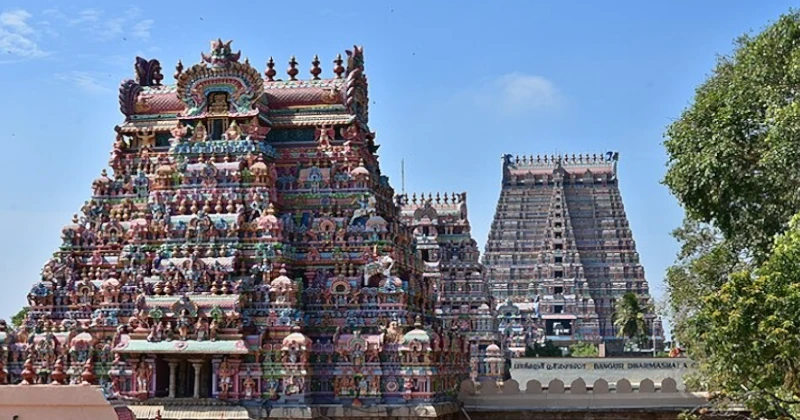
Tamil Nadu is home to some of the grandest Hindu mandirs, which served as centers of Sanskrit learning and Vedic discourse.

  • Chidambaram mandir – A hub of Vedic studies and home to the famous Sanskrit Ananda Tandava Stotra.
  • Kanchipuram – Known as the “City of a Thousand mandirs,” it became a center for Advaita Vedanta, largely due to Adi Shankaracharya’s influence.
  • Ranganathaswamy mandir, Srirangam – A sacred site where Ramanujacharya propagated Vishishtadvaita Vedanta, ensuring the continuity of Sanskrit scriptures.
  • Madurai’s Meenakshi mandir – A Shaiva Siddhanta and Vedic learning hub that continues to perform rituals in accordance with Sanskrit traditions.

The Harmony Between Tamil and Sanskrit

Tamil Nadu has always upheld a unique balance between Tamil and Sanskrit. Several Tamil scholars wrote extensively on Sanskrit texts, translating and interpreting them for a wider audience.

A. Kambar and His Contribution

Kambar, the great Tamil poet, translated Valmiki’s Ramayana into Tamil (Kamba Ramayanam), preserving the essence of the original Sanskrit text.

B. Thiruvalluvar and the Influence of Sanskrit

  • Thiruvalluvar, the legendary Tamil poet and author of Thirukkural, was deeply influenced by Sanskrit scriptures such as the Dharmashastras and Bhagavad Gita.

C. Agastya: The Bridge Between Tamil and Sanskrit

  • Sage Agastya, revered in both Tamil and Sanskrit traditions, is credited with bringing Sanskrit knowledge to Tamil Nadu while also enriching Tamil grammar and literature.

Modern Challenges and the Need for Revival

During colonial rule, a narrative was propagated to create a false divide between Tamil and Sanskrit. The British and missionary scholars encouraged the “Dravidian vs. Aryan” theory, leading to attempts to disconnect Tamil identity from Hindu Dharma and Sanskrit traditions. Even today, political and ideological movements seek to downplay Sanskrit’s influence in Tamil Nadu. However, historical and mandir traditions prove that Tamil Nadu has always been a defender of Sanatana Dharma and Sanskrit heritage.

Tamil Nadu has played an indispensable role in preserving Hindu Dharma and Sanskrit. The great Tamil kings, saints, and scholars ensured that Sanskrit and Tamil coexisted harmoniously, complementing each other in spiritual and administrative domains. Despite modern distortions, the region remains deeply intertwined with Hindu traditions and Sanskrit learning. Tamil Nadu remains a beacon of Hindu Dharma, proving that its cultural roots are deeply embedded in both Tamil and Sanskrit traditions.
Topics: CholasSanatana DharmaHindu DharmaPandya DynastySanskrit HeritageMeenakshi mandir
ShareTweetSendShareSend
✮ Subscribe Organiser YouTube Channel. ✮
✮ Join Organiser's WhatsApp channel for Nationalist views beyond the news. ✮
Previous News

Bihar: Elderly Dalit woman thrashed and raped allegedly in Gopalganj, police arrests key accused Chote Alam

Next News

Bofors cover-up still haunts India: ‘Papers don’t lie, but governments do,’ says Chitra Subramaniam

Related News

Dharti Aaba Birsa Munda: Sva-dharma, Culture and National Identity

103 gold coins from the 13th-century Chola-Pandya era unearthed at Kovilur Sivan Mandir

Historic Discovery in Tamil Nadu: 103 Chola-Pandya gold coins found during Kovilur Sivan Mandir restoration

Banu Mushtaq inaugurating Mysuru Dasara festival epitomizes political & ideological project to detach Hindus from their own faith and traditions

Dasara under siege: When secularism challenges Hindu faith

TTD’S Mandir Construction: Outreach for inclusion Vs insensitive outage

Guruvayur Sri. Krishna Mandir

Rising Mandir intrusions in Kerala spark debate over the sanctity of Sanatani rituals and religious freedom

J Nandakumar and K Annamalai stress devotion and unity at Sabarimala protection conference

Hindus united can overcome foes like Ravana or Duryodhana: J Nandakumar & Annamalai at Sabarimala Protection Sangam

Load More

Comments

The comments posted here/below/in the given space are not on behalf of Organiser. The person posting the comment will be in sole ownership of its responsibility. According to the central government's IT rules, obscene or offensive statement made against a person, religion, community or nation is a punishable offense, and legal action would be taken against people who indulge in such activities.

Latest News

DGCA orders probe into IndiGo flight disruptions; Committee to report in 15 days

BJYM leader Shyamraj with Janaki

Kerala: Widow of BJP worker murdered in 1995 steps into electoral battle after three decades at Valancherry

Russian Sber bank has unveiled access to its retail investors to the Indian stock market by etching its mutual fund to Nifty50

Scripting economic bonhomie: Russian investors gain access to Indian stocks, Sber unveils Nifty50 pegged mutual funds

Petitioner S Vignesh Shishir speaking to the reporters about the Rahul Gandhi UK citizenship case outside the Raebareli court

Rahul Gandhi UK Citizenship Case: Congress supporters create ruckus in court; Foreign visit details shared with judge

(L) Kerala High Court (R) Bouncers in Trippoonithura temple

Kerala: HC slams CPM-controlled Kochi Devaswom Board for deploying bouncers for crowd management during festival

Fact Check: Rahul Gandhi false claim about govt blocking his meet with Russian President Putin exposed; MEA clears air

Union Minister for Road Transport and Highways Nitin Gadkari (Right)

India set for highway overhaul as Union Minister Nitin Gadkari unveils nationwide shift to MLFF electronic tolling

RSS Akhil Bharatiya Prachar Pramukh Shri Sunil Ambekar

When Narrative Wars result in bloodshed, countering them becomes imperative: Sunil Ambekar

Ministry of Civil Aviation mandates emergency action: IndiGo ordered to stabilise flight operations by midnight

Chhattisgarh CM Vishnu Deo Sai at Panchjanya Conclave, Nava Raipur, Image Courtesy - Chhattisgarh govt

Panchjanya Conclave: Chhattisgarh CM Sai shares views on development projects in Maoist hotbed, women empowerment

Load More
  • Privacy
  • Terms
  • Cookie Policy
  • Refund and Cancellation
  • Delivery and Shipping

© Bharat Prakashan (Delhi) Limited.
Tech-enabled by Ananthapuri Technologies

  • Home
  • Search Organiser
  • Bharat
    • Assam
    • Bihar
    • Chhattisgarh
    • Jharkhand
    • Maharashtra
    • View All States
  • World
    • Asia
    • Africa
    • North America
    • South America
    • Europe
    • Australia
  • Editorial
  • Operation Sindoor
  • Opinion
  • Analysis
  • Defence
  • Culture
  • Sports
  • Business
  • RSS @ 100
  • Entertainment
  • More ..
    • Sci & Tech
    • Vocal4Local
    • Special Report
    • Education
    • Employment
    • Books
    • Interviews
    • Travel
    • Health
    • Politics
    • Law
    • Economy
    • Obituary
  • Subscribe Magazine
  • Read Ecopy
  • Advertise
  • Circulation
  • Careers
  • About Us
  • Contact Us
  • Policies & Terms
    • Privacy Policy
    • Cookie Policy
    • Refund and Cancellation
    • Terms of Use

© Bharat Prakashan (Delhi) Limited.
Tech-enabled by Ananthapuri Technologies