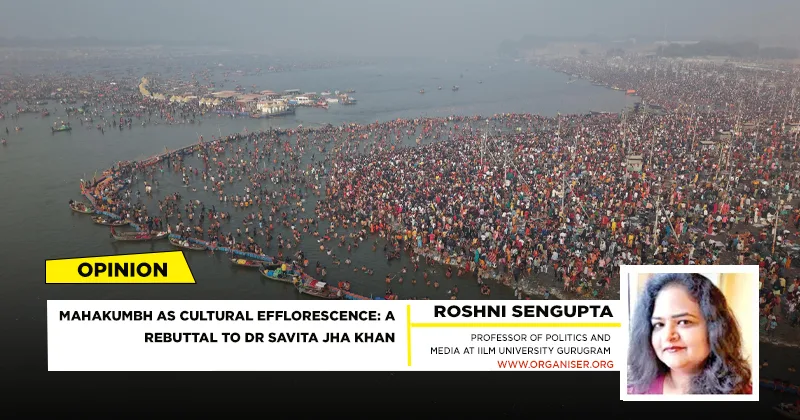
Mahakumbh as cultural efflorescence: A rebuttal to Dr Savita Jha Khan
September 14, 2026
  • Read Ecopy
  • Circulation
  • Advertise
  • Careers
  • About Us
  • Contact Us
Android AppiPhone AppArattai
Organiser
  • ‌
  • Bharat
    • Assam
    • Bihar
    • Chhattisgarh
    • Jharkhand
    • Maharashtra
    • View All States
  • World
    • Asia
    • Europe
    • North America
    • South America
    • Africa
    • Australia
  • Editorial
  • International
  • Opinion
  • RSS @ 100
  • More
    • World Hindu Congress 2026
    • Op Sindoor
    • Analysis
    • Sports
    • Defence
    • Politics
    • Business
    • Economy
    • Culture
    • Special Report
    • Sci & Tech
    • Entertainment
    • G20
    • Azadi Ka Amrit Mahotsav
    • Vocal4Local
    • Web Stories
    • Education
    • Employment
    • Books
    • Interviews
    • Travel
    • Law
    • Health
    • Obituary
  • Subscribe
    • Subscribe Print Edition
    • Subscribe Ecopy
    • Read Ecopy
  • ‌
  • Bharat
    • Assam
    • Bihar
    • Chhattisgarh
    • Jharkhand
    • Maharashtra
    • View All States
  • World
    • Asia
    • Europe
    • North America
    • South America
    • Africa
    • Australia
  • Editorial
  • International
  • Opinion
  • RSS @ 100
  • More
    • World Hindu Congress 2026
    • Op Sindoor
    • Analysis
    • Sports
    • Defence
    • Politics
    • Business
    • Economy
    • Culture
    • Special Report
    • Sci & Tech
    • Entertainment
    • G20
    • Azadi Ka Amrit Mahotsav
    • Vocal4Local
    • Web Stories
    • Education
    • Employment
    • Books
    • Interviews
    • Travel
    • Law
    • Health
    • Obituary
  • Subscribe
    • Subscribe Print Edition
    • Subscribe Ecopy
    • Read Ecopy
Organiser
  • Home
  • Bharat
  • World
  • Operation Sindoor
  • Editorial
  • Analysis
  • Opinion
  • Culture
  • Defence
  • International Edition
  • RSS @ 100
  • Magazine
  • Read Ecopy
Home Bharat

Mahakumbh as cultural efflorescence: A rebuttal to Dr Savita Jha Khan

Dr Savita Jha Khan’s recent article in The Indian Express, claiming that the Maha Kumbh is evidence of Hinduism losing its plurality, reflects a long-standing colonial and missionary narrative aimed at belittling Hindu traditions. Her sweeping generalisations not only dismiss the deeply personal and spiritual significance of the Kumbh pilgrimage but also appear to be driven by a predetermined ideological bias against Hindu rituals and symbols

Roshni SenguptaRoshni Sengupta
Mar 2, 2025, 05:00 pm IST
inBharat, Opinion, Culture
Follow on Google News
Facebook
Twitter
WhatsAppTelegramEmail

A recent article by Dr Savita Jha Khan in The Indian Express on how the Maha Kumbh was evidence of Hinduism losing its plurality provoked this humble rebuttal. The title of the article itself – over which the author has full control – appears presumptuous and condescending towards the ability to rationalise on the part of millions of Hindus gathered at Prayag for the ritual dip at the Triveni Sangam. Yes, there have been incidents of lawlessness leading to unfortunate deaths and injuries. Yes, the Kumbh management – and the BJP government in UP which appears to have been positioned as the real adversary in terms of this rather sweeping comment by Dr Jha Khan – have faltered periodically to provide adequate response to the human build-up at the pilgrimage site. But how does the author deduce the fashioned, curated character of people’s piety from them having undertaken a pilgrimage? Very simply, by taking recourse to the one ploy Christian missionaries adopted to bring Hinduism to its knees – belittling Hindu symbols, rituals, tropes and traditions as backward, regressive, fault-ridden, discriminatory, exploitative and gender insensitive.

The heavily ingenuous narrative was enough to prepare grounds for colonial apologists like Raja Ram Mohan Roy – an anglicised, upper class Bengali nobleman who only gained from ingratiating himself to the Raj – while the missionaries, with him on their side, moved bills and enacted laws against completely fabricated and concocted “Hindu traditions” like Sati. The narrative – pushed by the missionaries and aided and abetted by the likes of Roy – suited the inglorious designs of the occupying colonial state quite well, waving the uncivilised nature and character of the Hindus (and Indian Muslims in some cases) in the face of the East India Company, which – to give credit where due – had initially fought tooth and nail the mass of British evangelical missionaries who viewed India as a teeming mass of pagans needing the light of Christianity. It was the white man’s burden, their manifest destiny – to bring the Hindus out of darkness!

I see similar nonchalant ridicule in the words chosen by Dr Jha Khan to dismiss the Maha Kumbh as evidence of the consignment to flames of the pluralistic nature of Hinduism. She underscores the performative aspect of the pilgrimage to make her point about how Hindus are fast losing their ability to be able to choose from the various forms of worship and paths available to them as members of the world’s largest faith without codes and strictures and therefore, becoming more Abrahamic. On the contrary. At the Kumbh, we witness an efflorescence of Hinduism that lay latent for millennia and is finding voice now, where Hindus of all castes and social classes – from movie stars to social media influencers to the everyman person on the street – finds their salvation. The teeming millions bear witness to a great awakening, one that should have occurred years ago – perhaps immediately after independence – but was brutally crushed under the subsumption of European secularism adopted by the early leadership. The masses gathered at the Kumbh signify a massive – even revolutionary – cultural convulsion, jolting this civilization from its induced reverie.

Further, the argument about forceful observance of a particular kind of Hinduism flies in the face of the sheer numbers. Let me tell you how. At last count, between 50-55 crore Hindus – and several thousand foreign devotees – had visited the Maha Kumbh, which essentially means that an equal number, or more, decided – for reasons known to them – to not visit the site. Give or take a few crore people, this roughly totals up to the population of Bharat. Why is it that despite the numbers, Dr Jha Khan decides to focus on the performance of Hinduism by those who visited but never thought of those Hindus who decided to not visit? Did they not suffer from some Modi-government induced FOMO which she liberally attributes as the reason for the large numbers?

The answer again seems to lie in the self-ridicule that has ingrained itself in a majority of Hindus through decades of self-righteous indignation at being Hindu created mainly by the fundamentally flawed educational superstructure that bound everyone to a vow of secularism. Not only that, any “performance” of the faith of their ancestors – would be viewed pejoratively, almost derisively – as regressive and backward behaviour, traditionalist and ritualistic to the point of being viewed as some sort of a deviance. In fact, the fear psychosis of being caught being a Hindu has been the bane of this civilizational nation and its identity as such. Most of us would – gathering some courage – proclaim ourselves as proud Hindus but years of anti-Hindu, “secular” socialization and indoctrination would come in the way prompting – almost forcing – us to let our Hinduness hang mid-sentence. It is the Hindus who for years, Dr Jha Khan, have let this great civilization down by not being who they are – by not being Hindu enough!

The Hindus have been made to feel so severely guilty of being Hindu that seasoned thinkers and trained academic minds such as Dr Jha Khan have to use words like dogmatic and irrational to describe this intense gathering of devotees at the Maha Kumbh. The decodified, intensely spiritual core of Hinduism allows Hindus to decide what they want to be – Hindu or not. Whether they want to be part of congregational worship or look inward for succour. To call to question anyone’s rationality in either being – or not – part of the Maha Kumbh or the kanwar yatra defies both logic and an understanding of the liberal allowance that Hinduism and other Indic faiths provide to their adherants – to perform, worship, even accept other faiths as their own. Such liberalism, I’m afraid, doesn’t really figure on the schemata of the Abrahamic faiths. Therefore, to compare is fallacious and even malicious to the point of being dangerous. One that continues to dominate the narrative and public discourse. One that has not ceased viewing a tilak and kaleva as an affront to secularism, but one that dare not make a similar charge against the hijab.

What we have been witnessing at the Maha Kumbh is a churning – for the soul of Bharat. A nation that is unafraid to be seen as one. Let’s not belittle this great civilizational wave, Dr Jha Khan!

Topics: Mahakumbh 2025
Share
Tweet
SendShareSend
✮ Subscribe Organiser YouTube Channel. ✮
✮ Join Organiser's WhatsApp channel for Nationalist views beyond the news. ✮
Previous News

Unfinished Agenda of 1947: Bharat finally decolonises its criminal laws

Next News

Punjab: Self-styled pastor Prophet Bajinder Singh booked for sexual harassment in Kapurthala

Related News

Journey of RSS and Sewa Bharti in disaster relief and public welfare

Saffron Shields: The 2025 saga of RSS and Sewa Bharti’s unwavering service to Bharat

Restoring Vision, Transforming Lives: Netra Kumbh 2025 and the future of eye health

Indian Army’s Role in Maha Kumbh 2025: A general’s insight

Kalagram at Mahakumbh Prayagraj, image courtesy: PIB via X

Bihar: Ministry of Culture to set up Kalagrams at Patna and Bodh Gaya

From lawlessness to progress: How Yogi Adityanath transformed Uttar Pradesh into Bharat’s growth engine in last 8 years

From heritage to development: CM Yogi calls Mahakumbh the symbol of progress

Load More

Latest News

RSS Akhil Bharatiya Sah-Bauddhik Shikshan Pramukh Deepak Vispute addressing the gathering

‘Nation First’ should be the guiding principle for every individual, regardless of their Field: Deepak Vispute

‘India was not poor; it was made poor’: The truth re-emerges through Jema Ferrer’s perspective

Six years after talent manager Disha Salian was found dead, her father Satish Salian on September 11 recorded a detailed statement with the Central Bureau of Investigation (CBI), naming Shiv Sena (UBT) leader Aaditya Thackeray, actors Dino Morea and Sooraj Pancholi, and others.

Disha Salian Murder Case: Father names Aaditya Thackeray in CBI statement; Lawyer claims gang rape, murder cover-up

Release of a book at Vishwa Bandhutva Diwas programme that was organised in Ujjain

Bharat’s youth rooted in sacrifice, service & discipline can give new direction to World: Parag Abhyankar

AI Generated Representative Image

“Let Go” — But only when it suits you? Exposing the double standards of Kashmir’s political leadership

Bharatiya Kisan Sangh distributed free school uniforms, notebooks, pen bundles, bags to 7,000 students in flood-affected areas of Assam

Assam: Bharatiya Kisan Sangh distributes free school uniforms, notebooks & bags to 7,000 flood-affected students

Chinmoy Prabhu

When a Bengali Hindu suffers in Bangladesh, where does ‘Bangali-Prem’ go?

AI Generated Representative Image

BRICS Summit: Not de-dollarisation, but derisking from dollar; India scripts pragmatic shield against external shocks

RSS Sarsanghchalak Dr Mohan Bhagwat, attended the 37th annual prize distribution ceremony ‘Swaraj’ at L.K. Singhania Education Centre

Education must go beyond livelihood and focus on holistic human development: Dr Mohan Bhagwat

(Left) Prime Minister Narendra Modi and Russian President Vladimir Putin (Right) Prime Minister Narendra Modi and Chinese President Xi Jinping in the backdrop of the Rameshwaram temple corridor in the backdrop of the BRICS 2026 summit

Bharat’s civilisational pride at BRICS 2026: Rameswaram temple corridor frames world leaders

Load More
  • Privacy
  • Terms
  • Cookie Policy
  • Refund and Cancellation
  • Delivery and Shipping

© Bharat Prakashan (Delhi) Limited.
Tech-enabled by Ananthapuri Technologies

  • Home
  • Search Organiser
  • Bharat
    • Assam
    • Bihar
    • Chhattisgarh
    • Jharkhand
    • Maharashtra
    • View All States
  • World
    • Asia
    • Africa
    • North America
    • South America
    • Europe
    • Australia
  • Editorial
  • Operation Sindoor
  • Opinion
  • Analysis
  • Defence
  • Culture
  • Sports
  • Business
  • RSS @ 100
  • Entertainment
  • More ..
    • Sci & Tech
    • Vocal4Local
    • Special Report
    • Education
    • Employment
    • Books
    • Interviews
    • Travel
    • Health
    • Politics
    • Law
    • Economy
    • Obituary
  • Subscribe Magazine
  • Read Ecopy
  • Advertise
  • Circulation
  • Careers
  • About Us
  • Contact Us
  • Policies & Terms
    • Privacy Policy
    • Cookie Policy
    • Refund and Cancellation
    • Terms of Use

© Bharat Prakashan (Delhi) Limited.
Tech-enabled by Ananthapuri Technologies