Bipartisan consensus in the US to boost ties with India
June 6, 2026
  • Read Ecopy
  • Circulation
  • Advertise
  • Careers
  • About Us
  • Contact Us
Android AppiPhone AppArattai
Organiser
  • ‌
  • Bharat
    • Assam
    • Bihar
    • Chhattisgarh
    • Jharkhand
    • Maharashtra
    • View All States
  • World
    • Asia
    • Europe
    • North America
    • South America
    • Africa
    • Australia
  • Editorial
  • International
  • Opinion
  • RSS @ 100
  • More
    • Op Sindoor
    • Analysis
    • Sports
    • Defence
    • Politics
    • Business
    • Economy
    • Culture
    • Special Report
    • Sci & Tech
    • Entertainment
    • G20
    • Azadi Ka Amrit Mahotsav
    • Vocal4Local
    • Web Stories
    • Education
    • Employment
    • Books
    • Interviews
    • Travel
    • Law
    • Health
    • Obituary
  • Subscribe
    • Subscribe Print Edition
    • Subscribe Ecopy
    • Read Ecopy
  • ‌
  • Bharat
    • Assam
    • Bihar
    • Chhattisgarh
    • Jharkhand
    • Maharashtra
    • View All States
  • World
    • Asia
    • Europe
    • North America
    • South America
    • Africa
    • Australia
  • Editorial
  • International
  • Opinion
  • RSS @ 100
  • More
    • Op Sindoor
    • Analysis
    • Sports
    • Defence
    • Politics
    • Business
    • Economy
    • Culture
    • Special Report
    • Sci & Tech
    • Entertainment
    • G20
    • Azadi Ka Amrit Mahotsav
    • Vocal4Local
    • Web Stories
    • Education
    • Employment
    • Books
    • Interviews
    • Travel
    • Law
    • Health
    • Obituary
  • Subscribe
    • Subscribe Print Edition
    • Subscribe Ecopy
    • Read Ecopy
Organiser
  • Home
  • Bharat
  • World
  • Operation Sindoor
  • Editorial
  • Analysis
  • Opinion
  • Culture
  • Defence
  • International Edition
  • RSS @ 100
  • Magazine
  • Read Ecopy
Home International Edition America USA

Bipartisan consensus in the US to boost ties with India

In the post-Cold War landscape, there has been a near consensus across the US political spectrum to focus on advancing its interests in the Indo-Pacific region, in which democratic India must play a central role. The Trump presidency is likely to carry forward this consensus and, in the process, Indo-US ties are all set to get better

Jagdish N SinghJagdish N Singh
Feb 9, 2025, 07:00 pm IST
in USA, Bharat, Opinion
Follow on Google News
FacebookTwitterWhatsAppTelegramEmail

In the wake of Donald J Trump’s return to the US presidency, speculation has been rife in a section of the public opinion that relations between the United States and India might take a beating. Reports go that President Trump’s key slogan today is “Make America Great Again.” As part of this, the issues of trade and illegal immigration are his key foreign policy priorities. His presidency is sure to be tough with India on these issues.

The reports add that the indications of President Trump’s insistence on these issues have been very much there. During his presidential campaign in September last, Trump called New Delhi a “very big abuser” of the bilateral trading relationship. Recently, after he took over the US presidency, Trump threatened the BRICS nations, of which India has been a founding member, with 100 per cent tariffs, if they formed a new currency or replaced the US dollar with a different tender. On January 28, he said that high-tariff countries, such as India (China and Brazil), “harm” America and hence, Washington would impose taxes on them to bring money into the US. He said the US would establish a “very fair system” so that money would “come into our coffers.”

Besides, there are reports that insinuate President Trump might not be favourably inclined to Prime Minister Narendra Modi now, for the latter did not call on him during his visit to the US to attend the fourth Quad Leaders’ summit in September last.

One thinks any assessment of the future of Indo-American ties based on such reports and insinuations would be utterly naïve. Knowledgeable sources say that in the post-Cold War landscape, there has been a near consensus across the US political spectrum to focus on advancing its interests in the Indo-Pacific region, in which democratic India must play a central role. In line with this consensual focus, the previous Democratic administration, led by then President Joe Biden in Washington, reinforced the Indo-Pacific Initiative unveiled during President Trump’s first term only. The Biden presidency elevated the QUAD with India to the summit level. It signed with India the Initiative on Critical and Emerging Technologies(ICET). Besides, the Biden presidency encouraged greater strategic and defence ties between Washington and New Delhi.

The Trump presidency is likely to carry forward this policy consensus and, in the process, Indo-US ties are all set to get better in the coming years . The White House under President Trump is unlikely to make any fuss of the allegation made during the Biden administration that New Delhi has had plots to assassinate anti-India elements in the United States. The Trump administration could rather take serious note of the Indian accusation that the Sikh militant activities have long been going on in the United States.

The sources say Trump has always been friendly to India. During his first presidency, he revived the QUAD with India as its primary focus. Washington and New Delhi signed the foundational agreements, such as the Basic Exchange and Cooperation Agreement (BECA) and the Compatibility and Security Agreement  (COMCASA ). His administration also sided with New Delhi on the issues of Doklam, Pulwama, Balakot and Galwan.

The issue of illegal immigration is a non-issue for  India today. New Delhi is in agreement with Washington to stop the menace of ’illegal immigrants’ anywhere. It is likely to take back its immigrants if they are identified “illegal.”  Of course, an important component of President Trump’s foreign policy framework has been trade. During his first term in the White House, Trump also applied tariffs on India’s steel and aluminium. He stripped India of preferential trade status. But this is unlikely to hurt Indo-US relations much.

Trump’s modus operandi has always been transactional. He is likely to focus on what the overall economic interests of the United States are.  Trade between India and the United States favours the former. In 2024,  the US imported more than $73 billion from India. It exported just over $35 billion. But India is being an increasingly important manufacturing hub today. The US companies such as Apple seek to build their supply chains outside China.

Trump’s emphasis on overall economic interest has been such that in  2018, his administration gave a waiver to New Delhi over its Chabahar Port project in Iran. Following the reimposition of sanctions on Iran, the US restrictions forced all US companies, foreign firms and “friendly” countries from doing business with Iran. But there was no such insistence in the case of India’s business with Iran.

The sources add President Trump is unlikely to club India with other BRICS nations on the issue of tariffs. Trump and his key aide, Elon Musk, are likely to focus mainly on rebalancing their nation’s highly unequal trade, which is currently in China’s favour. The Trump administration must know fully well that New Delhi has little interest in weakening the US dollar. Unlike BRICS members, such as Russia, China and Brazil,  India is not “anti-American in sentiment” today. There is considerable pro-Washington sentiment in the section of the Indian foreign policy community. This section calculates that the US today is on a collision course with China. India has had a history of arguments. New Delhi could use its proximity to Washington to its advantage in this regard.

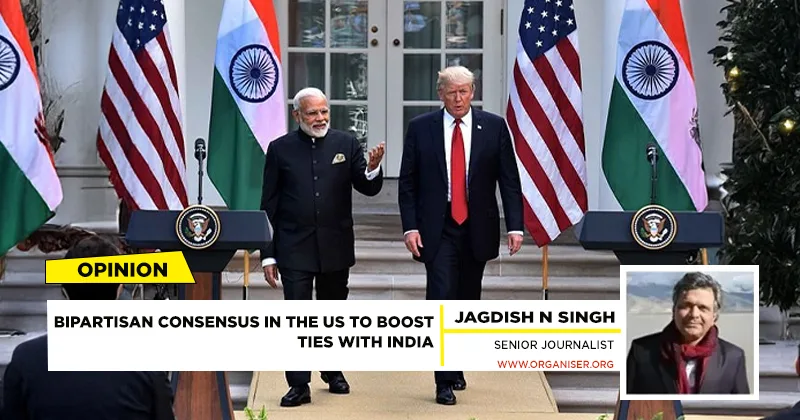
More importantly, President Trump has had a very warm personal rapport with Prime Minister Modi. In 2019, during his first term, Trump feted Modi at a rally titled “Howdy Modi,” in Texas. In 2020, Modi had over 125,000 people turn out for the “Namaste Trump” rally in Ahmedabad.

Notwithstanding the rumours to the contrary, the Trump-Modi rapport is intact. This was clearly visible when Modi’s representative and our External Affairs Minister, S Jaishankar, attended Trump’s presential inaugural ceremony. During his recent sojourn in Washington, Jaishankar happened to be the first foreign minister to hold a one-on-one  meeting with new U.S. Secretary of State Marco Rubio. During this sojourn, Minister Jaishankar met President Trump’s National Security Advisor Michael Walz as well.

Pertinently, the sources add, Prime Minister Modi is likely to visit the US very soon. In his telephonic conversation with President Trump on January 27, Modi had a ‘productive’ discussion on deepening cooperation between the two countries. Both leaders emphasized their commitment for a “ mutually beneficial” relationship. They discussed “ various facets” of the Indo-US Comprehensive Global Strategic Partnership, “including in the areas of technology, trade, investment, energy and defence.”



Topics: US foreign policyTrump Modi PartnershipUS India Strategic TiesBipartisan SupportIndia US TradeIndo-Pacificindo-us relations
ShareTweetSendShareSend
✮ Subscribe Organiser YouTube Channel. ✮
✮ Join Organiser's WhatsApp channel for Nationalist views beyond the news. ✮
Previous News

Real foreign interference: How USAID was directly disrupting politics in Bharat

Next News

BJP’s Dynamic Victory in Delhi: Overcoming odds and defeating AAP 

Related News

A series of high-level engagements signals New Delhi's growing focus on building interoperable security networks across the Indo-Pacific

India strengthens Indo-Pacific security architecture with new defence and maritime partnerships

Australian Deputy Prime Minister and Defence Minister Richard Marles and Defence Minister Rajnath Singh

India-Australia Defence Ministers’ Dialogue: Bilateral synergy on defence research, co-production and maritime security

External Affairs Minister Dr. S. Jaishankar and US Secretary of State Marco Rubio(File Photo)

Marco Rubio India Visit: New Delhi scripts strategic autonomy as US pushes transactional Indo-Pacific agenda

Australia Defence Minister Richard Marles and Defence Minister Rajnath Singh(File Photo)

India-Australia Defence Dialogue: Co-production, interoperability & catalysing Indo-Pacific security on the agenda

Exercise Pragati at Umroi Army Camp, Meghalaya

Exercise PRAGATI 2026: 13 nations unite at Umroi to boost operational readiness; Reaffirm Indo-Pacific peace & security

India-Vietnam seal BrahMos deal: Defence indigenisation & export goal gains traction; Impetus for regional security

Load More

Latest News

The Porumamilla inscription and the ancient science behind a reservoir that survived 650 years

India’s 655-Year-Old Water Policy: The Porumamilla inscription that turned stone into a manual of hydrology

India’s Permanent Representative to the United Nations Ambassador Harish Parvathaneni

India slams Pakistan at UNSC for peddling false narratives on Jammu & Kashmir

Keralam: Pathanamthitta temple property occupied beyond lease period reclaimed by devotees

A series of high-level engagements signals New Delhi's growing focus on building interoperable security networks across the Indo-Pacific

India strengthens Indo-Pacific security architecture with new defence and maritime partnerships

Prime Minister Narendra Modi

“Makes every Indian proud”: PM Modi hails India’s 7.7 per cent GDP growth in FY 2025-26

Once known for maoist violence, Minpa now leads healthcare revolution with telemedicine services in Sukma

From Maoist Stronghold to Healthcare Hub: How Chhattisgarh’s Minpa is transforming through telemedicine & development

Dr Surendra Jain, Joint General secretary, VHP

VHP Demands Audit of Waqf Properties Amid Encroachment Claims: “Land should go to rightful owner,” says Surendra Jain

A Special NIA Court has framed charges against banned PFI and 20 office bearers, including E. Abubakar and O.M.A. Salam, under UAPA and IPC

PFI Terror Case: Special NIA court charges Abubakar, Salam & others for alleged conspiracy to wage war against India

Prime Minister Narendra Modi with women during an event (Old image used for representative purposes)

The Nari Shakti Decade: How 12 years of policy reforms under Modi govt transformed lives of women in Bharat

Ritabrata Banerjee, expelled by Mamata Banerjee from TMC, has been appointed as the Leader of the Opposition in Bengal assembly.

TMC House Divided: Mamata’s party battles Itself as LoP row exposes deepening cracks after BJP’s big blow

Load More
  • Privacy
  • Terms
  • Cookie Policy
  • Refund and Cancellation
  • Delivery and Shipping

© Bharat Prakashan (Delhi) Limited.
Tech-enabled by Ananthapuri Technologies

  • Home
  • Search Organiser
  • Bharat
    • Assam
    • Bihar
    • Chhattisgarh
    • Jharkhand
    • Maharashtra
    • View All States
  • World
    • Asia
    • Africa
    • North America
    • South America
    • Europe
    • Australia
  • Editorial
  • Operation Sindoor
  • Opinion
  • Analysis
  • Defence
  • Culture
  • Sports
  • Business
  • RSS @ 100
  • Entertainment
  • More ..
    • Sci & Tech
    • Vocal4Local
    • Special Report
    • Education
    • Employment
    • Books
    • Interviews
    • Travel
    • Health
    • Politics
    • Law
    • Economy
    • Obituary
  • Subscribe Magazine
  • Read Ecopy
  • Advertise
  • Circulation
  • Careers
  • About Us
  • Contact Us
  • Policies & Terms
    • Privacy Policy
    • Cookie Policy
    • Refund and Cancellation
    • Terms of Use

© Bharat Prakashan (Delhi) Limited.
Tech-enabled by Ananthapuri Technologies