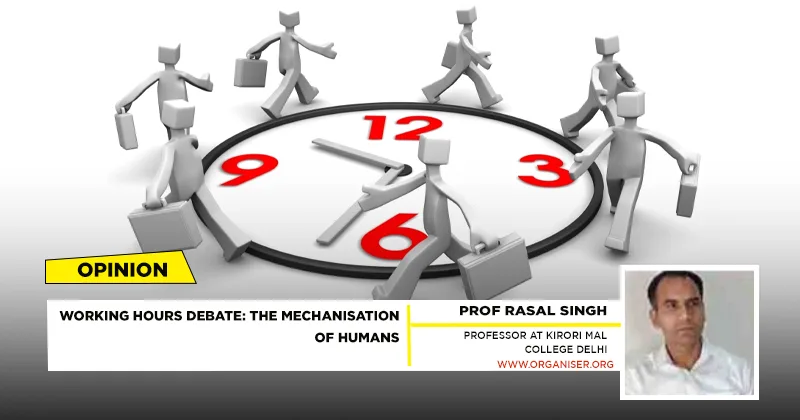
In India’s “Amrit Kaal” (Golden Era), the debate on work-life balance is gaining significant momentum. Some statements by prominent industrialists in this context are quite startling. After overcoming the global crisis of COVID-19, we all have tried to establish a time balance between our work and family with great difficulty. Despite the adverse circumstances of the pandemic, we managed to maintain our growth rate.
However, the recent discussions about work hours were initiated by Infosys co-founder N.R. Narayana Murthy, who stated at a youth program that if we want to outcompete globally, we need to work 70 hours a week. Similarly, Gautam Adani (Chairman, Adani Group), Bhavish Aggarwal (Founder, Ola), and Shantanu Deshpande (CEO, Bombay Shaving Company) have advocated for longer working hours and stringent professional schedules. Taking this a step further, Larsen & Toubro Chairman SN Subrahmanyan proposed a 90-hour work week in a recent statement. Moreover, he mocked marital life and questioned the importance of family life, dismissing the necessity of Sunday as a holiday in a meeting with employees. Such absurd remarks demonstrate a lack of understanding of human resource management and a disregard for human sensitivity. These individuals seem disconnected from Indian life philosophy and innovations in human management. They view humans as mere robots. Ironically, even robots require recharging and maintenance.
We know that in the eternal tradition of India, a very human-centric scientific approach has been adopted with regard to human life and its efficiency. In this tradition, we do not compete cut-throat by joining the blind race of development and materialism; rather, by adopting a healthy and balanced lifestyle, we try to reach the peak of our individual and collective productivity. In this process, we also see that life and life values are important for us. We do not let the physical and mental balance deteriorate to increase productivity because ‘ati sarvatra varjayet’ (excess of anything is bad). The goal of our philosophy of life is the all-round development of the individual, society and the nation, and not concentrated material development as our sole aim. This is the reason why we emphasise on meaningfulness instead of success. There is a trend of looking at the various needs and achievements of human life in totality. Thinkers like Mahatma Buddha, Mahatma Gandhi, and Pandit Deendayal Upadhyaya emphasised balance, harmony, and integration, recognising the interconnectedness of individuals, society, nature, and divinity. Achieving life’s ultimate goals—Dharma (righteousness), Artha (wealth), Kama (desires), and Moksha (liberation)—requires a balance of body, mind, intellect, and soul. Any nation’s progress should be measured by happiness indices, not just growth rates.
A person not only builds a family but also joins the society. He makes his life simple and interesting by establishing a sense of belonging with nature. He establishes a balance between the living beings and the world. Conversely, consumerist ideologies view humans as machines, measuring life’s value by labor and productivity. Mechanisation of human life affects the quality of his life. Man’s mental health is also affected. If human life is seen from a utilitarian point of view, then only mental insanity and social deformity will increase. Human relations will also weaken. Institutions like family and society will also be in crisis. The utilitarian point of view is dangerous for the society because it devalues human life by classifying it according to its utility. This encourages a divisive, discriminatory and destructive way of life in the society. Today, anger, rage, dissatisfaction, violent behaviour on trivial matters like parking of vehicles, increasing road accidents due to rush, shortcuts like intoxication, shopping, promiscuous sex for pleasure (hike), craving for pleasure from material things bought with money, competition/hunger to earn more and more money, exhibitionism, etc. are increasing perversions. It is strange that after reaching the pinnacle of civilisation, man is turning away from human life values. The feeling of goodwill, harmony and harmony is vanishing from the society.
If considered from a scientific point of view, working 70 or 90 hours a week will have a long-term effect on a person’s health and it will gradually make his body and mind empty and hollow. The 2021 United Nations report also opposes long working hours. The United Nations has tried to explain in many of its researches that the most important cause of death of a person working too much is high blood pressure, diabetes, depression and heart-related diseases. The risk of these lifestyle-related diseases increases manifold in those who work sitting for long hours. The increasing tendency of suicide among the youth and the decreasing fertility are also the result of excessive work pressure and negative environment. Various studies have revealed the fact that the cause of maximum deaths is chronic obstructive pulmonary disease. The cause of this disease is the inability to expel air properly from the lungs. A large number of hard-working labourers and people working in factories are suffering from this.
This age of artificial intelligence and mechanisation has certainly put a question mark on human life and human sensibilities, but we should not forget the fact that the human brain is the original source of ideas. If we want to research new facts, then we have to maintain good mental health. This will be possible only when there is a work-life balance. The second most important thing is that original thinking is possible only with a healthy brain. We can make our work easier through artificial intelligence and robotics, etc., but we cannot do the same work with novelty or originality. Machines cannot replace humans.
To avoid depression and loneliness, he improves his body and mind in the company of family and nature. In the corporate lifestyle, he becomes mentally ill. Due to unnecessary pressure of work, his lifestyle gets affected and then he becomes mentally deranged. In the storm of commercialism, his material needs and ambitions also keep increasing. As a result, he gets trapped in a toxic cycle. There is a need to look at the productivity and achievements of life not in isolation but in totality. A person has neither any personality nor existence apart from family and society. All-round development of his personality takes place only by living in family and society. His positivity, creativity and productivity also increase. Therefore, the working population has to make a proper balance between their family and professional life. Due to excessive working hours, children will become distracted and the elderly will become neglected and lonely. Such a situation is not good for any society and nation. Certainly, life is also being cursed by the excessive and unnecessary use of modern technology such as artificial intelligence, robotics and information-devices like mobile phones, laptops etc. Social media platforms invented for communication are also becoming a factor of family lack of communication and loneliness. Concerned about this, socio-cultural organisations like Rashtriya Swayamsevak Sangh have started work on family enlightenment.
Industrialists like Anand Mahindra (Chairman of Mahindra Group), Sanjeev Puri (Chairman of ITC) and Ritesh Agarwal (Co-founder and CEO of OYO) have opposed extending work hours and have talked about giving priority to work and quality of life. What is meant to say is that only due to work-life balance, a person can give his best contribution to the society and the institution. This automatically develops the power to control the isolation and depression caused by work and workplace. Therefore, it is important that the company understands the need of an employee and provides him the necessary leave. The company can also encourage yoga, meditation and indoor sports during its time period. On some important festivals, the company should also organise cultural programs for all its employees. This will strengthen their attachment towards their work, a sense of attachment towards the organisation and will also increase their positivity, creativity and productivity.