Unmasking the Delhi Riots 2020: How Aam Aadmi Party’s Municipal Councilor Tahir Hussain fueled communal tensions
June 13, 2026
  • Read Ecopy
  • Circulation
  • Advertise
  • Careers
  • About Us
  • Contact Us
Android AppiPhone AppArattai
Organiser
  • ‌
  • Bharat
    • Assam
    • Bihar
    • Chhattisgarh
    • Jharkhand
    • Maharashtra
    • View All States
  • World
    • Asia
    • Europe
    • North America
    • South America
    • Africa
    • Australia
  • Editorial
  • International
  • Opinion
  • RSS @ 100
  • More
    • Op Sindoor
    • Analysis
    • Sports
    • Defence
    • Politics
    • Business
    • Economy
    • Culture
    • Special Report
    • Sci & Tech
    • Entertainment
    • G20
    • Azadi Ka Amrit Mahotsav
    • Vocal4Local
    • Web Stories
    • Education
    • Employment
    • Books
    • Interviews
    • Travel
    • Law
    • Health
    • Obituary
  • Subscribe
    • Subscribe Print Edition
    • Subscribe Ecopy
    • Read Ecopy
  • ‌
  • Bharat
    • Assam
    • Bihar
    • Chhattisgarh
    • Jharkhand
    • Maharashtra
    • View All States
  • World
    • Asia
    • Europe
    • North America
    • South America
    • Africa
    • Australia
  • Editorial
  • International
  • Opinion
  • RSS @ 100
  • More
    • Op Sindoor
    • Analysis
    • Sports
    • Defence
    • Politics
    • Business
    • Economy
    • Culture
    • Special Report
    • Sci & Tech
    • Entertainment
    • G20
    • Azadi Ka Amrit Mahotsav
    • Vocal4Local
    • Web Stories
    • Education
    • Employment
    • Books
    • Interviews
    • Travel
    • Law
    • Health
    • Obituary
  • Subscribe
    • Subscribe Print Edition
    • Subscribe Ecopy
    • Read Ecopy
Organiser
  • Home
  • Bharat
  • World
  • Operation Sindoor
  • Editorial
  • Analysis
  • Opinion
  • Culture
  • Defence
  • International Edition
  • RSS @ 100
  • Magazine
  • Read Ecopy
Home Bharat

Unmasking the Delhi Riots 2020: How Aam Aadmi Party’s Municipal Councilor Tahir Hussain fueled communal tensions

The Delhi riots of February 2020 exposed deep political and communal rifts, with violent clashes leaving lasting scars. Allegations have pointed to Aam Aadmi Party’s Municipal Councilor, Tahir Hussain, as a key figure in orchestrating the violence, raising serious concerns about political involvement in fueling such chaos

WEBDESKWEBDESK
Jan 27, 2025, 06:30 pm IST
in Bharat, Delhi
Follow on Google News
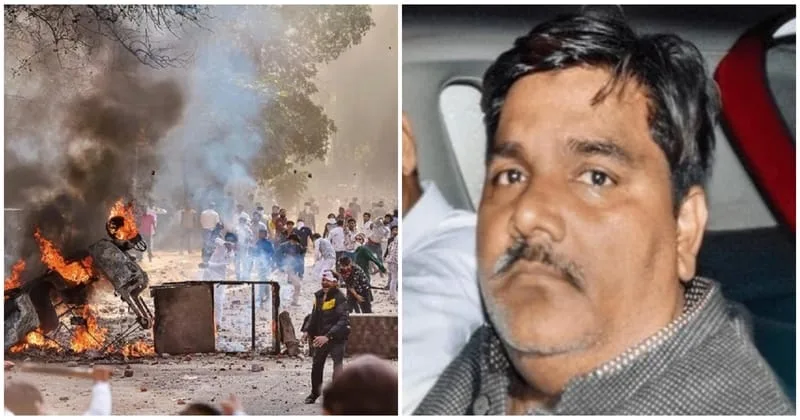
Aam Aadmi Party’s Municipal Councilor Tahir Hussain (Right)

Aam Aadmi Party’s Municipal Councilor Tahir Hussain (Right)

FacebookTwitterWhatsAppTelegramEmail

The Delhi riots of February 2020 shook the nation, exposing deep political and communal fault lines. Violent clashes between groups, primarily along religious lines, led to the loss of life and property and an escalation of mistrust. Amidst the tragedy, several alarming reflections, especially those pointing toward premeditated action, surfaced. Among these, some individuals in Delhi’s Muslim community have drawn attention to what they believe were deliberate preparations for violence. In particular, the claims of involvement by figures like Aam Aadmi Party’s Municipal Councilor Tahir Hussain sparked significant controversy.

The Allegations and Claims
The 2020 Delhi riots were not a mere outbreak of spontaneous violence; instead, various accounts suggest that they were preceded by careful preparations, strategic thinking, and coordinated efforts. The points raised, particularly by some members of the Muslim community in Delhi, paint a disturbing picture of a well-orchestrated event, where violence was preplanned and communities were targeted along religious lines. The 25 points of reflection outlined by certain individuals reveal significant detail about the planning stages of the riot. They suggest a high level of organisation, including the collection of weapons, the marking of Hindu areas, and the mobilisation of people across states.

Here are some of the key points highlighted in the reflections:

Premeditation and Preparation: The assertion that preparations were made “before the war” suggests that violence was planned in advance. The mobilisation of resources, from weapons to personnel, points to a level of coordination that goes beyond the typical escalation of protests into violence.

Infiltration and Resource Mobilisation: Relatives were reportedly called from other states, and money was collected to fund the planned violence. This indicates not only the involvement of local elements but also suggests the participation of outsiders who might have been directed to take part in the chaos.

The Role of Political and Religious Leaders: Claims suggest that some people took matters into their own hands, with no formal leadership in place to control the narrative or ensure peaceful resolution. Leaders, including political figures like Tahir Hussain, have been accused of inciting violence, though investigations are still ongoing.

Targeting and Identification: The use of slingshots, petrol bombs, and even acid bags, coupled with the use of helmets to distinguish attackers, raises questions about the intentional targeting of specific communities, particularly Hindus. The strategic marking of Hindu houses and shops indicates a clear intent to cause harm to specific religious groups.

Diverting Attention and Manipulating Sympathy: The strategic use of women and children to divert attention to places like Shaheen Bagh while the men prepared for violence is one of the more troubling aspects of the reflections. This tactic appears designed to distract from the violence as it unfolded, creating a false narrative of peaceful protest.

A Call for Reflection and Unity

The 2020 Delhi riots were undoubtedly fueled by a complex array of issues, not least of which were political tensions surrounding the Citizenship Amendment Act (CAA) and the National Register of Citizens (NRC). While these laws remain controversial, it is essential that political parties and community leaders do not use these issues as tools for further division. The tragic events of the Delhi riots exposed the dangers of division, not only between Hindus and Muslims but also between different political factions.

One of the more controversial aspects of the reflections is the criticism aimed at secular Hindus, who are described as “stupid and hypocritical.” This sentiment likely arises from a sense of betrayal, as many individuals within the Muslim community may have believed that secularism in India, which enshrines religious tolerance, was undermined by the actions of both political parties and specific individuals in power. However, labelling an entire community in such broad terms is both divisive and counterproductive.

Lessons for the Future

As we reflect on the Delhi riots and the complex dynamics that led to them, there are key lessons that must be learned:

Political Responsibility: Leaders must prioritise national unity over political gains. It is crucial that political figures from all sides recognise the responsibility they hold in either exacerbating or alleviating communal tensions. Exploiting religious divides for electoral advantage only deepens the wounds of the nation.

The Role of Law: The justice system must be empowered to act impartially, ensuring that all individuals, regardless of religion or politics, are held accountable for their actions. The future of a peaceful India lies in the ability of the legal system to act without fear or favour.

Youth Engagement: The next generation of Indians must be taught the values of tolerance, respect, and peaceful conflict resolution. They must be equipped with the tools to engage in constructive dialogue, rather than turning to violence as a means of expression.

Also Read: US Suspends All Aid to Bangladesh: The impact of Trump’s 90-day moratorium

The Delhi riots of February 2020 erupted amidst widespread protests against the Citizenship Amendment Act and the National Register of Citizens. These protests, initially focused on the controversial legislation, quickly escalated into violent clashes between pro- and anti-CAA groups, particularly in Northeast Delhi. The violence, which included targeted attacks on properties and individuals along religious lines, exposed the deepening fault lines within the capital. The riots resulted in over 50 deaths and hundreds of injuries, leaving behind a trail of devastation. The incidents raised serious questions about political polarisation, communal tensions, and the role of law enforcement.


Topics: Aam Aadmi PartyDelhi riots 2020Communal Tensions in IndiaPolitical PolarisationCAA NRC ProtestsAAP Municipal Councilor Tahir Hussain
ShareTweetSendShareSend
✮ Subscribe Organiser YouTube Channel. ✮
✮ Join Organiser's WhatsApp channel for Nationalist views beyond the news. ✮
Previous News

Tackling India’s Water Crisis: Learning from Israel’s success

Next News

Mahakumbh : Sants, Sangh and society together will make Bharat a world leader

Related News

CJP Under the Lens: From Delhi Riots defenders to foreign media endorsements

Cockroach Janata Party Under Scrutiny: From Naxal sympathisers to foreign media endorsements- Know real face of CJP

Senior Advocate Prashant Bhushan

Delhi Anti-Hindu Riots: Prashant Bhushan’s ‘Cover Blown’? Held meetings, conspired with anti-nationals Umar, Sharjeel

Tahir Hussain, accused in 2020 Delhi riots case

2020 Delhi Riots Case: Tahir Hussain’s lies exposed; Admits attacking Hindus, raising ‘Kafiro Ko Maaro’ slogans

AAP’s New Front? CJP Emerges as Congress’s Biggest Narrative Challenger

Congress Protests, CJP Trends: AAP harvests through CJP on ground tilled by Congress

Drug Census or Political Exercise? Punjab survey includes questions on Bhagwant Mann Government’s schemes & performance

BJP sweeps Gujarat local body elections 2026

Gujarat Local Body Poll Results: PM Modi hails BJP’s clean sweep; AAP & Congress party bite the dust

Load More

Latest News

MP and UP ATS detains terror suspect Naeem Abdullah

Uttar Pradesh: Terror link surfaces again in Saharanpur, UP & MP ATS detains Naeem Abdullah

Police Search Abhishek Banerjee’s Home, ED Raids Madan Mitra Properties in Twin Blow to TMC

Fresh Trouble for TMC in Bengal: Police search Abhishek Banerjee’s home, ED raids Madan Mitra properties in twin blow

Martyr Nanak Bhil

Tribute to Martyr Nanak Bhil: Tribal revolutionary who took bullet on his chest and fought for rights of farmers

Reporter TV Consulting Editor Arun Kumar - Masked participants at the CJP protest site

Mumbai Police file case against Reporter TV consulting editor over ‘city should catch fire’ comment during CJP protest

The former CM of Bengal Mamata Banerjee

West Bengal: FIR against Mamata Banerjee over provocative speech as TMC faces internal revolt

Press Conference by Ayyappa Seva Samajam

Sabarimala Gold Case: Ayyappa Seva Samajam questions SIT Probe, says CM Satheeshan no different from Pinarayi Vijayan

Yusuf Pathan, Saayoni Ghosh, Shatrughan Sinha among 20 TMC rebel list signatories

TMC Rebellion Deepens: Rebel MPs to meet speaker Om Birla, seek recognition as ‘Real Trinamool Congress’

Kamal Ashraf who posed as Sumit to trap a minor Hindu girl in Bihar

Bihar: Education department clerk Ashraf accused of posing as ‘Sumit’, trapping Hindu minor, forcing conversion

Pramukh Sanchalika Shantakka Ji and Varg Adhikari Mukta Thakur Ji (Himachal Prant Karyavahika) present on the stage on the occasion of the commencement of Praveen Varg of the Rashtra Sevika Samiti

Nagpur | Rashtra Sevika Samiti Praveen varg begins; Sita Gayatri calls for united efforts for progress of nation

At the press conference marking two years of the state government, CM Mohan Charan Majhi and others addressing the media at the Convention Centre, Lok Seva Bhavan.

Odisha: BJP Government completes two Years; CM Majhi announces free KG-to-PG education and 10 kg rice scheme

Load More
  • Privacy
  • Terms
  • Cookie Policy
  • Refund and Cancellation
  • Delivery and Shipping

© Bharat Prakashan (Delhi) Limited.
Tech-enabled by Ananthapuri Technologies

  • Home
  • Search Organiser
  • Bharat
    • Assam
    • Bihar
    • Chhattisgarh
    • Jharkhand
    • Maharashtra
    • View All States
  • World
    • Asia
    • Africa
    • North America
    • South America
    • Europe
    • Australia
  • Editorial
  • Operation Sindoor
  • Opinion
  • Analysis
  • Defence
  • Culture
  • Sports
  • Business
  • RSS @ 100
  • Entertainment
  • More ..
    • Sci & Tech
    • Vocal4Local
    • Special Report
    • Education
    • Employment
    • Books
    • Interviews
    • Travel
    • Health
    • Politics
    • Law
    • Economy
    • Obituary
  • Subscribe Magazine
  • Read Ecopy
  • Advertise
  • Circulation
  • Careers
  • About Us
  • Contact Us
  • Policies & Terms
    • Privacy Policy
    • Cookie Policy
    • Refund and Cancellation
    • Terms of Use

© Bharat Prakashan (Delhi) Limited.
Tech-enabled by Ananthapuri Technologies