Self-Rule and Spiritual Sovereignty: Swaraj in the Bhagavad Gita
June 10, 2026
  • Read Ecopy
  • Circulation
  • Advertise
  • Careers
  • About Us
  • Contact Us
Android AppiPhone AppArattai
Organiser
  • ‌
  • Bharat
    • Assam
    • Bihar
    • Chhattisgarh
    • Jharkhand
    • Maharashtra
    • View All States
  • World
    • Asia
    • Europe
    • North America
    • South America
    • Africa
    • Australia
  • Editorial
  • International
  • Opinion
  • RSS @ 100
  • More
    • Op Sindoor
    • Analysis
    • Sports
    • Defence
    • Politics
    • Business
    • Economy
    • Culture
    • Special Report
    • Sci & Tech
    • Entertainment
    • G20
    • Azadi Ka Amrit Mahotsav
    • Vocal4Local
    • Web Stories
    • Education
    • Employment
    • Books
    • Interviews
    • Travel
    • Law
    • Health
    • Obituary
  • Subscribe
    • Subscribe Print Edition
    • Subscribe Ecopy
    • Read Ecopy
  • ‌
  • Bharat
    • Assam
    • Bihar
    • Chhattisgarh
    • Jharkhand
    • Maharashtra
    • View All States
  • World
    • Asia
    • Europe
    • North America
    • South America
    • Africa
    • Australia
  • Editorial
  • International
  • Opinion
  • RSS @ 100
  • More
    • Op Sindoor
    • Analysis
    • Sports
    • Defence
    • Politics
    • Business
    • Economy
    • Culture
    • Special Report
    • Sci & Tech
    • Entertainment
    • G20
    • Azadi Ka Amrit Mahotsav
    • Vocal4Local
    • Web Stories
    • Education
    • Employment
    • Books
    • Interviews
    • Travel
    • Law
    • Health
    • Obituary
  • Subscribe
    • Subscribe Print Edition
    • Subscribe Ecopy
    • Read Ecopy
Organiser
  • Home
  • Bharat
  • World
  • Operation Sindoor
  • Editorial
  • Analysis
  • Opinion
  • Culture
  • Defence
  • International Edition
  • RSS @ 100
  • Magazine
  • Read Ecopy
Home Bharat

Self-Rule and Spiritual Sovereignty: Swaraj in the Bhagavad Gita

The concept of Swaraj—self-rule—goes beyond political independence, encompassing the mastery over one’s mind, senses, and spirit. The Bhagavad Gita, a timeless spiritual scripture, offers profound insights into this idea, advocating for inner sovereignty as the foundation for external harmony

Prof Punit KumarProf Punit Kumar
Jan 26, 2025, 03:00 pm IST
in Bharat, Opinion, Culture
Follow on Google News
FacebookTwitterWhatsAppTelegramEmail

The concept of Swaraj, or self-rule, resonates deeply within Indian philosophy, ethics, and spirituality. Rooted in the ancient scriptures, Swaraj is not merely political freedom but also signifies the mastery of the self, a state where one’s inner being is harmonised with universal truths. The Bhagavad Gita, a timeless philosophical treatise and spiritual guide, offers profound insights into Swaraj through its teachings on duty (Dharma), detachment, self-realization, and liberation (Moksha).

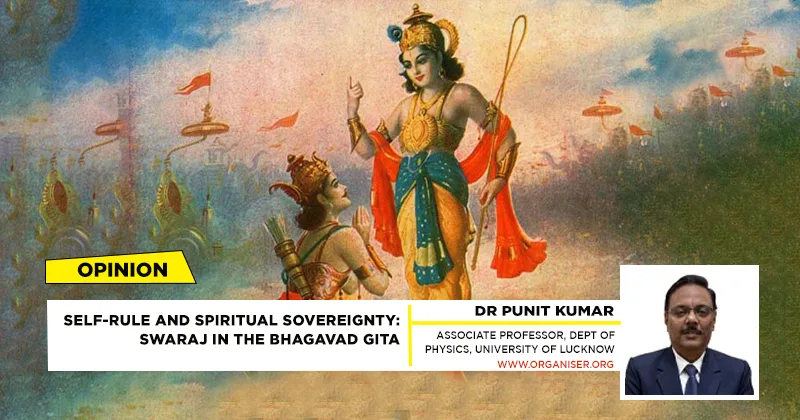
The Bhagavad Gita’s discourse begins with Arjun’s moral dilemma, symbolising the inner conflicts faced by every individual. This state of confusion and despair represents the lack of Swaraj, where the self is dominated by ignorance, fear, and emotional turmoil. Bhagwan Krishna’s teachings guide Arjun towards self-mastery, urging him to rise above these limitations and act according to his Dharma.

Bhagwan Krishna’s central message in the Gita is that true Swaraj begins within, a state where the individual is free from the bondage of desires, ego, and external influences. He declares :

“उद्धरेदात्मनात्मानं नात्मानमवसादयेत्। आत्मैव ह्यात्मनो बन्धुरात्मैव रिपुरात्मनः||” (Gita 6.5)
(Translation: “One must elevate oneself by one’s own mind and not degrade oneself. The mind is the friend of the self and also its enemy”.)

Here, Swaraj is depicted as the conquest of the mind, where self-discipline and introspection lead to inner freedom.

One of the Gita’s core teachings is the importance of detachment, or Vairagya. Bhagwan Krishna advises Arjuna to act without attachment to the fruits of his actions:

“कर्मण्येवाधिकारस्ते मा फलेषु कदाचन|…”  (Gita 2.47)

(Translation: “You have the right to perform your duties, but not to the fruits thereof”.)

This principle underscores that true Swaraj lies in freedom from the compulsions of worldly rewards. By detaching oneself from outcomes, individuals achieve a state of equanimity and inner peace, allowing them to focus on their responsibilities without distraction. Such self-mastery enables one to act in harmony with the cosmic order, unshackled by ego or desire.

The Gita’s emphasis on Dharma aligns seamlessly with the idea of Swaraj. Dharma, or righteous duty, is not merely adherence to societal norms, but the fulfillment of one’s higher purpose in life. Lord Krishna’s exhortation to Arjun to perform his Kshatriya duties reflects this alignment:

“… स्वधर्मे निधनं श्रेय: परधर्मो भयावह: ||”    (Gita 3.35)

(Translation: “It is better to perish in one’s own Dharma than to thrive in another’s Dharma”.)

Swaraj, in this context, is the realisation and pursuit of one’s innate responsibilities. It is about living authentically and fearlessly, grounded in one’s true nature.

The Gita introduces various paths of Yoga, Karma Yoga (path of action), Bhakti Yoga (path of devotion), Jnana Yoga (path of knowledge), and Dhyana Yoga (path of meditation) as tools for attaining Swaraj. Together, these practices guide individuals towards holistic self-rule, where the body, mind, and spirit are aligned with higher consciousness.

The culmination of Swaraj in the Gita is Moksha, liberation from the cycle of birth and death. Krishna reveals that liberation is not a distant ideal, but an attainable state of being for those who transcend the ego and realize their oneness with the universe. He declares:

“ब्रह्म-भूत: प्रसन्नात्मा न शोचति न कांक्षति …”    (Gita 18.54)

(Translation: “One who is established in the self becomes joyful, desires nothing, and sees all beings as equal”.)

This ultimate freedom is the essence of Swaraj, a state where the soul is unencumbered by material limitations, living in harmony with the eternal truth.

The timeless teachings of the Bhagavad Gita hold immense relevance in contemporary life. In a world often dominated by materialism, stress, and fragmentation, the Gita’s emphasis on inner mastery and self-realization serves as a beacon for achieving personal and societal harmony.

In the realm of politics and governance, the Gita’s vision of Swaraj inspires leaders to act selflessly and responsibly. Mahatma Gandhi, a staunch proponent of Swaraj, derived much of his philosophy from the Gita. For Gandhi, Swaraj was not only political independence, but also moral and spiritual self-rule, where individuals and communities govern themselves with integrity and compassion.

On a personal level, the Gita’s teachings empower individuals to overcome inner conflicts, build resilience, and lead purposeful lives. By embracing principles like detachment, mindfulness, and devotion, individuals can attain a state of self-mastery, contributing to a more balanced and harmonious society.

The Bhagavad Gita’s depiction of Swaraj transcends conventional notions of freedom, offering a holistic framework for self-governance and liberation. It emphasises that true freedom begins within, requiring the conquest of desires, ego, and ignorance. By aligning oneself with Dharma and cultivating self-mastery through Yoga, one attains the ultimate Swaraj, a state of unity with the divine and liberation from all forms of bondage.

In the modern era, the Gita’s insights continue to inspire individuals and societies to strive for higher ideals, reminding us that the path to Swaraj is not only a journey outward but also inward, towards the realization of our truest selves.


Topics: Bhagavad GitaGitaSwarajBhagwan Krishna
Share1TweetSendShareSend
✮ Subscribe Organiser YouTube Channel. ✮
✮ Join Organiser's WhatsApp channel for Nationalist views beyond the news. ✮
Previous News

Republic Day 2025: All-women marching contingent of CRPF showcases spirit of ‘Nari Shakti’ at Kartavya Path

Next News

Mahakumbh 2025: A Catalyst for India’s soft power expansion

Related News

The extraordinary concept of cosmic time in Hindu scriptures

Time Relativity in Hindu Scriptures: How ancient Indian cosmology explained different flows of time across lokas

Lucknow University introduces courses in Bhagwad Gita

Lucknow University introduces Bhagavad Gita based courses for holistic student development

Vishu ad row widens across Keralam as cases, arrests mount and NIA probe is sought into restaurant links

Keralam Vishu Ad Row: BJP demands NIA probe into Arabic-themed restaurants, flags funding trail and extremist links

(Left) Arabian Majlis restaurant Vishu poster (Right)
My Raydan Restaurant ad depicts a blue hand styled as Krishna picking meat from a biryani platter

Keralam Vishu Ad Row: More Jihadi owned restaurant posters surface as Krishna-meat visuals trigger fresh protests

Nadawi Mandi Restaurant’s Vishu poster showing a child-like Krishna with a meat dish sparks outrage and is later deleted from social media

Bengaluru restaurant ‘Nadawi Mandi’ shares Krishna-meat poster on Vishu day triggering outrage over targeting Hindus

Vishu poster by Yamama Shawaya showing Bhgwan Krishna seated before a meat dish (left) Exterior view of Yamama Shawaya Hotel in Angadipuram in Malappuram district (Right)

Keralam Vishu Ad Row: Mustafa, Hameed & Shahil arrested in Malappuram over Krishna-meat poster after VHP complaint

Load More

Latest News

India Deploys 12 Nuclear Warheads: Heralds doctrinal shift to script strategic deterrence against multi-front threat

J&K: Zojila tunnel clears key hurdle; Signals new era of connectivity for Ladakh

How Cockroach politics is hollowing out Bharatiya democratic culture

RSS centenary year is a time for renewed resolve and greater commitment to nation-building: Dr Mohan Bhagwat

Ex-DMK Minister Senthil Balaji (Right Side-File Photo)

Tamil Nadu: CBI books Rs 397 cr transformer tender scam from ex-DMK Minister Senthil Balaji’s tenure (2021-2023)

Border Security Force (BSF) officials inspect the Single Row Fencing (SRF) at a Border Out Post area (India-Bangladesh border)

Infiltration and Border Management: Saving the Siliguri corridor

External Affairs Ministry spokesperson Randhir Jaiswal, slams Pakistan over the recent killings in POJK

‘Hope Pakistan is held accountable’: India reacts after 20 killed in Pakistan Occupied Jammu & Kashmir

China’s anti-BLA offensive hits snag as UN members demand proof

UN Setback for China and Pakistan: US and allies stall move to ban Baloch Liberation Army

West Asia Conflict: Collective response to energy crisis

Atul Limaye Ji Sah Sarkaryavah, Rashtriya Swayamsevak Sangh while addressing a Pramukh Jan Gosthi Rashtriya at Raipur, Chhattisgarh

Chhattisgarh: Society must lead its own transformation through collective initiative: Atul Limaye

Load More
  • Privacy
  • Terms
  • Cookie Policy
  • Refund and Cancellation
  • Delivery and Shipping

© Bharat Prakashan (Delhi) Limited.
Tech-enabled by Ananthapuri Technologies

  • Home
  • Search Organiser
  • Bharat
    • Assam
    • Bihar
    • Chhattisgarh
    • Jharkhand
    • Maharashtra
    • View All States
  • World
    • Asia
    • Africa
    • North America
    • South America
    • Europe
    • Australia
  • Editorial
  • Operation Sindoor
  • Opinion
  • Analysis
  • Defence
  • Culture
  • Sports
  • Business
  • RSS @ 100
  • Entertainment
  • More ..
    • Sci & Tech
    • Vocal4Local
    • Special Report
    • Education
    • Employment
    • Books
    • Interviews
    • Travel
    • Health
    • Politics
    • Law
    • Economy
    • Obituary
  • Subscribe Magazine
  • Read Ecopy
  • Advertise
  • Circulation
  • Careers
  • About Us
  • Contact Us
  • Policies & Terms
    • Privacy Policy
    • Cookie Policy
    • Refund and Cancellation
    • Terms of Use

© Bharat Prakashan (Delhi) Limited.
Tech-enabled by Ananthapuri Technologies