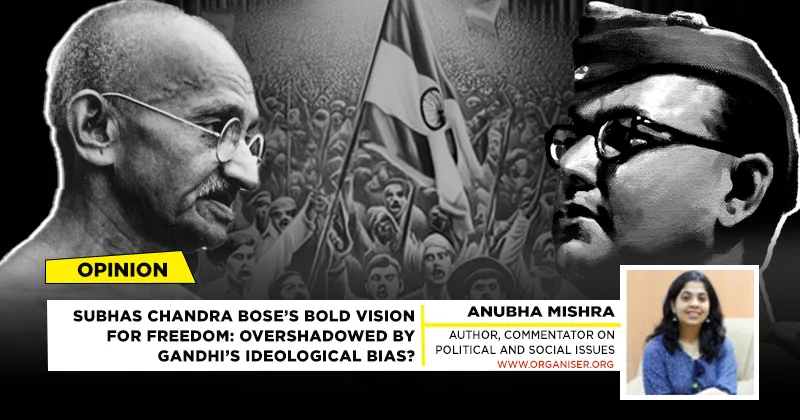
Subhas Chandra Bose’s bold vision for freedom: Overshadowed by Gandhi’s ideological bias?
June 6, 2026
  • Read Ecopy
  • Circulation
  • Advertise
  • Careers
  • About Us
  • Contact Us
Android AppiPhone AppArattai
Organiser
  • ‌
  • Bharat
    • Assam
    • Bihar
    • Chhattisgarh
    • Jharkhand
    • Maharashtra
    • View All States
  • World
    • Asia
    • Europe
    • North America
    • South America
    • Africa
    • Australia
  • Editorial
  • International
  • Opinion
  • RSS @ 100
  • More
    • Op Sindoor
    • Analysis
    • Sports
    • Defence
    • Politics
    • Business
    • Economy
    • Culture
    • Special Report
    • Sci & Tech
    • Entertainment
    • G20
    • Azadi Ka Amrit Mahotsav
    • Vocal4Local
    • Web Stories
    • Education
    • Employment
    • Books
    • Interviews
    • Travel
    • Law
    • Health
    • Obituary
  • Subscribe
    • Subscribe Print Edition
    • Subscribe Ecopy
    • Read Ecopy
  • ‌
  • Bharat
    • Assam
    • Bihar
    • Chhattisgarh
    • Jharkhand
    • Maharashtra
    • View All States
  • World
    • Asia
    • Europe
    • North America
    • South America
    • Africa
    • Australia
  • Editorial
  • International
  • Opinion
  • RSS @ 100
  • More
    • Op Sindoor
    • Analysis
    • Sports
    • Defence
    • Politics
    • Business
    • Economy
    • Culture
    • Special Report
    • Sci & Tech
    • Entertainment
    • G20
    • Azadi Ka Amrit Mahotsav
    • Vocal4Local
    • Web Stories
    • Education
    • Employment
    • Books
    • Interviews
    • Travel
    • Law
    • Health
    • Obituary
  • Subscribe
    • Subscribe Print Edition
    • Subscribe Ecopy
    • Read Ecopy
Organiser
  • Home
  • Bharat
  • World
  • Operation Sindoor
  • Editorial
  • Analysis
  • Opinion
  • Culture
  • Defence
  • International Edition
  • RSS @ 100
  • Magazine
  • Read Ecopy
Home Bharat

Subhas Chandra Bose’s bold vision for freedom: Overshadowed by Gandhi’s ideological bias?

Subhas Chandra Bose, one of India’s most dynamic and visionary leaders, played a pivotal role in the country’s struggle for independence with his bold and uncompromising approach. Unlike Mahatma Gandhi’s philosophy of non-violence and gradualist tactics, Bose believed in direct confrontation with the British colonial regime, a stance that often put him at odds with Gandhi and the Indian National Congress

Anubha MishraAnubha Mishra
Jan 23, 2025, 01:30 pm IST
in Bharat, Opinion
Follow on Google News
FacebookTwitterWhatsAppTelegramEmail

Netaji Subhas Chandra Bose was a fierce nationalist whose defiant patriotism made him one of the greatest freedom fighters in Indian history. He was born on January 23, 1897, in Cuttack, Orissa Division, Bengal Province, to Prabhavati Dutt Bose and Janakinath Bose. After his early schooling, he joined Ravenshaw Collegiate School. From there, he joined Presidency College, Calcutta, but was expelled due to his nationalist activities. Later, he went to the University of Cambridge, UK. He was influenced by the teachings of Swami Vivekananda and Ramakrishna after reading their works at the age of 16.

In 1919, Bose headed to London to take the Indian Civil Services (ICS) examination, and he was selected. Bose, however, resigned from Civil Services as he believed he could not side with the British. His famous slogans are ‘tum mujhe khoon do, main tumhe aazadi dunga‘, ‘Jai Hind’, and ‘Delhi Chalo‘, which still echo in young India’s minds and hearts. He formed Azad Hind Fauj and made several contributions to India’s freedom struggle. He was also sent to prison in Mandalay in 1925 due to his connections with revolutionary movements. He also joined the Non-Cooperation Movement, which was started by Mahatma Gandhi, who made INC a powerful non-violent organisation. During the movement, he decided to work with Chittaranjan Das, who became his political guru. After that, he became a youth educator and commandant of the Bengal Congress volunteers. He started the newspaper ‘Swaraj’. In 1927, after being released from prison, Bose became general secretary of the Congress party and worked with Jawaharlal Nehru for independence. In 1938, he was elected president of the Indian National Congress and formed a national planning committee, which formulated a policy of broad industrialisation. However, this did not harmonise with Gandhian economic thought.

The differences emerged right from their first encounter in 1921 when Netaji questioned Gandhi’s clarity on plans that he created for India’s independence. Adding to their political views, Bose and Gandhi also had diverging views on heritage, religion and development, and all that showed up from time to time during India’s freedom struggle. Seven years after their first meeting, Bose publicly challenged Gandhi, for the first time, on Gandhi’s resolution for dominion status. Although Gandhi narrowly won the resolution, Bose’s and his supporter’s conduct made Gandhi write, “The volunteers dressed in European fashion presented, in my opinion, a sorry spectacle in Calcutta (Congress session 1928),” Gandhi wrote in Young India.” As a result, Bose was removed from the Congress Working Committee, but his resistance and opposition continued.

In the following years, Gandhi and Bose exchanged words quite a few times as round table negotiations went on until Netaji Subhas Bose was jailed and then sent on an exile to Europe in 1932. During his time overseas, Bose met European leaders and Indian students and established contacts. He met Benito Mussolini, too, and saw Nazism and Fascism rise. He gained perspective and started to plan things systematically, only to criticise Gandhian politics more strongly.

Responding to an accusation of “following Gandhi blindly”, Netaji wrote in 1934, “I have no faith in the Congress Working Committee dominated by the satellites of Mahatma Gandhi”. Bose’s election as Congress president in 1938 was seen as a temporary measure by Gandhi. “I have observed that Subhas is not dependable. However, there is nobody who can be the President,” Gandhi wrote to Vallabhbhai Patel in a letter.

Gandhi, by then, had been nurturing Jawaharlal Nehru as India’s leader and made his choice evidently clear. Bose also lent support to Gandhi’s Quit India Movement but feared Gandhi and Congress might settle for a dominion status.

The onset of World War II widened differences between Bose and Gandhi, with Bose forming his party and advocating a more radical approach, while Gandhi chose a moment of slowdown. Bose did not subscribe to Gandhi’s idea of supporting the British in the Great War that started in 1939. In what is known as the Tripuri crisis, Bose won the presidency by defeating Gandhi-backed Pattabhi Sitaramayya. Bose had to pay the price and was disqualified from the presidency of the Bengal Provincial Congress Committee and expelled from Congress committees for three years in 1939. Bose was jailed in 1940, and the following year, in 1941, he fled to Germany. As Bose was looking to organise armed resistance against the British, Gandhi maintained that India would not seek the help of a foreign power to gain independence. Bose and Gandhi were at loggerheads many times.

Mahatma Gandhi’s Non-Cooperation movement had little impact, but it was the military resistance of Netaji Subhas Chandra Bose that led to the end of the British Raj in India. A conversation between the then British Prime Minister Clement Attlee and the then Acting governor of West Bengal, Justice PB Chakraborthy rules the same.

“When the governor asked Atlee the reason, why the Britishers left India, Atlee said, that it was out of fear that the Britishers were not secure in India.”

In spite of all this, there were glaring differences between Gandhi and Subhas, and in political life, both posed against each other. Young Netaji was a firebrand nationalist who believed in the tradition of Tilak and Aurobindo. Gandhiji, on the contrary, was a reluctant nationalist who belonged to the tradition of his mentor Gokhale and Tagore. Bose’s strong revolutionary urge for the emancipation of his motherland made him critical of many of Gandhiji’s techniques. There was respect despite the discord.

Topics: Netaji Subhash Chandra BoseMahatma Gandhi
ShareTweetSendShareSend
✮ Subscribe Organiser YouTube Channel. ✮
✮ Join Organiser's WhatsApp channel for Nationalist views beyond the news. ✮
Previous News

“Land of knowledge”: Bihar’s tableau at R-Day parade to showcase Nalanda ruins, newly built university & Bhagwan Buddh

Next News

Breaking Stereotypes: Scottish Hindu Foundation hosts Parliamentary Reception to address Hinduphobia

Related News

The soldiers surrounded the garden and started firing on unarmed people without giving any warning and a total of 1650 rounds were fired in 10 minutes

Anniversary of Jallianwala Bagh Massacre: From bloodshed to national awakening; Turning point in freedom struggle

1946 Revolt by the Sailors of Royal Indian Navy against the British Raj

Feb 18, 1946 Naval Revolt that shook foundation of the British Raj 80 years ago; Continued legacy of Azad Hind Fauz

Mahatma Gandhi statue vandalised in Melbourne, Australia

India condemns vandalism & theft of Mahatma Gandhi statue in Australia; Urges to hold culprits accountable

454 names, one dynasty: Ashok tears into Congress in explosive Assembly speech

Karnataka assembly erupts as BJP’s R Ashok waves ‘454 Fake Gandhis’ list to counter Congress protest

Representative image

Karnataka: Tumakuru Mahatma Gandhi Indoor Stadium renaming sparks outrage; BJP condemns, Home Minister defends

Mahatma Gandhi and Dr. Keshav Baliram Hedgewar

Gandhi and Hedgewar, From power to service, An inspiring journey of national vision

Load More

Latest News

Union Home Minister Amit Shah addressing BSF personnel at the Lankamura Border Outpost along the India-Bangladesh border in West Tripura district on June 5, 2026

Amit Shah at Bangladesh Border: “India will have an impregnable security grid soon”

India slams Pakistan’s bid to hold elections in Gilgit-Baltistan, demands end to illegal occupation

Maharashtra government approves central wage structure for Pune Metro Contract Workers; Major victory for BMS

India seals robust 7.7% GDP Growth in FY26: Reflects economic resilience amid West Asia crisis & other global headwinds

A representative image

After TCS, Corporate Jihad allegations reach SBI: Married Hindu employee conversion claims trigger FIR in Mumbai

MEA spokesperson Randhir Jaiswal highlights India's resolve to deport illegal Bangladeshi migrants via bilateral mechanisms

India reiterates strong resolve to deport illegal Bangladeshis; Flags delay of bilateral procedures from Dhaka

Kerala HC rejects CMRL appeal, clears way for ED probe against Pinarayi Vijayan’s daughter in money laundering case

Uttar Pradesh leads in Bharat's green transformation

World Environment Day 2026: On his birthday, Yogi Adityanath’s green vision powers Uttar Pradesh’s transformation

As Khalistani networks seek new platforms beyond the West, Azerbaijan has emerged as a key venue for conferences, campaigns and narratives aligned with the Pakistan-Turkey axis against India.

Khalistan’s New Grazing Ground: Azerbaijan emerges as new hub for Turkey-Pakistan backed anti-India networks

Kochi IPL Mystery: Why Did Sunanda Pushkar Surrender Stake Amid Benami Claims Tied to Shashi Tharoor, Sonia Gandhi?

Kochi IPL Mystery: Why Did Sunanda Pushkar Surrender Stake Amid Benami Claims Tied to Shashi Tharoor, Sonia Gandhi?

Load More
  • Privacy
  • Terms
  • Cookie Policy
  • Refund and Cancellation
  • Delivery and Shipping

© Bharat Prakashan (Delhi) Limited.
Tech-enabled by Ananthapuri Technologies

  • Home
  • Search Organiser
  • Bharat
    • Assam
    • Bihar
    • Chhattisgarh
    • Jharkhand
    • Maharashtra
    • View All States
  • World
    • Asia
    • Africa
    • North America
    • South America
    • Europe
    • Australia
  • Editorial
  • Operation Sindoor
  • Opinion
  • Analysis
  • Defence
  • Culture
  • Sports
  • Business
  • RSS @ 100
  • Entertainment
  • More ..
    • Sci & Tech
    • Vocal4Local
    • Special Report
    • Education
    • Employment
    • Books
    • Interviews
    • Travel
    • Health
    • Politics
    • Law
    • Economy
    • Obituary
  • Subscribe Magazine
  • Read Ecopy
  • Advertise
  • Circulation
  • Careers
  • About Us
  • Contact Us
  • Policies & Terms
    • Privacy Policy
    • Cookie Policy
    • Refund and Cancellation
    • Terms of Use

© Bharat Prakashan (Delhi) Limited.
Tech-enabled by Ananthapuri Technologies