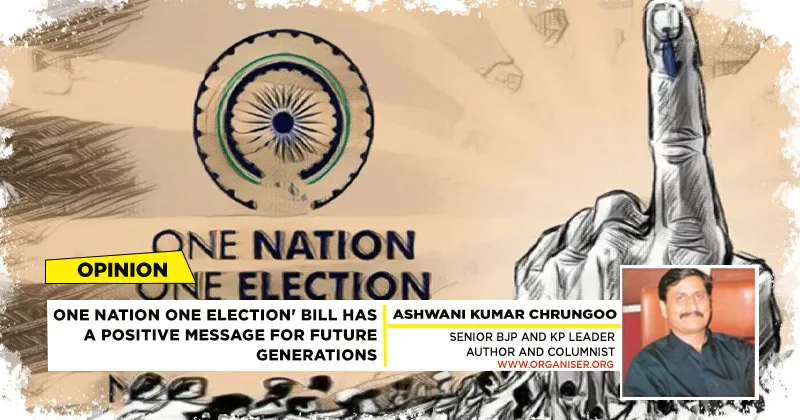
The Central government finally introduced the ‘One Nation, One Election’ bill in the Lok Sabha on 17 December, 2024 proposing simultaneous Lok Sabha and state assembly elections in the country. ‘The Constitution 129th Amendment Bill 2024’ as well as the ‘The Union Territories Laws Amendment Bill 2024’ were introduced after a voting process in the Lok Sabha. Despite heavy opposition from several political parties, the government made it known that the bills would be referred to a Joint Parliamentary Committee (JPC) for detailed deliberations. A committee led by the former President, Ram Nath Kovind had earlier sought opinions from 47 political parties on the issue, with 32 supporting the proposal and 15 opposing it. Consequent upon the voting in favour of the introduction of the bills, the Speaker of the Lok Sabha constituted the JPC with members from both the houses of parliament. The Home Minister, Amit Shah during his intervention informed the House that the Prime Minister Narendra Modi in the cabinet meeting also wanted that the Bills be sent to the JPC for detailed deliberations on them.
In 1947 when the new government was formed under the leadership of Pt. Jawaharlal Nehru, it was not an elected government. This interim arrangement lasted for five years. The first general elections in the country took place in 1952 for both the Lok Sabha and the state assemblies simultaneously. This process continued for three elections after 1952 upto 1967. Midterm elections and the toppling of state governments during the Indira Gandhi regime disturbed the whole process and simultaneous polls became the biggest casualty. For a long time there has been a discourse in the country about the revival of the system of simultaneous polls. As the intermittent elections every now and then for the state assemblies and the Lok Sabha disturb the normal life, speed of development and the projects in hand besides creating a number of hurdles for the administration to work effectively without any curtailment due to the code of conduct, it was proposed to think afresh in regard to the simultaneous polls throughout the country. Moreover, it is also seen in the context of saving the exchequer’s money that is spent on various elections round the year.
Even when the above mentioned bills were introduced, voted and referred to the JPC in the House, some opposition parties opposed the bills ab initio without any reason. From their opposition, it seems that they have a lurking fear in regard to the simultaneous polls to the Lok Sabha, state assemblies and the local bodies. Their fear is surely unexplainable and undefined. There are people who are always scared of a change in any kind of an established system mostly because of the uncertainties involved in the change. But in this case there is an additional argument that is being put forward by those who oppose it. It is said that the simultaneous polls will have the potential to wipe out the regional political parties in due course of time and instead the national parties would gain their space in the political spectrum and hence the federal system in the country would be damaged in the process.
It is important to visit history in this context. Despite simultaneous polls in 1952, 1957, 1962 and 1967 barring the aberrations in two or three states, where governments were dismissed by the then central government, different political parties got elected in the states and for the Lok Sabha. In particular, the elections held in 1967 saw defeat of Congress in eight states where regional parties and the others gained control though the Congress won the elections held for the Lok Sabha. During all these simultaneously conducted elections in the country for four different terms, the federal system and the structure didn’t crumble in any way. This whole process got derailed when Congress got divided in 1969 and mid-term elections were conducted in 1971 by the Indira Gandhi government. Now, the Bills in question aspire to revive the same system of simultaneous polls which was prevalent from 1947 to 1967.
In 1957, it was CPI under EMS Namboodiripad which won elections in Kerala state and the National Conference that won in Jammu and Kashmir. In 1967, DMK, the regional outfit assumed power in Tamil Nadu and various other political parties including Shiromani Akali Dal, Bhartiya Jana Sangh, Bhartiya Kranti Dal, Sanyukt Socialist Party, Praja Socialist Party and the other groupings formed Samyukta Vidhayak Dal (SVD) governments in a number of states including MP, UP, Bihar, Punjab and Rajasthan. The simultaneously held polls didn’t bar the regional political parties and the others either from contesting the elections or winning the same wherever they were in a formidable position to do that.
In the current context, the elections held in 2014, 2019 and also in 2024 are a classic example to quote where simultaneous elections were held for the Lok Sabha and some states without any sort of hiccups. Both national parties and the regional parties made their way as per their support base in the states where polls were held. In 2024, four states went to the elections simultaneously in April-June, i.e. Odisha, Andhra Pradesh, Arunachal Pradesh and Sikkim. While in Arunachal Pradesh and Odisha, the BJP won and formed the government, the regional parties were the main winners in Sikkim and Andhra Pradesh. The argument that the BJP which is a national party and is also the ruling party at the centre would undermine the regional issues during such elections and would bulldoze them to be replaced by the national issues during the simultaneous polls has no valid ground to stand. Neither is there any historical evidence to support this notion.
In 2019, when the BJP won 303 seats, its highest number of seats in the Lok Sabha, the regional parties in Odisha and Andhra Pradesh swept the elections which were also conducted simultaneously. They didn’t win only in the state elections but also made big inroads even in the Lok Sabha by capturing maximum seats as compared to BJP and Congress, the national political parties. There is no scientific logic that can divest the regional groups or any other political party from their due share as per their support base in the public either in the simultaneously held poll or the exclusively held poll for the state assemblies. Moreover, in 2019 the entire election campaign had an overwhelming impact of a national issue, ie. the national security & nationalism, yet the powerful regional parties made their way successfully in both these two states, Odisha and Andhra Pradesh.
The regional parties achieve success on the basis of their leadership, support in public, their issues that can catch the imagination of the people and their organisational structure and management. There is absolutely no alternative to these fundamental principles and when there is recession in these basic principles in a party, defeat looms large on them. Elections held simultaneously or exclusively have no special meaning for any kind of a party, whether national or regional. An able and strong leadership at the centre has its own advantage for a national party but the regional parties have made history of sorts in many ways despite a strong leadership at the centre many a time. TMC under Mamta Bannerjee, Hemant Soren’s JMM and AAP under the leadership of Arvind Kejriwal are a testimony of this fact.
The voters in the country have a better sense of choice and they have proved it time and again in the past. They make conscious decisions when they are supposed to vote either a national party or a regional party or an independent in an election. Their maturity in this regard can’t be questioned. Voting patterns in the states like Tamil Nadu, UP, Maharashtra, Telangana, Bihar and Haryana have enough voting pattern data available in this regard. The arguments of opposition groups against the ‘one nation one election’ proposal are too little and brittle to disprove the data available for the last several decades. Their arguments are mainly inspired by a lurking fear that the BJP under the able and strong leadership of PM Modi is invincible and can’t be defeated by ordinary means and fake propaganda.
The model code of conduct which is declared by the Election Commission of India at the time of the announcement of elections is a very important issue of concern in this connection. Movement of bureaucracy, security forces, police personnel, election machinery and also of the political activists create a special situation in which the whole focus remains on the effective and smooth conduct of the elections. The simultaneously held elections will drastically shorten this special period in which the normal governance is hugely affected. In addition, thousands of crores of rupees would be saved in the process. It is high time that the bills referred to the JPC are debated and deliberated upon extensively by the members and sent back to the Lok Sabha with the necessary additions and alterations wherever necessary so that the parliament is in a position to adopt them for a positive and desired change in the elections scenario in future.