How Islamist extremist ideology is steering Yunus's Government
September 14, 2026
  • Read Ecopy
  • Circulation
  • Advertise
  • Careers
  • About Us
  • Contact Us
Android AppiPhone AppArattai
Organiser
  • ‌
  • Bharat
    • Assam
    • Bihar
    • Chhattisgarh
    • Jharkhand
    • Maharashtra
    • View All States
  • World
    • Asia
    • Europe
    • North America
    • South America
    • Africa
    • Australia
  • Editorial
  • International
  • Opinion
  • RSS @ 100
  • More
    • World Hindu Congress 2026
    • Op Sindoor
    • Analysis
    • Sports
    • Defence
    • Politics
    • Business
    • Economy
    • Culture
    • Special Report
    • Sci & Tech
    • Entertainment
    • G20
    • Azadi Ka Amrit Mahotsav
    • Vocal4Local
    • Web Stories
    • Education
    • Employment
    • Books
    • Interviews
    • Travel
    • Law
    • Health
    • Obituary
  • Subscribe
    • Subscribe Print Edition
    • Subscribe Ecopy
    • Read Ecopy
  • ‌
  • Bharat
    • Assam
    • Bihar
    • Chhattisgarh
    • Jharkhand
    • Maharashtra
    • View All States
  • World
    • Asia
    • Europe
    • North America
    • South America
    • Africa
    • Australia
  • Editorial
  • International
  • Opinion
  • RSS @ 100
  • More
    • World Hindu Congress 2026
    • Op Sindoor
    • Analysis
    • Sports
    • Defence
    • Politics
    • Business
    • Economy
    • Culture
    • Special Report
    • Sci & Tech
    • Entertainment
    • G20
    • Azadi Ka Amrit Mahotsav
    • Vocal4Local
    • Web Stories
    • Education
    • Employment
    • Books
    • Interviews
    • Travel
    • Law
    • Health
    • Obituary
  • Subscribe
    • Subscribe Print Edition
    • Subscribe Ecopy
    • Read Ecopy
Organiser
  • Home
  • Bharat
  • World
  • Operation Sindoor
  • Editorial
  • Analysis
  • Opinion
  • Culture
  • Defence
  • International Edition
  • RSS @ 100
  • Magazine
  • Read Ecopy
Home World

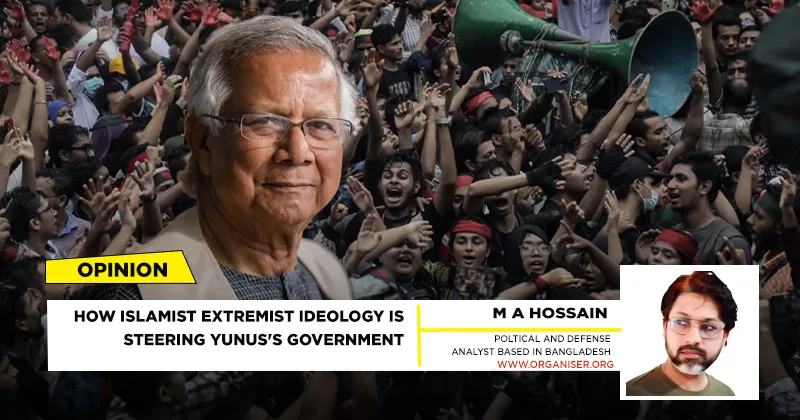
How Islamist extremist ideology is steering Yunus’s Government

The government of Bangladesh, under caretaker Prime Minister Mohammad Yunus, has come under scrutiny for its perceived alignment with Islamist extremist ideologies. Critics argue that Yunus's administration has turned a blind eye to growing religious extremism in the country, while allowing radical groups to operate with increasing impunity

M A HossainM A Hossain
Dec 5, 2024, 08:30 pm IST
inWorld, Opinion, Asia
Follow on Google News
Facebook
Twitter
WhatsAppTelegramEmail

The political trajectory of Bangladesh took a dramatic turn after Sheikh Hasina’s government fell on August 5, 2024. With high hopes and public enthusiasm, Prof. Muhammad Yunus assumed the position of Chief Adviser on August 8, 2024. Initially, this transition was welcomed by political factions—except the Awami League—as a potential pathway toward early inclusive elections and political stability. However, within 100 days of governance, the true face of the Yunus-led interim government began to surface, revealing a disturbing alliance with Islamist extremist groups such as Hizb ut-Tahrir, Hefazat-e-Islam, and Jamaat-e-Islami.

One of the earliest signs of Islamist extremist influence was the apparent alignment between the Yunus government and radical groups. While political parties such as Jamaat-e-Islami and Hefazat-e-Islam lack the electoral mandate to secure power independently, they have used the interim government as a vehicle to consolidate their influence. By delaying elections, these groups gain valuable time to reorganize and expand their reach, thereby securing a foothold in the political arena.

The alignment between the government and these groups has been subtle yet undeniable. Policies and statements from the interim government have mirrored the demands of Islamist factions, raising suspicions about a deeper ideological nexus. Issues such as the moral policing of women, the destruction of sculptures, atrocities towards Hindu minority, release of militants, and lack of legal actions by Yunus government against perpetrators demonstrate a deliberate silence that emboldens extremist actors.

The involvement of advisers with alleged ties to extremist ideologies further deepens concerns. Prof. Yunus introduced one of his advisers as the mastermind behind the July 2024 uprising, whose allegations of ties to Hizb ut-Tahrir were reported in local and international media, raising red flags both domestically and internationally. This individual, alongside other key figures, has reportedly echoed agendas similar to those of Islamist extremist groups, posing challenges to Bangladesh’s secular identity.

The case of the law adviser criticizing Rabindranath Tagore—echoing Jamaat’s long-standing agenda—is particularly alarming. Jamaat and its affiliates have repeatedly attacked the secular cultural and intellectual fabric of Bangladesh, targeting figures like Tagore, who symbolize the country’s pluralistic heritage. Such rhetoric from a government representative suggests an unsettling ideological convergence.

The release of 144 militants and numerous criminals under the Yunus administration underscores a broader agenda. This is not merely an administrative failure; it is a deliberate strategy to empower extremist forces. Notorious groups like Jamaatul Mujahideen Bangladesh (JMB) and Al Qaeda connected Ansar Al-Islam, with links to transnational terrorism, have regained freedom, exacerbating an already volatile security situation.

The violent jailbreak in Narsingdi District on July 19, 2024, where over 900 inmates escaped and substantial arms were looted, marks a tipping point. Such incidents are not isolated but part of a pattern of systematic destabilization. The inflow of weapons from Myanmar, coupled with the looting of police armories, highlights the scale of the crisis.

The empowerment of militants has also led to a surge in violence against religious minorities, particularly Hindus. Systematic attacks, including killings, rapes, and the destruction of temples, have reached levels reminiscent of the 1971 genocide. The Hindu community in Chittagong, for instance, has been subjected to horrifying atrocities, signaling a targeted campaign of terror.

The role of law enforcement under the Yunus government has been severely compromised. Traumatised and poorly motivated, the police have struggled to maintain order amid widespread looting of police stations and armories. Over 400 police stations have been targeted, leaving thousands of weapons in the hands of extremists.

This lawlessness is not merely a symptom of weak governance but appears to be part of a larger strategy to dismantle civil order. By creating an environment of fear and chaos, the Yunus administration has allowed Islamist groups to thrive, pushing Bangladesh closer to a Taliban-style state.

One of the most concerning aspects of the Yunus government is its alleged connection to Hizb ut-Tahrir, a group that advocates for a global caliphate and rejects democratic governance. The presence of some transnational extremist organization’s flags in processions across the country and the government’s reluctance to return to democratic governance suggest an ideological alignment.

Hizb ut-Tahrir’s radical rhetoric and rejection of democratic norms make this organization banned in some European countries. Bangladesh banned this organization in 2009. Now, this ideological shift has far-reaching implications, not only for Bangladesh but also for its regional and global partnerships.

The role of the Bangladesh Nationalist Party (BNP) in this scenario also warrants scrutiny. By remaining silent on key issues such as the denial of bail to a minority leader in Chattogram, the BNP appears complicit in the Islamist agenda. The party’s involvement in the “Boycott India” campaign further aligns it with radical elements that seek to destabilize Bangladesh’s relationship with its neighbor.

This silence and tacit support for extremist policies highlight the convergence of political opportunism and ideological extremism, further undermining Bangladesh’s secular and democratic foundations.

The current trajectory of the Yunus government has pushed Bangladesh to the brink of a humanitarian and security crisis. The release of militants, targeted violence against minorities, and the dismantling of law enforcement have created an environment of fear and instability. The actions—or inactions—of this government are not mere policy failures but indicators of a deeper, more sinister agenda to hand over Bangladesh to Islamist extremist forces.

Prof. Yunus’s government, once seen as a beacon of hope, has become a vehicle for Islamist extremist ideologies. The alignment between the government and radical groups, coupled with the release of militants and the erosion of civil governance, paints a grim picture of Bangladesh’s future.

Unless decisive action is taken to address these issues, Bangladesh risks descending into a Taliban-style state, with devastating consequences for its people and the region. In my various articles, I have categorically mentioned that Bangladesh is poised to follow the “Egypt Model” after the Arab Spring. Failure to address this crisis will leave a legacy of injustice and suffering that future generations will hold us accountable for. The time to act is now.


Topics: IslamistsBangladesh Nationalist PartyHizb-ut-TahrirBNPCaretaker Prime Minister Mohammad Yunus
Share11
Tweet
SendShareSend
✮ Subscribe Organiser YouTube Channel. ✮
✮ Join Organiser's WhatsApp channel for Nationalist views beyond the news. ✮
Previous News

Pakistan: Rana Sanaullah accuses Imran Khan’s party of engaging in propoganda, misleading people for protests

Next News

Karnataka: High Court hearing on CBI probe against CM Siddaramaiah to continue, next hearing on January 25

Related News

Representative Image

September 9 to 11, 1924: The forgotten Hindu Massacre of Kohat

Contractual municipal worker Dhiraj Kacharsing Pardeshi lynched to death by Islamists

Ahilyanagar Horror: Hindu civic worker lynched to death by Islamists; Arrests made, CM Fadnavis assures fast trial

Afghan migrant Sharif Ahmadzai and Scottish Christian missionary worker Elisabeth-Jane Ross

From Red Cross’ ‘Model Refugee’ to Murderer: Afghan migrant case shakes Europe’s Muslim migration narratives

Love Jihad case surfaces in Varanasi; Accused Sharukh absconding, FIR Filed

Love Jihad in Varanasi: Accused Shahrukh conceals identity, marries Hindu woman, rapes & forced her to convert to Islam

Kodagu Temple Under Spotlight After 'Chadar Chadhana'; Hindu Groups Demand Action

Kodagu Temple Row in Karnataka: Massive outrage after Chadar Chadhana’ ritual by Islamists

An investigation into the demographic, cultural and security transformations unfolding across Europe's cities

Europe’s No-Go Zones and Parallel Societies: How political Islam and immigration are reshaping the continent?

Load More

Latest News

RSS Akhil Bharatiya Sah-Bauddhik Shikshan Pramukh Deepak Vispute addressing the gathering

‘Nation First’ should be the guiding principle for every individual, regardless of their Field: Deepak Vispute

‘India was not poor; it was made poor’: The truth re-emerges through Jema Ferrer’s perspective

Six years after talent manager Disha Salian was found dead, her father Satish Salian on September 11 recorded a detailed statement with the Central Bureau of Investigation (CBI), naming Shiv Sena (UBT) leader Aaditya Thackeray, actors Dino Morea and Sooraj Pancholi, and others.

Disha Salian Murder Case: Father names Aaditya Thackeray in CBI statement; Lawyer claims gang rape, murder cover-up

Release of a book at Vishwa Bandhutva Diwas programme that was organised in Ujjain

Bharat’s youth rooted in sacrifice, service & discipline can give new direction to World: Parag Abhyankar

AI Generated Representative Image

“Let Go” — But only when it suits you? Exposing the double standards of Kashmir’s political leadership

Bharatiya Kisan Sangh distributed free school uniforms, notebooks, pen bundles, bags to 7,000 students in flood-affected areas of Assam

Assam: Bharatiya Kisan Sangh distributes free school uniforms, notebooks & bags to 7,000 flood-affected students

Chinmoy Prabhu

When a Bengali Hindu suffers in Bangladesh, where does ‘Bangali-Prem’ go?

AI Generated Representative Image

BRICS Summit: Not de-dollarisation, but derisking from dollar; India scripts pragmatic shield against external shocks

RSS Sarsanghchalak Dr Mohan Bhagwat, attended the 37th annual prize distribution ceremony ‘Swaraj’ at L.K. Singhania Education Centre

Education must go beyond livelihood and focus on holistic human development: Dr Mohan Bhagwat

(Left) Prime Minister Narendra Modi and Russian President Vladimir Putin (Right) Prime Minister Narendra Modi and Chinese President Xi Jinping in the backdrop of the Rameshwaram temple corridor in the backdrop of the BRICS 2026 summit

Bharat’s civilisational pride at BRICS 2026: Rameswaram temple corridor frames world leaders

Load More
  • Privacy
  • Terms
  • Cookie Policy
  • Refund and Cancellation
  • Delivery and Shipping

© Bharat Prakashan (Delhi) Limited.
Tech-enabled by Ananthapuri Technologies

  • Home
  • Search Organiser
  • Bharat
    • Assam
    • Bihar
    • Chhattisgarh
    • Jharkhand
    • Maharashtra
    • View All States
  • World
    • Asia
    • Africa
    • North America
    • South America
    • Europe
    • Australia
  • Editorial
  • Operation Sindoor
  • Opinion
  • Analysis
  • Defence
  • Culture
  • Sports
  • Business
  • RSS @ 100
  • Entertainment
  • More ..
    • Sci & Tech
    • Vocal4Local
    • Special Report
    • Education
    • Employment
    • Books
    • Interviews
    • Travel
    • Health
    • Politics
    • Law
    • Economy
    • Obituary
  • Subscribe Magazine
  • Read Ecopy
  • Advertise
  • Circulation
  • Careers
  • About Us
  • Contact Us
  • Policies & Terms
    • Privacy Policy
    • Cookie Policy
    • Refund and Cancellation
    • Terms of Use

© Bharat Prakashan (Delhi) Limited.
Tech-enabled by Ananthapuri Technologies