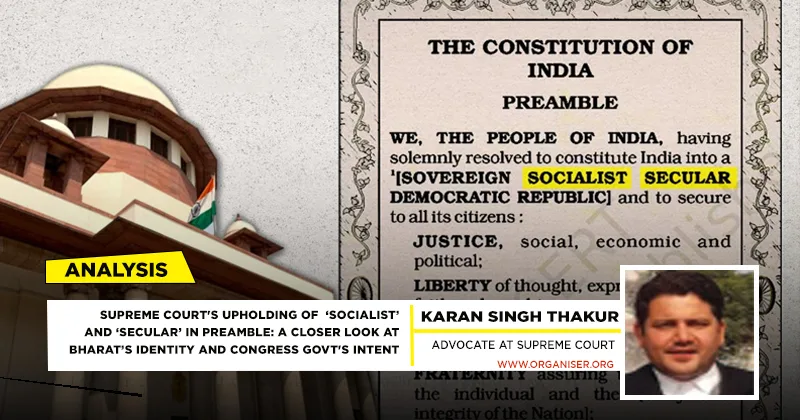
The recent ruling by the Supreme Court, which upheld the inclusion of the words ‘Socialist’ and ‘Secular’ in the Preamble of the Constitution, has unleashed a tempest of intellectual discourse, challenging the very essence of Bharat’s identity. These terms, inserted during the epochal 42nd Amendment of 1976 under Prime Minister Indira Gandhi, have become the fulcrum of fierce debates about Bharat’s soul. While the Court’s decision reaffirms the Constitution as it stands, it provokes critical inquiry into how these terms have been interpreted, manipulated, and weaponized, often obscuring the cultural, spiritual, and historical mosaic that forms the bedrock of this ancient civilisation.
Secularism and Its Disruptive Impact on Bharat’s Cultural Identity
The word ‘Secular’ was added to the Preamble to signify a state that maintains neutrality in matters of religion. However, this noble concept has, over time, been perverted and contorted in ways that stand in stark contradiction to the very ethos of Bharat. The essence of Bharat has always been deeply intertwined with its religious and spiritual heritage—where dharma, not a secular void, has been the guiding light of social, moral, and cultural evolution. Yet, the term ‘secularism’ has been hijacked by urban intellectuals, left-wing elites, and political forces who have strived to erase Bharat’s profound connection to its Hindu identity.
For decades, secularism has been weaponized as a tool to marginalize the indigenous spiritual traditions of Bharat, particularly its Hindu practices, symbols, and festivals. The left-liberal intelligentsia, with its penchant for foreign ideologies, has depicted Bharat’s Hinduism as an antiquated relic, ill-suited for the modern world. This secularism, often peddled as religious neutrality, has instead fostered an artificial and reductive dichotomy, where Bharat’s spiritual identity is vilified, and Western notions of secularism are held as the gold standard. In this ideological climate, Bharat’s vast cultural and spiritual tapestry is continually undermined, pushing the nation further away from its own roots.
The Socialist Agenda: A Stagnating Force on Bharat’s Economic Potential
The insertion of the term ‘Socialist’ in the Preamble, though intended to foster economic equity, has, in practice, been a disruptive force, shackling Bharat’s potential. Socialist policies, which advocate for state control and wealth redistribution, were conceived in an era where such ideas were seen as necessary to address glaring inequalities. However, these policies have ultimately resulted in inefficiency, stagnation, and a pervasive culture of dependency. Rather than encouraging innovation, self-reliance, and entrepreneurial vigor, the socialist agenda has suffocated Bharat’s dynamic spirit.
Bharat’s age-old tradition of entrepreneurship, self-sufficiency, and community-driven progress has been stifled under the heavy hand of bureaucratic socialism. Instead of empowering individuals to chart their own course, these policies have created a sprawling state apparatus that interferes in nearly every sector, limiting the potential of the nation’s people. The zeal for equality, while noble in intent, has often crippled individual initiative and innovation, thereby eroding the nation’s competitive edge in the global arena.
The Congress Government’s Motive Behind the Insertion of ‘Secular’ and ‘Socialist’
It is crucial to examine the political backdrop against which the terms ‘Socialist’ and ‘Secular’ were inserted into the Preamble. The 42nd Amendment of 1976, which added these words, was passed during the tenure of Indira Gandhi’s Congress government. At that time, the country was in the midst of a turbulent period marked by the Emergency (1975-1977), a phase that saw the curtailment of civil liberties, political dissent, and a significant consolidation of power under the Prime Minister’s office. The addition of ‘Secular’ and ‘Socialist’ was part of a broader attempt by the ruling Congress regime to redefine Bharat’s political and ideological landscape in a manner that aligned with the prevailing global currents of the time.
The Congress leadership sought to solidify its own ideological control and appeal to the emerging global leftist movements by adopting terms that were in vogue in Western democracies. ‘Secularism’ was viewed as a necessary counterbalance to religious tensions in Bharat, while ‘socialism’ was seen as an attempt to appeal to the masses by promoting social justice and welfare policies. However, this intervention came at the cost of Bharat’s unique spiritual fabric. The terms were not part of the original Constitution drafted by Dr. B.R. Ambedkar and the Constituent Assembly, who crafted a Preamble that emphasized justice, liberty, equality, and fraternity—principles that were more grounded in Bharat’s indigenous values.
The Congress government’s move to introduce these terms was a political maneuver designed to centralize power and create a new ideological narrative, which often obscured the deeper, more complex spiritual, cultural, and historical identity of Bharat. The addition of ‘Secular’ and ‘Socialist’ sought to align Bharat with Western notions of governance, which, while appealing in some respects, do not take into account the nation’s distinct history, spirituality, and cultural traditions. This ideological shift led to the continued marginalization of Bharat’s Hindu heritage, replacing it with a secular and socialist vision that was more in line with European and communist ideologies.
Urban Naxalism: A Radical Assault on Bharat’s Identity
At the heart of this ideological revolution lies urban Naxalism—a movement that seeks to dethrone Bharat’s spiritual and cultural foundations and replace them with Marxist-Leninist dogma. These urban Naxals, entrenched in the corridors of academia, media, and political power, view Bharat’s Hindu identity as an obstruction to their vision of a utopian, egalitarian state. They have cunningly used the terms secularism and socialism as weapons to forge a new narrative that seeks to sever Bharat’s deep connection to its ancient heritage.
The rise of this radical agenda has led to the systematic denigration of Bharat’s glorious civilization and its contributions to the world. The legacy of Hinduism, which has long been the cornerstone of Bharat’s social and cultural values, is relentlessly downplayed or ignored in favor of an ideology that seeks to undermine its very essence. The secularism propagated by these forces is not one of peaceful coexistence, but rather one that seeks to impose a vision of equality that disregards the unique contributions of Bharat’s spiritual and cultural traditions.
The Role of Left-Wing Media: Fueling Divisions and Misrepresentations
The left-wing media has been complicit in promoting this vision of secularism and socialism, often distorting the very nature of Bharat’s cultural identity. Through selective reporting, biased framing, and a deliberate downplaying of Hindu symbols and practices, the media has constructed a distorted view of Bharat’s values. Instead of fostering unity, the media has deepened societal divisions by perpetuating the myth that Bharat’s Hindu identity is a source of intolerance and division.
In this media-driven narrative, Hindu symbols, festivals, and practices are continually depicted as regressive, while the voices of minority communities are amplified to create the illusion of inequality. The media has failed to acknowledge that Bharat has always been a land of religious tolerance, where diverse faiths have coexisted harmoniously for centuries. The secularism touted by these forces does not respect Bharat’s diversity but seeks to impose a monolithic worldview that threatens the very foundation of the nation’s unity.
A Path Forward: Reclaiming Bharat’s True Identity
While the Supreme Court’s decision to uphold the inclusion of ‘Secular’ and ‘Socialist’ in the Preamble may be constitutionally sound, it is imperative for the people of Bharat to engage in a deep and honest reflection on the implications of these terms for the future of the nation. The adoption of secularism and socialism, without a clear understanding of Bharat’s historical and cultural context, has only exacerbated divisions within society, alienating the people from their heritage.
Bharat’s true strength lies in its unparalleled civilization, where dharma, spirituality, and community-oriented progress have always been the guiding principles. It is time for Bharat to rediscover its ancient wisdom and assert its rightful place as a beacon of cultural and spiritual excellence. Rather than adhering to foreign ideologies, Bharat must forge a new path—one that celebrates its Hindu traditions while embracing a model of governance that respects diversity and fosters true unity.
Revisiting Bharat’s Roots for a Unified Future
In conclusion, while the Supreme Court’s ruling may provide legal clarity, it is crucial for Bharat to reassess the meaning of secularism and socialism in the context of its own rich history. The nation must return to its roots—honoring its Hindu identity and reimagining a future that celebrates its cultural and spiritual heritage. Only by embracing its true identity can Bharat rise to its full potential, united and strong, with a clear sense of pride in its past and confidence in its future.
Bharat must reject the imposition of foreign ideologies and instead look inward to its own values—values of self-reliance, tolerance, and respect for diversity—to shape a prosperous and united future. By integrating Bharat’s timeless wisdom with contemporary solutions, the nation can offer a unique and powerful model to the world—one that emphasizes harmony, inclusivity, and self-determination. Only then can Bharat truly fulfill its destiny as a global powerhouse, rooted in its ancient traditions, and poised to lead the world into an era of peace, prosperity, and spiritual awakening.