The recent Pakistan Supreme Court ruling on the rights of the Ahmadiyya community has ignited a firestorm of protests and intensified the already fraught tensions between religious hardliners and the judiciary. This legal battle, which has seen multiple revisions and widespread demonstrations, reflects the complex and perilous position of the Ahmadiyya community in Pakistan, a country where they are systematically marginalised and denied basic rights.
What is the blasphemy case?
The controversy began on February 6, 2024, when the Pakistan Supreme Court delivered a landmark verdict in the case of Mubarak Ahmad Sani, an Ahmadiyya who had been arrested for distributing a religious text known as the Tafseer-i-Sagheer. This text is a condensed version of the Tafseer-i-Kabeer, a comprehensive ten-volume exegesis of the Quran authored by Mirza Basheer-ud-Din Mahmood Ahmad, the son of the founder of the Ahmadiyya sect. Sani’s arrest was made under a 2021 law in Punjab that criminalised the printing and distribution of “heterodox” Quranic commentaries. However, Sani contended that he had distributed the text in 2019 before the law was enacted.
Chief Justice Qazi Faez Isa, in a decision that would soon become a flashpoint, ruled in favour of Sani. The court held that criminal laws could not be applied retroactively, a fundamental legal principle.
Supreme Court’s ruling
Initially, the ruling attracted little attention, but it quickly became the centre of a national uproar after being highlighted by social media accounts linked to the Tehreek-e-Labbaik Pakistan (TLP), a radical group infamous for its violent anti-blasphemy protests.
The ruling evoked mixed reactions across Pakistan. On one side, legal experts and human rights advocates hailed the decision as a rare and courageous step towards safeguarding religious freedom, particularly for the Ahmadiyya community, which has faced relentless persecution in Pakistan.
However, the Ahmadiyya community’s optimism was tempered by the fact that the ruling did not go far enough—it failed to affirm their right to distribute religious texts openly. Meanwhile, Sunni extremist groups reacted with fury, accusing Chief Justice Isa of undermining Islamic values and siding with the Ahmadiyyas, whom they regard as heretics.
Backlash begin
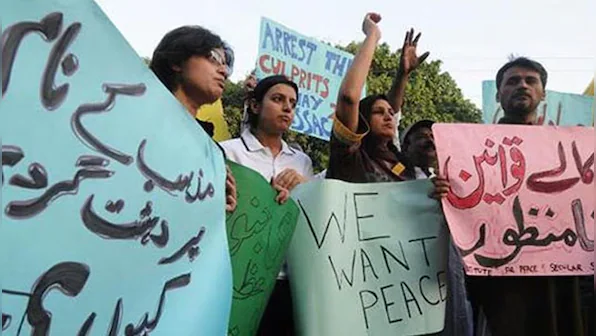
As the backlash grew, the Supreme Court faced increasing pressure from religious factions. On February 23, tens of thousands of Pakistanis took to the streets in protest against Chief Justice Isa, framing the ruling as an affront to Islamic principles. The Supreme Court responded by issuing a statement defending the decision, emphasizing that it did not violate Pakistan’s Islamic constitution. The court condemned the orchestrated campaign against the judiciary, describing it as an attack on the independence of the legal system.
Despite the Supreme Court’s defence, the controversy continued to escalate. The Punjab government, bowing to pressure from religious groups, filed a review petition challenging the court’s ruling. Several religious parties followed suit, filing petitions that echoed the demand for the ruling to be overturned. However, the court restricted the scope of these petitions, focusing the review process on constitutional and Islamic law arguments. The court also sought the input of ten religious institutions, including the Council of Islamic Ideology (CII), to provide guidance on the matter.
Ruling re-examined
On July 24, 2024, in a rare move, the Supreme Court convened a three-judge bench, including Chief Justice Isa, to re-examine the ruling. The bench clarified that their original decision was based solely on the principle of retroactivity and reaffirmed that the Ahmadiyya community could not identify as Muslims or propagate their beliefs outside their places of worship. This clarification, however, did little to quell the anger of radical Sunni groups or the CII. The CII, a constitutional advisory body, criticised the ruling for allowing Ahmadiyyas to practice their faith even within their own places of worship, arguing that they should be prohibited from doing so even in private.
The CII’s stance was particularly jarring given the timing—it coincided with Pakistan Minorities Day on August 11, 2024, a day meant to reaffirm the country’s commitment to protecting the rights of religious minorities. On this day, President Asif Ali Zardari reiterated Pakistan’s dedication to minority rights, highlighting the deepening contradiction between the government’s official stance and the actions of its advisory bodies.
In response to the growing unrest, the Punjab government filed yet another petition, challenging the court’s conclusions and arguing that they were based on erroneous assumptions. The Supreme Court is scheduled to hear this petition on August 22, 2024, on an urgent basis, a move that underscores the high stakes of this legal battle.
Extremists stormed Supreme Court
On Monday, August 19, 2024, the situation reached a boiling point. Workers from various religious organisations, including Jamiat Ulema-e-Islam (JUI) and Jamaat-e-Islami (JI), rallied under the banner of Majlis-e-Tahaffuz-e-Khatme Nabuwwat to demand the complete withdrawal of the Supreme Court’s decision in the Mubarak Sani case. Visuals shared across social media depicted chaotic scenes as protesters attempted to breach the Judges Gate of the Supreme Court. Despite police efforts to control the situation using tear gas, baton charges, and water cannons, the protesters managed to reach the Parliament House and the Supreme Court building, raising fears of further unrest.
Dwindling status of Ahmadiyya’s in Pakistan
The Ahmadiyya community, numbering between two to five million in Pakistan, continues to face severe persecution and discrimination. They are legally barred from worshiping in non-Ahmadiyya mosques, using Islamic greetings, quoting the Quran publicly, and producing or disseminating religious materials. Violations of these restrictions can result in imprisonment. Moreover, the community is excluded from the electoral process unless they renounce their faith or agree to be listed as “non-Muslims” on electoral rolls, a classification that contradicts their religious beliefs. As a result, the Ahmadiyya community boycotted the 2024 general elections, protesting against the ongoing persecution, which has included grave desecrations in Punjab.
In addition to these legal constraints, Ahmadiyyas must declare themselves non-Muslim to obtain essential documents such as passports or national ID cards. These laws have entrenched the community’s marginalization, subjecting them to frequent hate-related incidents. Religious seminaries across Pakistan perpetuate this discrimination by incorporating materials specifically designed to refute Ahmadiyya beliefs, further entrenching societal prejudice against them.
The ongoing legal and social battle over the rights of the Ahmadiyya community is a stark reminder of the deep-seated religious intolerance that plagues Pakistan. The Supreme Court’s ruling, while legally sound in its adherence to the principle of non-retroactivity, has exposed the fragility of religious freedom in a country where extremist views often dictate public policy.
As the situation continues to unfold, the question remains: will Pakistan’s judiciary stand firm in its defence of minority rights, or will it succumb to the mounting pressure from religious hardliners? The answer to this question will not only determine the future of the Ahmadiyya community but also the broader trajectory of human rights in Pakistan.