Bharat is a culture of celebrations and festivals. The aims of these festivals are to develop human relations and make meaningful expressions of noble emotions. Shravani or Raksha Bandhan has an important place in these festivals. The festival, which has been prevalent since the Vedic era, establishes and restores education, health, beauty and cultural values. It is celebrated as Sankalp Parv to atone for and protect values of life. This is the basis of the happiness and prosperity of life. Raksha Bandhan is observed on the last day of the Hindu lunar calendar month of Shravan, which typically falls in August month of Gregorian Calendar. The word “Raksha Bandhan” in Sanskrit literally means “the bond of protection, obligation, or care,”- this expression is now principally applied to this ritual. Until the mid-20th-century, the expression was more commonly applied to a similar ritual, also held on the same day, with precedence in ancient Hindu texts, in which a domestic priest ties amulets, charms, or threads on the wrists of his patrons, or changes their sacred thread, and receives gifts of money; in some places, this is still in the practice.
There are two major festivals which are celebrated on the day of Shravani Purnima-Shravani or Upakarma and Raksha Bandhan. Raksha Bandhan means to be bound to protect. The sutra symbolises the identity of holy love, the unbreakable faith of the brother and sister. This festival of Rakhi is also known as Rakhadi, Saloni, Shravani and many other names. But the real meaning of each name is affection. Rakhi is an unbreakable bond of raw threads that has given a distinct identity to Bharaiya culture.
There are many stories about this festival. It is believed that when the deities continued to be defeated in the Devasura war, Indra expressed his desire to conquer with his guru Brahaspati and prayed for a solution. Devguru Brahaspati made rakhi of aak fibres on the day of Shravan Purnima and tied it on Indra’s wrist. This defence shield proved to be a boon. Thus, Brahaspati, who tied the first raksha sutra in human culture, was established as Devguru. From then on, the practice of tying the defence thread started.
It was on this day when Indra’s wife Sachi tied a raksha sutra on his arm he was about sent off for the Devasura war. This thread was a symbol of belief and faith. Faith flourished and Indra returned victorious. In ancient times, the wives of warriors used to tie raksha sutras and send them to the battlefield so that they could return victorious. According to another plot, Bhagwan Vamana had obtained Dakshina on the same day by tying a thread for protection to King Bali. In fact, in exchange for this raw thread of Rakhi, Bhagwan Krishna saved the dignity of Draupadi’ by making Draupadi’s saree inexhaustible and unlimited. This can be called the sacred thread and sacred relationship of the brothers and sisters and this is where raksha bandhan came into vogue. The punya tradition appears in various forms in the ancient , medieval and present times.
In the chapter 137 of the Uttara Parva of the Bhavishya Purana, in which Bhagwan Krishna describes to Yudhishthira the ritual of having a raksha (protection) tied to his right wrist by the royal priest (the rajpurohit) on the purnima (full moon day) of the Hindu lunar calendar month of Shravan). In the crucial passage, Bhagwan Krishna says,
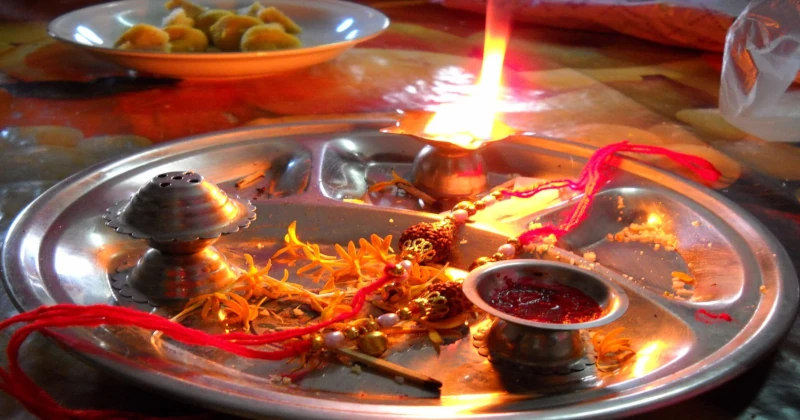
“Parth (applied to any of the three sons of Kunti (also, Pritha), in particular, Yudhishthira): When the sky is covered with clouds, and the earth dark with new, tender, grass, in that very Shravan month’s full moon day, at the time of sunrise, according to remembered convention, a Brahmin should take a bath with perfectly pure water. He should also according to his ability, offer libations of water to the gods, to the paternal ancestors, as prescribed by the Vedas for the task required to be accomplished before the study of the Vedas, to the sages, and as directed by the gods carry out and bring to a satisfactory conclusion the shradh ceremony to honour the deceased. It is commended that a Shudra should also make a charitable offering, and take a bath accompanied by the mantras. That very day, in the early afternoon (between noon and 3 PM) it is commended that a small parcel (bundle or packet) be prepared from a new cotton or silk cloth and adorned with whole grains of rice or barley, small mustard seeds, and red ocher powder, and made exceedingly wondrous, be placed in a suitable dish or receptacle. … the purohit should bind this packet on the king’s wrist with the words,’I am binding raksha (protection) to you with the same true words with which I bound Mahabali King of the Asuras. Always stay firm in resolve.’ In the same manner as the king, after offering prayers to the Brahmins, the Brahmins, Kshatriyas, Vaishyas and Shudras should conclude their Raksha Bandhan ceremony.”
Raksha Bandhan is the cultural paradigm of Bharatiyas . Its nature is completely cultural. Based on the spirit of defence, this festival is a messenger of strength and courage. This festival has contributed a lot in installing a spirit of care and protections of weaker sections of the society among the Bharatiyas. It has played an important role in changing the flow of history. This festival has bound people emotionally by limiting the boundaries of religion, blood, language and ethnicity. The formulas of emotion are very subtle and permanent. Rakhi’s raw threads have more strength and power than iron binding.
The relevance of this festival is intact in the face of the present adversity. It is associated with equality, unity, protection and affection as well as the sacred eternal relationship between brothers and sisters.
Raksha Bandhan is one of the six festivals inscribed by Adi Sarsanghchalak of RSS Dr Hedgewar ji in the ritual calendar of the organisation: Varsha Pratipada (the Hindu new year), Shivajirajyarohonastava (the coronation of Shivaji), guru dakshina, Raksha Bandhan (a popular Hindu festival in which sisters tie Rakhi (Sacred ribbons) round the wrists of their brothers to remind them of their duty as protectors).
RSS organises the Utsav in near by area and all the Swayamsevaks tie rakhi to each other promising to protect each other. And then they take some rakhis along with them and they go into the society and tie rakhi to other common people promising the same.
As Raksha Bandhan is celebrated where brother promises sister who ties rakhi to brother that he will protect her from all the evils.
In RSS rakhi is symbol that Swayamsevaks are there in the society to protect common people from all the evil and anti-social elements present in the society. As in Hinduism all the festivals are celebrated symbolically which symbolises some social cause. As protecting cultural and moral values of society is one of the commitments of the RSS, to remember this RSS celebrates Rakshabandhan.
Finally, the nation state of Bharat has itself promoted this festival as Leo Coleman states:… as citizens become participants in the wider “new traditions” of the national state. Broadcast mantras become the emblems of a new level of state power and the means of the integration of villagers and city dwellers alike into a new community of citizens. While Raksha Bandhan is celebrated in various parts of South Asia, different regions mark the day in different ways.
In the state of West Bengal, this day is also called Jhulan Purnima. Prayers and puja of Bhagwan Krishna and Radha are performed there. Sisters tie rakhi to brothers and wish immortality. Political parties, offices, friends, schools to colleges, street to palace celebrate this day with a new hope for a good relationship.
In Maharashtra, among the Koli community, the festival of Raksha Bandhan/Rakhi Pournima is celebrated along with Narali Pournima (coconut day festival). Kolis are the fishermen community of the coastal state. The fishermen offer prayers to Bhagwan Varuna, the Hindu god of Sea, to invoke his blessings. As part of the rituals, coconuts were thrown into the sea as offerings to Bhagwan Varuna. The girls and women tie rakhi on their brother’s wrist, as elsewhere.
In the regions of North Bharat, mostly Jammu, it is a common practice to fly kites on the nearby occasions of Janmashtami and Raksha Bandhan. It’s not unusual to see the sky filled with kites of all shapes and sizes, on and around these two dates. The locals buy kilometres of strong kite string, commonly called as “gattu door” in the local language, along with a multitude of kites.
In Haryana, in addition to celebrating Raksha Bandhan, people observe the festival of Salono. Salono is celebrated by priests solemnly tying amulets against evil on people’s wrists. As elsewhere, sisters tie threads on brothers with prayers for their well being, and the brothers give her gifts promising to safeguard her.
In Nepal, Raksha Bandhan is referred to as Janai Purnima or Rishitarpani, and involves a sacred thread ceremony. It is observed by both Hindus and Buddhists of Nepal. The Hindu men change the thread they wear around their chests (janai), while in some parts of Nepal girls and women tie rakhi on their brother’s wrists. The Raksha Bandhan-like brother sister festival is observed by other Hindus of Nepal during one of the days of the Tihar (or Diwali) festival.
The festival is observed by the Shaiva Hindus, and is popularly known in Newar community as Gunhu Punhi.
Another aspect of Shravan Purnima is Shravani i.e. Upakarma. Upakarma is purely Vedic karma. Without this, Raksha Bandhan is incomplete. The festival is performed collectively by bathing, worshipping, havaning on a holy river, reservoir or beach. On the same day, there is also a legislation to change the yagnapavita. The Scriptures are the Word
संप्राते श्रावणास्यान्त पौर्णिमास्या दिनोदये। स्नानं कुवत मतिमान् श्रुति स्मृति विधानतः॥
That is, a wise man should perform a bath on the full moon of Shravan in the morning according to the Shruti-Smriti vidhana. This is the holy festival of self-purification. Even those who live with caution make some mistakes. Shravani has made a special contribution to these defects and to get rid of sin. Acharya Hemadri Krit Shravani Sankalp is the biggest resolution of Karmakand. This is an atonement resolution. It seeks to get rid of many known and unknown sins. It is bathed through soil, dung, ash, panchgavya, apamarga, kushya water etc. This leads to physical purification and spiritual sanity is provided by sage worship, worship of god. After havan, the sun is offered arghya (libation of water). There is also the law of vedadhyan after self-purification.
The methods of bathing on Shravani parv have been stabilised on a very scientific basis. Clay, ash, gomay, kusha, durva etc. are all healthy and pathogenic. Thus, the entire process of Shravani is extremely beneficial for all purification. Ayurveda also accepts the usefulness of panchagavya substance.
The festival, which has been celebrated since the Vedic era, aims to remove the evils committed by pramad or ignorance through atonement. At the same time, you have to be determined to protect the values of life. It inspires good deeds in the future. At the core of this festival lies the sacred spirit and the high ideal. By adopting which life and society can be made excellent and advanced.