Knowingly and unknowingly, most of our present–day writers are following the thoughts of the best-known post-modern writer, Jacques Derrida, one of the most revolutionary philosophers of the 20th C. Some of his revolutionary works are ‘Speech and Phenomena (1967), ‘Of Grammatology’ (1967), Writing and Différance (1967), ‘Dissemination’ (1972) and ‘Margins of Philosophy’ (1972). Derrida is a staunch supporter of post-structuralism as well, which is a version or an off-shoot of post-modern thinking that deals particularly with the concerns of language and literature.
Derrida is an Algerian left-wing thinker, a realist and a materialist. He is an atheist who wants to eradicate every kind of mysterious other-worldly entity that has any connection with language and literature. So, in his works, we see a constant fight against metaphysics that deals with entities beyond the realm of physics. According to him, language and literature should be purged of their relation to any divine or transcendental ‘presence’. He also questions the claim of language to have a single authoritarian message. Hence, the post-structuralists are interested in exploring how language can convey many different things simultaneously. A single text can convey a variety of mutually contradictory effects. The readers are free to interpret in their own interests, ignoring the intention of the author.
The post-modern style of reading is known as deconstruction, which is directed against the idea of a single dominant message of any book that represses or marginalises others. Deconstruction is supposed to be neither the destruction of the given theme nor the construction of an entirely new theme, but in effect, it is a destructive criticism of the author’s message. It is a tactic of decentering or subverting the central theme of a text so that the marginalised theme can become central and can overthrow the previous hierarchy.
This technique of reading texts has left grave consequences with respect to the Indian traditional texts, especially the great epics and other puranas. The epics of Bharat that excel all other texts in literature in their magnitude and magnificence are now found increasingly subjected to devastating criticism from the standpoint of post-modernism and post-structuralism. The left-wing thinkers and writers find the new trend, especially the atheistic thinking of Derrida, very enticing. They are led as a result to deconstruct the traditional literary works that contain spiritual themes as their primary ones. The new writers attempt to shift these prime themes to make room for other insignificant sub-themes to take the prime role. The argument of the post-modernists is that all the themes and characters should be given equal importance so that none of the subjects of discourse remain marginalised. On this pretext, they sympathise with the villains and criticise the heroes. This is a crafty stand enunciated by Derrida, whose intention was actually to decentralise the metaphysical focus of the texts to maintain and promote spiritual tradition. We know that the epics are the texts that have been the most influential in satisfying the theological aspirations of the great masses in India.
Derrida questions the traditional pattern of the human mind when thinking in terms of binary oppositions, the contrasts between two opposite things. It is this way of thinking that leads cultures to think in terms of good and bad, along with other binaries such as reason and emotion, mind and matter, infinite and finite, immortality and mortality and so on. The first of these binaries is treated as dominant over the other. Thus, reason is superior to emotion, the mind is superior to matter, and the infinite and immortality reign the finite mortals. Derrida intends to do away with this kind of opposition, so he proposes to subvert the binaries. This technique of deconstruction obviously conveys hazardous implications to individual lives as well as social life and culture. Reducing mind to matter, making the rational being submissive to the emotional part, eliminating the immortal and the infinite from the mortal and the finite life of man turns topsy turvy the values and culture of a community. More serious is its implication with respect to the binary of good and evil. Subverting this binary carries a very dangerous signal to the future of humanity that follows post-modern trends.
This is the instigation behind the recent trend of misreading the epics of Bharat in such a way as to find fault with the great deeds of the heroes and glorify the wrongdoings of the villains. Such a subversive mode of reading of authoritative texts is what is known as deconstruction. The Marxist thinkers became quite enchanted by this deceptive way of demoting the metaphysical tradition of Bharat, which plays a crucial role in bringing unity among those people who feel proud of their glorious tradition. Their need is to promote a materialistic way of thinking, for Marxism can strengthen its shrinking roots only in such damp soil. Those writers who are quite ignorant of this devious method of criticism adopted by the Marxists are misguided by the propaganda that it is the present-day novel trend in writing which has replaced all others that were old-fashioned and obsolete.
The fundamental notions that guided Derrida in his analysis of language were to throw off the hitherto dominant roles played by metaphysics over physics, rational thinking over emotions and passions, eternal existence over temporary existence, etc. When such dominance is sublated, man simply becomes a sensory animal, of course possessing the most complex brain structure compared to other animals. The materialistic perspective of the post-modernists conceives the mind merely as a function of the brain, which in turn is a part of the physical body. Hence, the mind is a product of matter, which is exactly the notion held by Karl Marx.
The epics of Bharat are the epitomes of a great tradition carrying spiritual truths that are supported by the findings of physical sciences as well as reason. The universe of multitude had arisen from a single source: the basic cosmology found in the Upanishads, which stands uncontradicted either by science or reason. The moral life of the people belonging to this tradition follows strictly the eternal spiritual truths revealed by the Vedas and illustrated by the epics. The kind of moral laws that necessarily follow the ultimate eternal spiritual truth is known as ‘Sanatana Dharma’. This dharma is different from relative morality that undergoes change from time to time, from society to society.
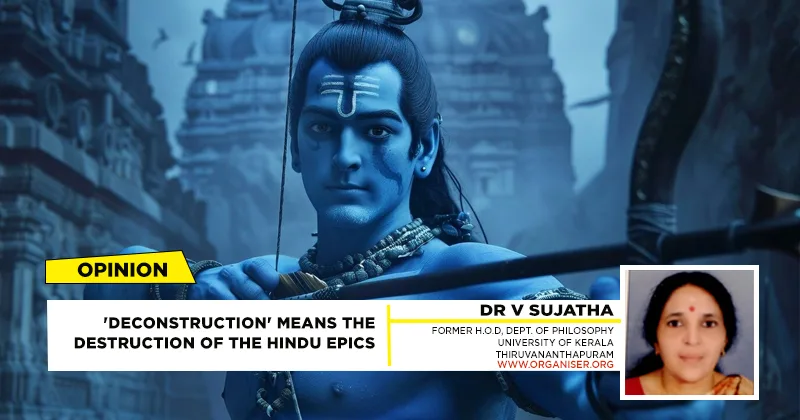
In order to subvert the supremacy of good over evil, the epics are today deliberately misinterpreted by the post-modernists in such a way that the evil deeds of Ravana, Duryodhana, Karna etc are justified while the good deeds of the great characters such as Rama, Krishna, Yudhisțhira etc are presented most irrationally by adopting a damagingly critical standpoint. To cite a particular case of this kind of strange reading of Ramayana by the post-modernists is their indictment that Rama’s killing of Tāțaka is the first instance, in the history of humanity, of murdering a woman. They deliberately ignore the fact that she is not an ordinary woman but a demoness with mysterious powers and herself a murderess who is attacking Rama and his brother Lakshmana. Such negative criticism enforced through adverse comments on the great deeds of the true heroes is intended to make the good and the evil aspects of the binary nullified, the post-modernists argue. It is true that the universe and its power in themselves are neither good nor evil, but human life and its society need the good as it is a stronghold, and our fight against evil is indispensable to preserve the ethics of the individual and society.
Derrida argues that deconstruction would bring out the hidden layers of meanings in a text that stood suppressed or implied. According to him, if we ignore this free-play of interpretation in our literature, then it will tend towards fixity, finalisation, totalitarianism and exclusion. However, the fact is that it is deconstruction that contains the fixed and exclusive agenda of throwing off all kinds of references from art and literature to the spiritual and moral. It is their blind belief in atheism and materialism that keeps the post-modernists closed-minded and prejudiced in their approach to reality.