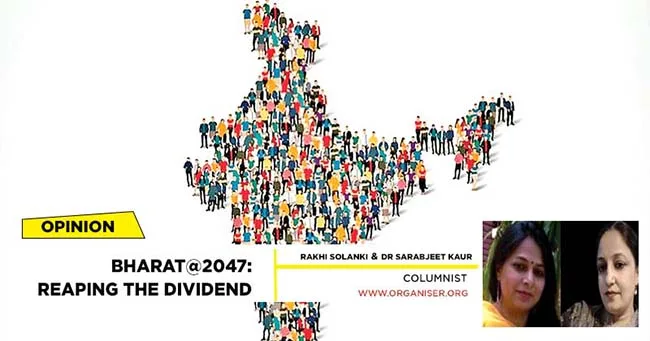
Bharat with its large and young population, is currently experiencing a demographic dividend. It is expected to last until 2055, providing Bharat with a unique opportunity to boost its economic growth. Bharat is expected to add another 183 million people to the working-age group between 2020 and 2050.This change in the age structure of the population can lead to a ‘demographic dividend’ of economic growth if it is accompanied by sustained investments in education and health, and policies that promote labor force participation. According to the IMF, the demographic dividend could add about 2 percentage points per annum to Bharat’s per capita GDP growth over the next two decades. A report by the Confederation of Indian Industry (CII)suggests that Bharat’s demographic dividend could boost India’s GDP growth from the current $3 trillion to $9 trillion by 2030 and $40 trillion by 2047
As India approaches its centenary of independence in 2047, the nation finds itself at a critical demographic crossroads. The vision of a fully developed or “Viksit” Bharat faces a significant challenge: a steadily declining fertility rate. In 2021-22, India’s fertility rate reached 2.0 births per woman, falling below the replacement level of 2.1. This demographic shift presents both challenges and opportunities for Vision 2047 Bharat, India’s ambitious blueprint for transformation into a developed nation. The changing landscape has profound implications for the country’s economic future and the role of its youth in shaping the path forward.
Shifting Demographic Patterns
India has long been poised to reap the benefits of its demographic dividend, with a large working-age population supporting economic growth. However, the declining Total Fertility Rate (TFR) may alter this scenario. According to the National Family Health Survey-5, the TFR dropped to 2.0 in 2019-21, potentially transforming the demographic dividend into a demographic burden by 2047. This shift has been driven by several factors, including increased female empowerment and education, government initiatives promoting family planning, urbanization and economic growth, delayed marriages, and changing social norms favouring smaller families.
The reasons behind India’s falling fertility rates are multifaceted. Increased access to education, particularly higher education for women, has led to delayed marriages and smaller family sizes. Educated women often have more autonomy in family planning decisions, contributing to the overall decline in fertility. The government’s expansion of family welfare programs, community health workers, and healthcare centers has improved access to family planning information and contraception, further accelerating the trend. Urbanisation and economic growth have changed lifestyles and reduced incentives for larger families, while the rising average age of marriage for both men and women has resulted in later childbearing and smaller family units. Additionally, cultural attitudes have shifted, with smaller, nuclear families becoming more desirable and accepted in Indian society.
Looking to the future, UN estimates paint a picture of rapid demographic change for India. The country’s senior population (over 60) is projected to grow by 41% between 2021 and 2031. By 2046, there will be more seniors than children in India, and by 2050, one in five Indians will be elderly. These projections extend further, suggesting that by the end of the century, 36% of Indians will be over 60. This aging population poses significant economic challenges, particularly in terms of the rising old-age dependency ratio, which will put strain on a declining working-age population.
Ageing Population and Economy
Unlike developed countries that aged more slowly and at higher income levels, India faces the challenge of managing an aging population earlier in its development trajectory. This presents a unique set of obstacles for policymakers and society at large. The impact on Vision 2047 Bharat will be far-reaching, affecting various aspects of India’s development. Economic growth may slow due to a shrinking workforce unless productivity significantly increases. The healthcare system will need to rapidly evolve to manage age-related illnesses and provide long-term care for an expanding elderly population. Social security and pension systems will face increased pressure as the dependent population grows, necessitating robust and sustainable solutions.
Youth for Viksit Bharat
Despite these challenges, India’s youth have a crucial role to play in realising the vision of Viksit Bharat. Young Indians must focus on acquiring high-value skills that can drive productivity and innovation, compensating for the future workforce shortage. Encouraging entrepreneurship and new business models can create employment opportunities and drive economic growth, even with a smaller working-age population. Embracing and developing new technologies, particularly in automation and artificial intelligence, can help maintain economic output and competitiveness on the global stage.
Young professionals in healthcare will be instrumental in developing innovative solutions for an aging population, including advancements in telemedicine and preventive care technologies. The youth can also lead in creating sustainable cities, developing clean technologies, and promoting circular economy models, ensuring that India’s development is both economically vibrant and environmentally sustainable. Social innovation will be crucial, with young people developing new models of community support
and intergenerational cooperation to address the challenges of an aging society.
As India navigates this demographic transformation, the world will be watching. The success of ‘Viksit Bharat @2047’ could provide valuable lessons for other developing nations facing similar demographic challenges. The future of India lies in the hands of its youth, and their actions today will shape the nation for generations to come. The journey towards Viksit Bharat is not just about economic indicators; it’s about creating a society that is prosperous, equitable, and sustainable in the face of significant demographic change. With the right strategies, policies, and youth engagement, India can emerge as a global leader, demonstrating how to successfully manage the transition to an aged society while maintaining economic dynamism and social progress.