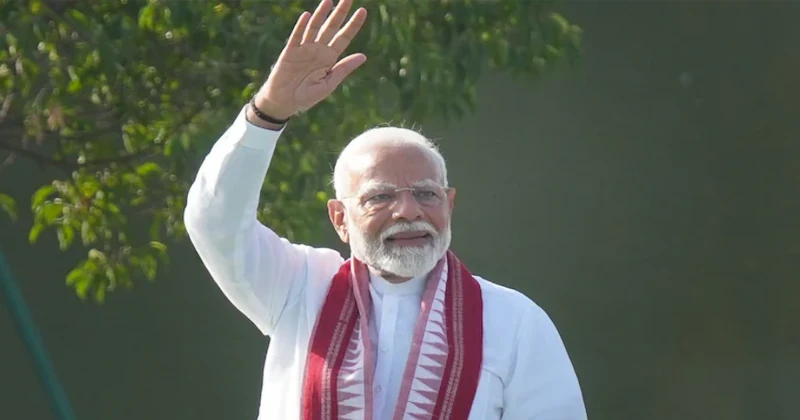
The largest electoral exercise in documented human history – the Indian General Elections 2024 has ended with a historic third term for the Bharatiya Janata Party (BJP) under the leadership of Prime Minister Shri Narendra Modi. The National Democratic Alliance (NDA) has secured the majority in the Lok Sabha, with the Telugu Desam Party, steered by Shri Chandrababu Naidu, having taken a new flight in Andhra Pradesh. In the run-up to the General Elections 2024, the Bharatiya Janata Party launched a dynamic and multifaceted campaign, emphasising its achievements over the past decade and promising further economic growth, national security, and social reforms. The campaign was characterised by extensive use of digital media, large-scale rallies, and targeted outreach programs aimed at different demographic groups, including young voters, women, and rural populations. Key highlights included promoting flagship initiatives like the Make in India, Digital India, and Swachh Bharat campaigns, alongside strong rhetoric on nationalistic themes and security issues. The outcomes of this vigorous campaign were significant, with the BJP securing a clear majority in the Lok Sabha, reinforcing its dominance in Indian politics. The party’s success was attributed to its ability to effectively communicate its vision, address voter concerns, and mobilise its extensive grassroots network, ensuring a decisive electoral victory. The attempt at harnessing post-binary thinking by the party was key in the entire exercise: Vikaas and Virasat (progress and heritage), but more importantly, grassroots and glass-roofs.
The politics of welfare is central to the story of development in Bharat. During Shri Narendra Modi’s tenure as Prime Minister, the Indian government launched several key welfare schemes aimed at socio-economic improvement. Notable initiatives include the Pradhan Mantri Jan Dhan Yojana for financial inclusion, Swachh Bharat Abhiyan for sanitation, and Pradhan Mantri Ujjwala Yojana providing LPG connections to BPL households. Health care received a boost with Ayushman Bharat, offering insurance coverage, while housing was addressed through the Pradhan Mantri Awas Yojana. Farmers benefited from direct cash transfers under the PM-KISAN scheme, and the Atal Pension Yojana targeted social security for the unorganised sector. Skill development was promoted through the Skill India Mission, while the Make in India and Digital India initiatives aimed to bolster manufacturing and digital infrastructure. These schemes reflect the government’s focus on inclusive growth, poverty alleviation, and enhancing the quality of life for all citizens.
After centuries of colonisation and economic crippling, Bharat went from being a robust industrial and economic powerhouse to being relegated to the list of developing countries. Unfortunately, this has led to appeasement politics and politicking with freebies. In these General Elections, the INDI alliance tried propagating false narratives based on people’s fear and insecurity. A helper at my residence asked me one fine morning whether Rahul Gandhi would give Rs. 1 lakh to women belonging to economically disadvantaged families. I had to explain to her the short-cut approach taken instead of the more sustainable skill development that the government’s Lakhpati Didi scheme, for instance, prioritises. But that is what, unfortunately, democracy sometimes becomes. A recently circulated video showed the delight of a woman in rural West Bengal for getting Rs. 1000 in her bank account from the Trinamool Congress government in the state. This was part of the state’s Lakshmir Bhandar scheme, which allocated money for cash transfers of Rs. 500 to general-category women and Rs. 1000 for women from SC/ST communities. This seems to have made a difference in West Bengal, reaching more than 2.15 crore women (accounting for more than 55 per cent of women voters and almost 30 per cent of voters in West Bengal).
This cashing-in by the Trinamool Congress and other reasons about intimidation tactics and poll violence made it obtain a significant number of seats in the state. As unsustainable and convenient as such schemes were, the Bharatiya Janata Party also employed Chanakya Neeti in other states to recognise this aspect of democracy as an interplay of self-interests. Thankfully, this happened from a space of genuine concern and interest for the welfare of people rather than as a purely political move. For instance, the BJP government in Madhya Pradesh initiated a cash transfer of Rs 1,000 each to the accounts of 1.25 crore women in the state as it rolled out the Ladli Behna Yojana. What makes this different, though, is that state leaders like Shri Shivraj Singh Chouhan have a strong connection with the ground. He is a true grassroots leader familiar with the concerns and interests of the people of his constituency and the state. Smt. On the other hand, Mamata Banerjee has displayed parochialism in not allowing union government schemes to be implemented in the state, announcing a slew of freebies before elections and appeasing minorities (brazenly, might I add). Sometimes, it is about battling things out in the realm of decentralised realpolitik to ensure good governance at a greater level, sure, but from a space of seva and sincerity.
In Uttar Pradesh, the narrative that the BJP will change the constitution if it were to secure the aim of 400 Paar was peddled in most constituencies. Unfortunately, even in the Faizabad constituency, which comprises Ayodhya as an Assembly constituency, the incumbent BJP MP Lallu Singh happened to refer to this in what would prove to be his own goal. The party may have been able to counter this narrative on the ground. Still, the thrust was on the positive message of good governance, which was both constructive and insufficient for purely electoral arithmetic in specific political areas. Fear sells more than hope, unfortunately. Insecurity is seemingly more unsettling than the prospect of misgovernance. Misgovernance and Gunda-raj were the memorable attributes of the last state government formed by the Samajwadi party in Uttar Pradesh. The left-liberal ideologues trying to portray the loss in Ayodhya as a loss for the BJP’s vision of Vikasit Bharat are celebrating having not lost the plot entirely. Even after ten years out of power, the Congress, the grand old party of India, formed and sustained for seemingly colonised minds and to further the interests of specific individuals and families who do not seem to have the best interests of the nation, could not even cross into triple digits, in terms of seats won. And that is where the glass-roof approach worked. The BJP has tried to break the proverbial glass roof on multiple fronts: human resource parameters, growth indices, foreign affairs presence, national security, science and technology, gender parity and civilisational resurgence. As much as electoral street tussles and grass-root dynamics are important, so is a coherent and meaningful vision for the Rashtra. While there is a strong need for local leadership and constituency-based organisational strength, there is also a need for a direction in which a political party seeks to drive the country upon being elected. That is where Congress seemed to be offering a khichdi of calumny. Besides the brazen appeasement of minorities, the pipe dreams and unrealistic projections of how Congress would help develop the nation did not quite catch the attention of the masses. Compounded on that was the hypocrisy: for a party seeking to talking of linguistic diversity and the promotion of non-Hindi languages, their manifesto was called Nyay Patra! The manifesto used New York’s Buffalo River picture to show a `dirty’ river in India, sought to champion democracy while talking of removing the elected state government of Manipur, wanted to take the country back to the stone-ages with paper ballots over EVMs in elections.
Within the Bharatiya Janata Party (BJP) as well as within the Dharmic way of thinking, Atmachintan (introspection) is an integral part of existence, be it in victory or loss, positive or negative state of matters. This election result should be no different. There should always be a thought towards what can be done better. If we must move towards a secure tomorrow, political stability is important, and for that we must even out some pertinent points of interest and concern. No polity, particularly a democratic one, can be taken for granted, in its will and choice. While the party triumphed in the nation, there were questions asked about candidate selection in specific states, about whether the positive message reached the last mile, with there being reports of booth management lagging in some constituencies. We must also be cautious against unknowingly imbibing that which we have stood against, following the footsteps of Shri Deen Dayal Upadhyay and Shri Shyamaprasad Mukherjee. Fierce nationalism, the Dharmic model of existence, the no-nonsense attitude to corruption and sycophancy for power, zero tolerance for appeasement. These are all aspects that we must look upto, even if electoral considerations may not always allow them to be implemented.
The BJP has always been a cadre-based party, where the sangathanis more important than any individual, where seva is always more primary than narcissism. That should be the way ahead, as it has been decades past: promoting merit and sincerity over nepotism and self-interests, since the latter are the Congressi vices. There are thousands of karyakartaswho have worked tirelessly in these elections. There are thousands more who would be great assets for the Rashtravadi, Dharmic politics that the Bharatiya Janata Party stands for. Instead of only seeking to bring around `influencers’, who are like shifting logs in the water: here today there tomorrow, we should follow the model that was implemented in states like Haryana, Madhya Pradesh and Rajasthan – performing karyakartas should be promoted. And by performing, I do not mean how many district, state and national functionaries a karyakarta knows and is close to alone, or which lobby within the party circles he/she is aligned with, but who can, by action and vision, help the party shape the future of the Rashtra towards a more sustainable, Dharmic and Vikasit tomorrow.
The Congress has an acute dearth of mass-leaders in its ranks, especially in its youth cadre. In the BJP, we must actively move away from the culture of grassroot leaders working in a constituency for years and then a hand-picked candidate coming and reaping the rewards of the work in that constituency, due to somebody’s reference. It is only when merit and sincerity is rewarded, decision-making is decentralised, and the party moves with the post-binary approach of grassroots and glass-roofs that Modiji has shown us, that we can move forward in a meaningful way. And who better than the quintessential karyakarta, our Rashtra’s Pradhan Sevak – Shri Narendra Modi himself! It is with honesty, integrity and sincerity that I, as a karyakarta, would like to put these few thoughts forward humbly.