
Of late, left-leaning historians have been biased toward the Tipu Sultan-centric view of the erstwhile Mysore kingdom. This view, which overemphasises the military achievements of Tipu Sultan, often overlooks the unique and significant contributions of the glorious Wodeyar dynasty, which originated in the world-famous Vijayanagar empire. It is, therefore, crucial to review and appreciate the profound and unique contributions of the Wodeyar dynasty in administration, music, arts, and culture that enriched the Mysore kingdom and set the highest standards for other states of India to emulate. For instance, the Wodeyars established a robust administrative system, patronized, and promoted various art forms, and contributed significantly to the development of Carnatic music in a way that was distinct and unparalleled.
Despite the looming threat of Abrahamic faiths and conversions, Karnataka, with its unique cultural identity, managed to preserve its heritage better than its southern counterparts. This remarkable achievement was not a stroke of luck but a testament to the steadfast dharmic rule established by the Mysore Wodeyars. Their resilience and dedication to safeguarding the state’s rich heritage over 548 years, from 1399 CE to 1947 CE, stand as a testament to their unwavering spirit and commitment, underscoring the pivotal role of the Wodeyar dynasty in shaping and preserving Karnataka’s cultural landscape.
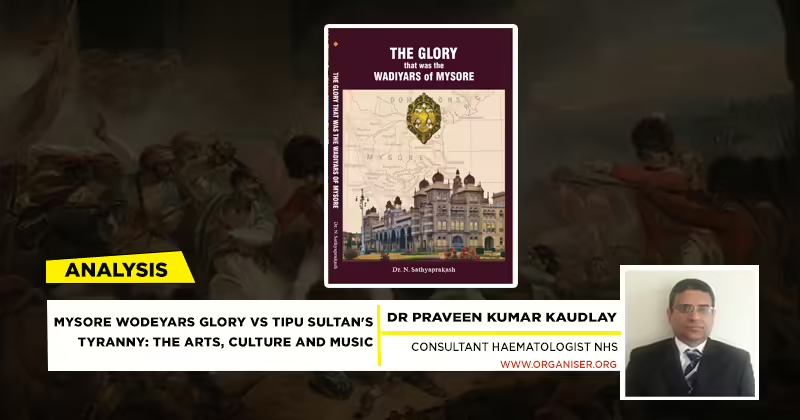
Dr N Sathyaprakash, an esteemed educationist, and a recipient of the Presidential Award, served on the textbook writing committee of the Karnataka government. He was deeply fascinated by the contributions of the Wodeyar dynasty, dedicating over three decades to his research. His efforts culminated in a substantial body of work and a well-deserved D. Lit from Tumakuru University in Karnataka. His work, titled “The Glory that was the Wodiyars of Mysore,” delves into the Mysore Wodeyar’s contributions to the administration and art forms that propelled the state to become the country’s most progressive and model state, a central theme of his research thesis, serving as an inspiration to all.
Administration reforms
The Wodeyars demonstrated exemplary administrative capabilities by themselves or through the Dewans who got appointed. Sri Chikka Devaraja Wodeyar (1672-1704) enhanced state administration by appointing a council of ministers and setting up the central secretariat, “Athara Kachcheri,” with eighteen departments. He introduced a fairer tax system, boosting revenue management.
The kingdom boasted exemplary administrators. Dewan Purnayya, a notable figure, started judicial reforms by setting up a court with two judges and a six-member jury in 1806, advancing justice efficiency and transparency. He also introduced smallpox vaccination in India, the first of its kind. When many in the court disagreed with the vaccine, Rani Lakshmmamanni, a sergeant, persuaded her daughter-in-law to have the vaccination first to raise awareness. The news spread throughout India, and the immunisation became successful.
The kingdom’s golden age lasted from 1881 to 1940 under Chamarajendra Wodeyar X and Rajarshi Krishna Raja Wodeyar IV. Chamarajendra Wodeyar, guided by Dewan Rangacharlu, established India’s first Representative Assembly, incorporating landlords, merchants, planters, and agriculturists, aligning the royal vision with public aspirations.
In 1881, Maharani’s Girls High School was founded, emphasizing girls’ education with scholarships for higher studies. Sir M. Vishveshwarayya was a notable beneficiary. Rangacharlu’s successor, Dewan Seshadri Iyer, improved agriculture and set up the Muzrai department to manage religious institutions.
Under Rajarshi Krishna Raja Wodeyar IV, the state saw significant infrastructure development, including railways, hospitals, hydroelectric plants, and bridges, driven by Sir M. Vishveshwarayya (Sir MV). He founded The Bank of Mysore, the Federation of Mysore Chambers of Commerce, the University of Mysore, engineering institutes, and various industries. He started the renowned KRS dam. Jaya Chama Raja Wodeyar lauded Sir MV’s genius and accomplishments, further advanced by Dewan Sir Mirza Ismail later.
The Literary lift
The Wodeyars themselves were highly learned, multilingual, and authors of books. Many poets and scholars from the neighbouring states were given royal patronage. Sri Chikka Devaraja Wodeyar, a great poet, introduced the doctrines of Srivaishnavism in a book titled “Chikkadevaraja Binnapam.” His musical work, “Geeta Gopala,” is popularly remembered as “Amara Sangeetha Grantha.”
Sri Mummadi Krishnaraja Wodeyar was a multifaceted genius credited with fifty-nine books in Sanskrit and Kannada. Among his works, Sritattvanidhi stands out as an encyclopedic treatise rich in iconography. Its goal was to compile comprehensive information on the iconography and iconometry of South Indian divine figures. Wodeyar gathered scholars and experts to write the treatise and enlisted palace miniaturists to create accompanying illustrations. Sritattvanidhi covers various forms of Shiva, Vishnu, Skanda, Ganesha, different goddesses, the nine planets (navagraha), and the eight protectors (aṣṭadikpālakas). The work is divided into nine parts, each aptly called a Nidhi (“treasure”).
Sri Jayachama Raja Wodeyar was again a prolific composer and writer. “The Path and Goal of Dattathreya,” “The Gita and Indian Culture,” and “Religion and Man” were some of his great contributions.
He composed ninety-four kritis in Sanskrit with different ragas, which accomplished musicians sing even today.
Musical tradition
The court of Mysore welcomed musicians from various parts of the country. Carnatic music was elevated to greater heights under the patronage of the Wodeyars, who were great composers. Veena Venkatasubbayya, who taught Sri Mummudi Krishna Raja Wodeyar and Lalgudi Rama Iyer, an expert in Pallavi singing, was also patronised by the king. Veena Sheshanna, bestowed with the title “Vainika Shikamani,” started playing the Mysore style of Veena and composed fifty-three compositions, including Swarajatis, Padas, Javalis and Tillanas.
Bidaram Krishnappa, bestowed with the “ Gnanavisharada” title, was the mentor of the great T.Chowdaiah, the violin maestro who designed the seven-stringed violin, Devendrappa, an expert in both Hindustani and Carnatic music, and other musical legends like RR Keshava Murthy, B Naranappa, Rallapalli Ananta Krishna Sharma, and Bangalore Nagaratnamma, who was the Asthana Vidushi.
Mysore Vasudevacharya, a stalwart in the Carnatic music world, composed a staggering two hundred kritis and popularised ragas like Abheri and Behaag. Muthaiah Bhagavatar, with the largest record of four hundred compositions in Kannada, Sanskrit, Telugu, and Tamil, displayed the equal importance given to other languages during the Wodeyar era, a testament to the musicians’ versatility and creativity.
A contemporary of Muthaiah Bhagavatar was KS Narayana Iyengar, who specialised in Gotuvadyam, also called Chitraveena. Reminiscing about his grandfather, Chitravina Ravikiran, the grandson continuing the legacy, recalls from sources how his grandfather was initially requested for fifteen minutes of performance when the Viceroy had visited Mysore. Enthused by his performance, Krishnaraja Wodeyar asked him to continue for over an hour.
The Wodeyars encouraged the musicians to get introduced to new instruments. Veena maestro Dr V Doraiswamy Iyengar introduced to Theriman, a new type of instrument; likewise, Dalajit, Bala Kokila, Harmonium, and Jalatarang were introduced to the court through various artists learning and performing. The Palace court also supported a Karnataka band and a Western Music Orchestra Band conducted by a German, Otto Schwitt.
Dance
After the fall of the Vijayanagar empire, the dance forms had lessened patronage, which the Wodeyars revived. During the reign of Sri Kanteerva Narasaraja Wodeyar, colonies for dancers were set up. Sri Chikkadevaraja Wodeyar’s time was the golden age for the dance forms. During Sri Mummudi Krishnaraja Wodeyar’s time, many dancers from Tamil Nadu made their way to Mysore.
Bharatanatyam dancer Jatti Tayamma introduced Choornike, a novel dance form. Chamaraja Wodeyar welcomed Chinnaiah, one of the Thanjavur quartet brothers, who immensely contributed to the growth of Bharatanatyam.
Stage art
The first Kannada drama, “Mitra Vrinda Govinda,” was written during the regime of Sri Chikkadevaraja Wodeyar (1672-1704). Preceding his rule under Sri Kantirava Narasaraja Wodeyar’s time, there was a school of drama in the palace. Many Parsi and Marathi dramas were played in Mysore. Famous Sanskrit plays, such as Shakunatala of Kalidasa, were translated into Kannada and enacted multiple times, inspiring the creation of “Sri Chamrajendra Karnataka Sabha” in 1882. This set the stage for the Kannada drama theatre, which got a big lift from Tiger Varadacharya, a gifted dramatist.
Yakshagana is a type of desi drama based on Bhagavatha stories. It involves music in visual form with different rhythm-oriented compositions. It is believed Sri Kanteerava Narasaraja Wodeyar-II was the first one to compose Yakshagana. Even today, subsequent royal patronage has ensured its popularity in the South Canara region.
Art, architecture, and Sculpture
Numerous temples, idols, and raja gopurams were constructed, and buildings were built in Greek, Roman, Gothic, Tudor, Indo-Sarcenic, and American styles. Many architects and sculptors got patronage. Raja Ravivarma and K Venkatappa (an art gallery in his name) were prominent.
The grandeur of Mysore Palace, the elegant Jaganmohan Palace, which has turned into a reputed art gallery, Lalitha Mahal, which was built in European style, and Bangalore Palace, which was built in the style of Windsor Castle in London, testify to the great taste of Krishnaraja Wodeyar, during whose tenure they were built.
Dr. N. Sathyaprakash regards the enduring legacy of the Mysore Wodeyars as a beacon of timeless excellence. Their unmatched contributions to art, culture, music, and administrative reforms resonate profoundly, urging the present generation to cherish and safeguard this invaluable heritage. The misdirected focus on Tipu Sultan should now be directed back to the glory of Wodeyars and the legacy left behind.