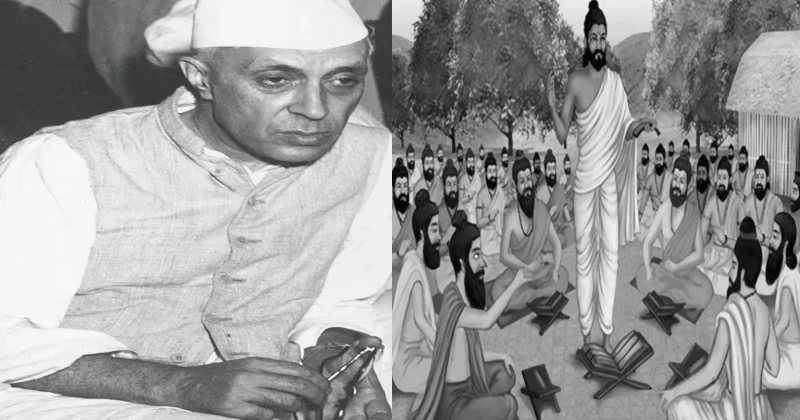
The nefarious nexus between Jawaharlal Nehru, the Congress party, and the British colonial rulers has been exposed, shedding light on the systematic eradication of the Gurukul education system from India. During the British colonial rule in India, the Anglo-Indian community emerged as a distinct ethnic group comprising individuals born to unions between British and Indian parents. Although minor, this community wielded significant influence in specific administrative roles during the colonial era.
Decline of the Anglo-Indian Community
During India’s independence in 1947, the Anglo-Indian community numbered between 125,000 to 150,000 individuals. However, post-independence, a large portion of this community migrated from India; today, it is believed that less than 500 people remain.
Historical Context
The term “Anglo-Indian” initially referred to all British individuals residing in India, while those of mixed British and Indian descent were known as “Eurasians.” However, by the 17th and 18th centuries, the term “Anglo-Indians” became prominent to denote individuals of mixed British and Indian heritage.
The roots of the Anglo-Indian community trace back to 1639 when the British East India Company established a settlement in Madras (now Chennai). Initially accepted and integrated into British society, the Anglo-Indians faced exclusion from positions of authority within the civil, military, and marine services of the East India Company in 1791.
The Alleged Conspiracy: Eradication of Gurukul Education
Recent revelations suggest a covert collaboration between Jawaharlal Nehru, the Congress party, and the British colonial rulers to eradicate the traditional Gurukul education system from India systematically. The Gurukul system, deeply rooted in ancient Indian traditions, was gradually marginalised and replaced by Western education models under Nehru’s leadership.
Impact on Indian Education
The deliberate sidelining of the Gurukul education system had profound implications for Indian education. The rich cultural heritage and values imparted by the Gurukul system were overshadowed by Western educational norms, leading to a loss of traditional knowledge and wisdom among Indian youth.
In light of these revelations, there is a growing clamour for reevaluating India’s educational policies and a revival of traditional systems like Gurukul education. Advocates argue that reconnecting with India’s ancient educational heritage is essential for fostering holistic development and preserving the nation’s cultural identity.
1857
During the 1857 First War of Independence, the Anglo-Indians sided with the British and, in return, consequently received favoured treatment from the British Government in preference to other Indians, serving in large numbers in the strategic services of the railways, the postal and telegraph services, and customs.
The Anglo-Indian community, a distinctive ethnic group born out of British and Indian unions, underwent significant political transformations from 1919 to 1952, marking a period of empowerment and representation.
1919: Rise to Political Power
By 1919, the Anglo-Indian community had amassed considerable influence and secured permanent representation in the Central Legislative Assembly in Delhi. At this juncture, English-speaking Anglo-Indians aligned themselves closely with the British colonial rulers, often opposing the Indian National Congress.
1926: Formation of the All India Anglo-Indian Association
In 1926, the All India Anglo-Indian Association was established, serving as a pivotal platform to champion the interests of the Anglo-Indian community. This association recognised Anglo-Indians as a unique ethnic group, distinguished by their Christianity, English-speaking proficiency, and historical connections to British and Indian heritage.
1942: The Leadership of Frank Anthony
In 1942, Frank Anthony assumed the presidency of the All India Anglo-Indian Association, embarking on a transformative leadership journey that would span five decades until his passing in 1993. Anthony’s visionary leadership reshaped the trajectory of the Anglo-Indian community, leaving an indelible mark on its political landscape.
1942-1946: Frank Anthony’s Political Engagements
During his tenure, Frank Anthony played multifaceted roles in Indian politics. From 1942 to 1946, he served as a nominated member of the Central Legislative Assembly, representing the interests of the Anglo-Indian community at the national level. Subsequently, Anthony was appointed as a member of the Constituent Assembly of India from 1946 to 1950, where he contributed significantly to discussions on minority rights and representation.
Anthony’s influence extended beyond legislative roles, as he assumed the position of Ad Hoc Vice President of the Constituent Assembly.
1947: Advocating for Anglo-Indian Representation
During this critical juncture, Frank Anthony presented the case of the Anglo-Indian community to key figures such as Mahatma Gandhi and Jawaharlal Nehru, seeking to secure their support and recognition of the community’s unique position in independent India.
1948: Special Provisions in the Indian Constitution
Frank Anthony’s persuasive efforts bore fruit when he successfully lobbied Jawaharlal Nehru to incorporate special provisions for the Anglo-Indian community in the Indian Constitution. Edwina Mountbatten’s intervention is believed to have played a significant role in persuading Nehru to accede to this demand, highlighting the community’s growing influence.
1950-52: Representation in the Indian Parliament
With the enactment of the Indian Constitution in 1950, the Anglo-Indian community was granted two permanent seats in the Lok Sabha, the lower house of the Indian Parliament. These seats were to be filled through nomination by the President of India on the government’s advice, akin to the reservation system for Scheduled Castes and Scheduled Tribes.
Initially intended for ten years, these special provisions were scheduled to be discontinued in 1960. However, this discontinuation did not materialise, and the Anglo-Indian representation persisted until 2019.
Frank Anthony’s leadership extended beyond advocacy and representation in Parliament during this period. He played a pivotal role in shaping the education sector in India, steering the transition from traditional Gurukul education to modern schooling systems.
1952-1993: Frank Anthony’s Enduring Legacy
Frank Anthony’s enduring legacy is evident in his remarkable tenure as a Member of Parliament, spanning multiple terms from the inception of the Lok Sabha in 1952 until his demise in 1993. His consistent nomination as an MP underscored his indispensable role in representing the Anglo-Indian community’s interests at the highest echelons of Indian governance.
As India embarked on its journey towards independence from British colonial rule, the contours of power were being redefined. While the physical departure of the Britishers loomed on the horizon, their influence continued to cast a long shadow, particularly in the realm of education. Lord Macaulay’s introduction of the Western education system in India in 1835 served as a strategic tool to perpetuate colonial dominance, aimed at erasing indigenous cultural roots and perpetuating a legacy of subjugation.
At the helm of reshaping India’s post-independence education landscape stood Frank Anthony, a distinguished barrister who pivoted from a career in law to become a permanent parliamentarian in the Indian political arena. With a British education, Anthony epitomised the fusion of Anglo-Indian identity and British colonial ethos, wielding significant influence in the corridors of power.
From 1947 to 1993, Frank Anthony embarked on a monumental mission to reimagine India’s education system in alignment with the British legacy. Central to his vision was establishing the Indian Certificate of Secondary Education (ICSE) board, which emerged as a beacon of British education in India. Under Anthony’s stewardship, the ICSE board became synonymous with excellence, promoting a curriculum rooted in Western pedagogy and values.
Despite the Britishers’ formal departure in 1947, their imprint on India’s educational fabric endured. Through institutions like the ICSE board, Anthony ensured the perpetuation of Western educational paradigms, effectively tethering future generations to a legacy of colonial indoctrination. The dream envisioned by Lord Macaulay in 1835 found fruition through Anthony’s concerted efforts, aided by political luminaries such as Jawaharlal Nehru, Indira Gandhi, and Rajiv Gandhi.
Since the inception of the Indian Parliament in 1952, the Anglo-Indian community has been guaranteed representation through reserved seats. This provision was enshrined in Article 331 of the Indian Constitution, which allowed the President to nominate two members of the Anglo-Indian community if they were not adequately represented in the House of the People (Lok Sabha).
However, in 2019, the Narendra Modi Government took the bold step of abolishing this long-standing tradition. The provision for Anglo-Indian representation in Parliament was repealed through a constitutional amendment, signalling the end of an era in Indian parliamentary history.